



![[ New Arrival ] Porto Max Electric Scooter For Commute & Grocery Shopping - HOVSCO](http://www.hovsco.com/cdn/shop/files/PotroMax-3.jpg?v=1706927007&width=1200)
- by SteveJames
Which Foldable Commuter Ebike Fits Your Ride?
- by SteveJames
E-Bikes
Accessories
 Free Shipping
 15-Day Returns
 2-Year Warranty
Free Shipping
15-Day Returns
2-Year Warranty
2-Year Warranty
Free Shipping
15-Day Returns
2-Year Warranty
The right foldable commuter ebike depends on four factors: your one-way distance, how many times a day you'll actually fold it, whether you connect to a bus or train, and how much floor or closet space you have at the office or home. Match those four constraints before comparing motor specs, and models like the HOVSCO HovBeta or Sync Max become easy to shortlist.
Choosing a foldable commuter ebike starts with your round-trip mileage, not the spec sheet. Measure your actual commute, add a 30% buffer for wind, detours, and cold-weather battery drain, then match that number against a bike's real-world range rather than its marketed maximum.
I've spent enough afternoons on a factory floor watching return units come back to know the single biggest mismatch between rider and bike isn't power — it's range planning. A rider commuting 8 miles round trip doesn't need a 720Wh battery; they need a bike that folds fast and weighs little. A rider covering 20+ miles with hills needs sustained wattage more than folded size. This is precisely why learning how to choose foldable commuter ebike models starts with a tape measure and a map, not a spreadsheet of watts.
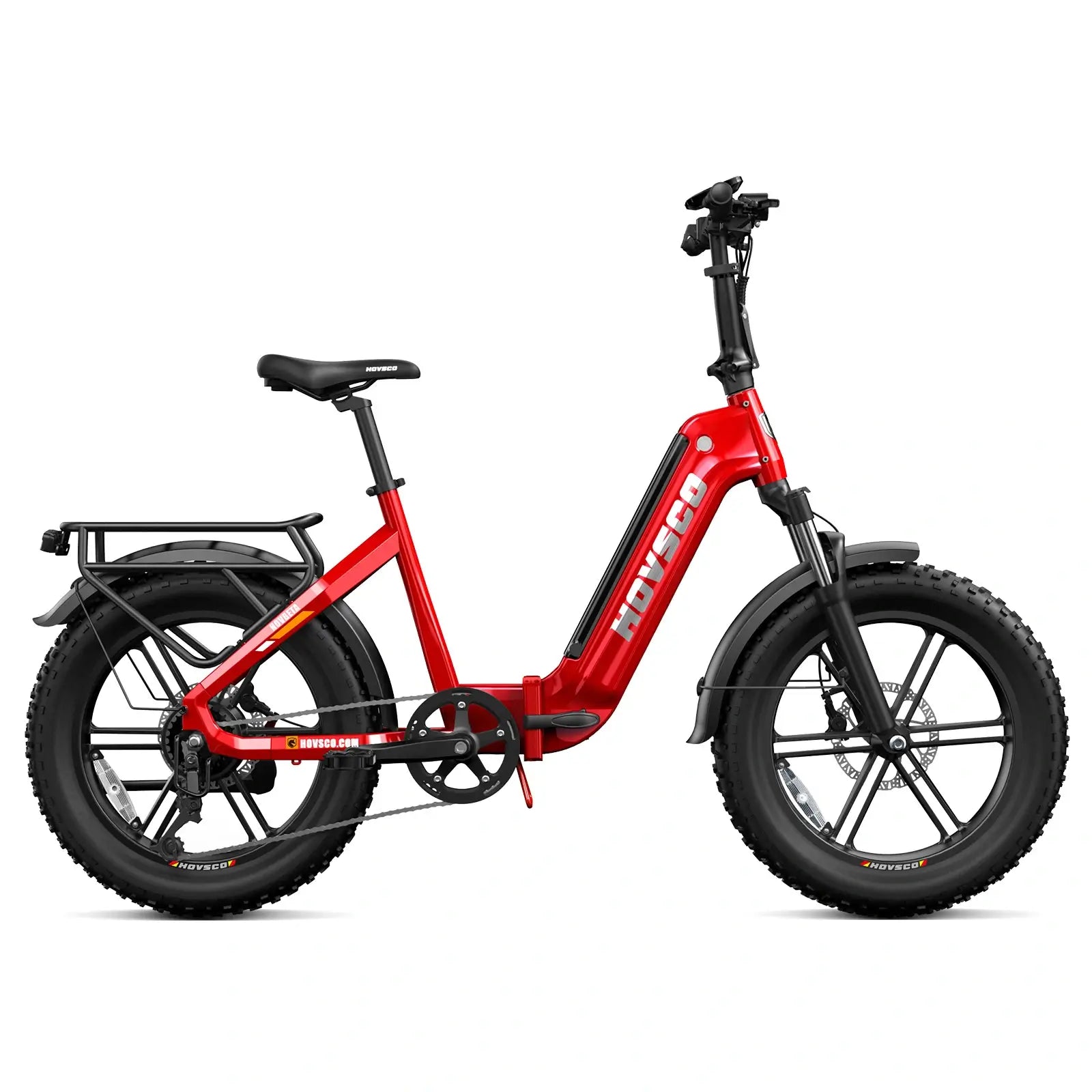
Once you know your distance, sort candidates into two buckets: short-hop bikes under 45 lbs with modest 250-450W motors, and longer-haul bikes with 500W+ sustained motors and batteries above 500Wh. The HOVSCO HovBeta, for example, is built for the second bucket — its 750W sustained motor (1300W peak) and 720Wh removable battery deliver a 60-80 mile average range, which comfortably absorbs a mixed-terrain commute with hills. The HOVSCO Sync Max sits in the first bucket, built around a 450W sustained motor and a 30-mile range for shorter, flatter routes.
If you fold your ebike more than twice a day — say, into an elevator and again at a train gate — prioritize fold speed and one-hand carry weight over raw range. Bikes folding in under 15 seconds with a single frame latch reduce daily friction far more than an extra 10 miles of range you'll rarely use.
This is a detail most buying guides skip entirely: fold mechanism durability matters more than fold size. A hinge rated for occasional weekend folding will fatigue faster under twice-daily commuter use. When I've inspected returned units, the most common wear point isn't the battery or motor — it's a loose or clicking main-frame hinge on bikes never designed for daily cycles.
For riders folding once or twice daily, a bike like the HOVSCO HovBeta, engineered with a quick-fold frame designed to collapse in roughly 10 seconds for subway platforms and office lobbies, holds up better over months of repeated use than lighter bikes with plastic-reinforced hinge points. For riders who fold rarely — maybe once a week for storage — hinge durability matters less, and you can prioritize weight or price instead.
If your commute includes a bus, train, or ferry leg, weight and folded dimensions matter more than motor power. Transit operators often cap carry-on bike weight or require the bike to be folded and bagged, so a sub-45 lb foldable ebike clears more restrictions than a 60+ lb fat-tire model.
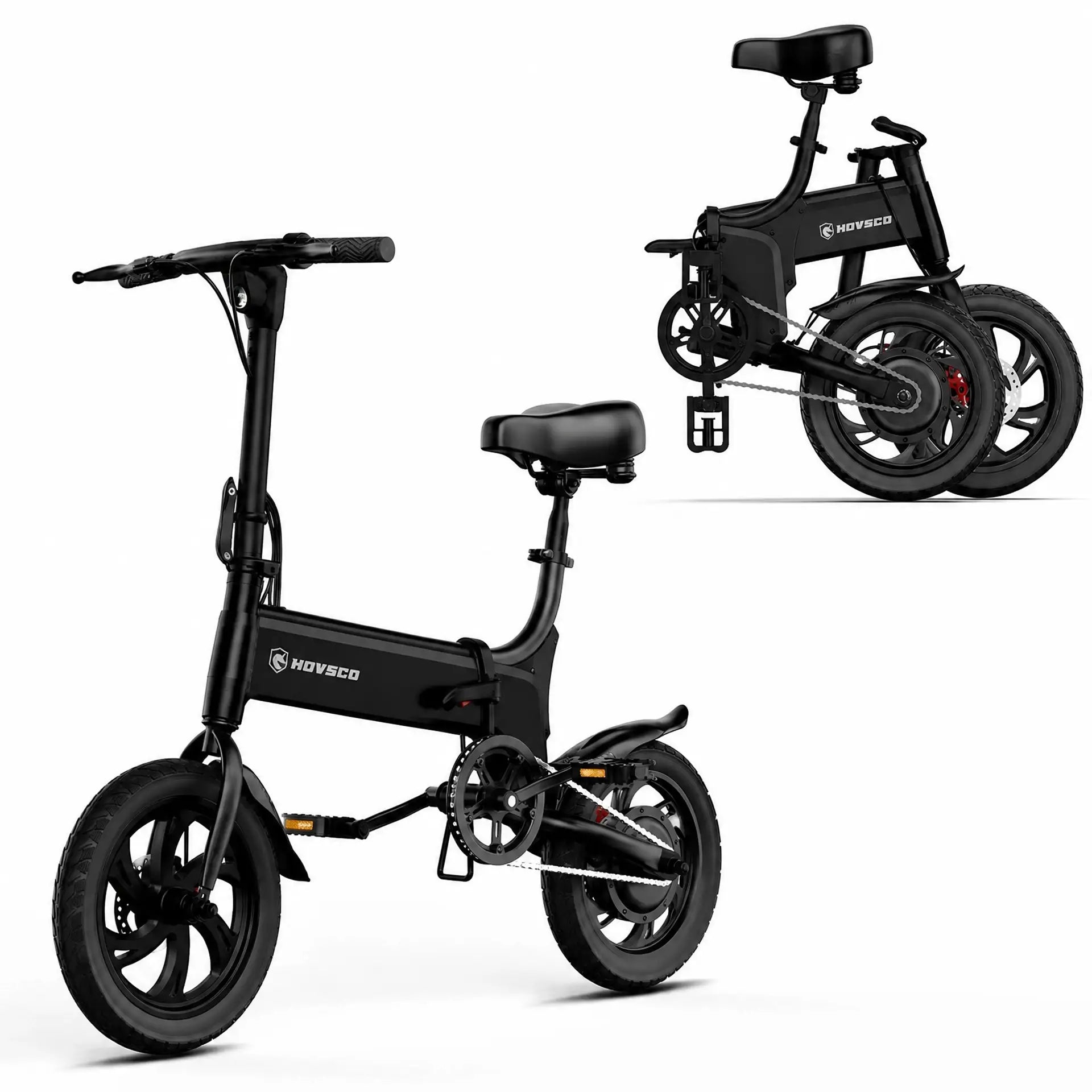
Transit-linked commuters face a constraint pure car-trunk commuters don't: you're carrying the bike, not rolling it. A bike that folds down but still weighs 65+ lbs is fine for a car trunk or RV storage bay, but becomes a genuine burden up two flights of station stairs. The HOVSCO Sync Max, at 42.3 lbs net weight with 14-inch wheels, was built with exactly this scenario in mind — light enough to carry with one hand up a staircase, small enough to tuck under a train seat.
Conversely, if your "transit" leg is really just loading the bike into a car trunk or RV bay before driving to a trailhead or office park, weight becomes far less important than range and ride comfort. The HOVSCO HovBeta's 20 x 4-inch fat tires and front suspension fork trade some portability for a smoother ride and 450 lb payload capacity — a reasonable trade when you're not physically carrying the bike up stairs. Always check your specific transit authority's folding-bike policy before buying, since rules vary by city and by peak versus off-peak hours.
Measure your available storage footprint before buying — a folded ebike still needs floor space, a closet corner, or an under-desk gap. Most folding commuter ebikes collapse to roughly 30-35 inches long and 20-28 inches tall, so confirm those numbers against your actual space, not just the "folds small" marketing claim.
Office storage is the constraint nobody plans around until moving-in day. A step-through folding frame, like the HovBeta's, tends to lean upright more stably against a wall or under a desk than a traditional diamond-frame fold, because the low center of gravity keeps it from toppling. If you're storing at home in a small apartment, factor in whether the battery is removable — the HovBeta's 48V 15Ah battery detaches and locks, so you can charge it at a desk without hauling the whole bike indoors, which matters if your only power outlet is nowhere near your bike storage spot.
Torque sensors deliver power proportional to your pedaling effort, producing smoother, more natural acceleration in stop-and-go traffic than cheaper cadence (speed) sensors, which apply power in a delayed, jerky burst. For daily commuting through intersections and pedestrian crossings, torque-sensing pedal assist reduces both fatigue and battery drain.
This is a genuine engineering trade-off, not marketing language: cadence sensors are cheaper to manufacture because they only detect whether the pedals are turning, not how hard you're pushing. That simplicity is why many budget foldable ebikes use them. Torque sensors, like the one built into the HOVSCO HovBeta, read actual pedal force and modulate motor output in real time, which is why the assist feels like an extension of your own effort rather than an on/off switch. On a commute with dozens of starts and stops, that difference compounds into noticeably less jerkiness and, in my experience testing both sensor types back to back, a smoother ride at crosswalks and stop signs. Paired with a smart LCD display showing live assist level and remaining range, that responsiveness is easier to monitor and adjust on the fly.
Take your round-trip commute distance, multiply by 1.4 to cover wind, cargo weight, and cold-weather capacity loss, and treat that number as your minimum usable range — not the manufacturer's peak-condition claim. A 10-mile round trip needs roughly 14 miles of practical range; most riders should not buy based on a bike's single best-case number.
Battery figures on spec sheets are typically measured under ideal conditions: flat ground, low assist, warm weather, and a rider near the lighter end of the payload range. Real commuting rarely matches that. The HOVSCO HovBeta's 60-80 mile average range reflects a spread specifically because pedal-assist-heavy riding stretches the low end toward 80 miles, while throttle-heavy riding on hills pulls it toward 60. The Sync Max's 30-mile range is a flatter, more predictable figure suited to shorter, less hilly routes. When comparing any two foldable commuter ebikes, always ask whether the quoted range assumes throttle-only or pedal-assist use, since the gap between the two can exceed 30%.
Yes, when the frame uses aircraft-grade aluminum, the hinge is metal-reinforced rather than plastic-clad, and the bike is backed by real-world support such as a multi-year warranty and an accessible return window. Daily folding puts repeated stress on hinge points, so frame material and after-sales backing matter more for commuter use than for occasional recreational folding.
A detail rarely discussed outside the industry: judging a folding ebike's day-to-day safety isn't just about a single spec — it's about whether the components that see the most repeated stress are built to last and backed if something goes wrong. Frame durability under repeated folding is largely an engineering question, addressed through hinge material and pivot bushing quality rather than any single claim. Buyers evaluating this should also look at what happens after purchase: does the brand offer a 2-year warranty, a 15-day return window, and a support network of 500+ partner bike shops for service? The HOVSCO HovBeta uses a 6061 single-butted aluminum alloy frame, the same aluminum grade found in higher-end mountain bike frames, and pairs it with hydraulic disc brakes, a torque sensor, and a 2-year warranty — a combination that addresses both the mechanical durability and after-purchase support questions a daily commuter should ask.
Fenders, a rear rack, and integrated lighting provide the most day-to-day value for commuters, since they address wet-weather riding, cargo carrying, and visibility during early-morning or evening rides. Suspension forks help on rougher pavement but add weight, so they matter more for mixed-surface commutes than smooth bike-lane routes.
Skip accessories that don't match your actual route. A front basket is only useful if you're stopping for groceries or carrying a bag daily; a rear rack matters more if you occasionally strap on a pannier for work documents. Both HOVSCO folding models include integrated LED lighting standard, which matters more than most riders initially realize — a bike light that shares the main battery avoids the hassle of separately charging clip-on lights, a small but real convenience during winter commutes with shorter daylight hours. Pairing the bike with the free companion app also lets you track ride data and battery status directly from your phone.
For round-trip distances under 25-30 miles with access to charging at either end, a folding commuter ebike can realistically replace short car trips, particularly in urban areas with bike lanes or multimodal transit connections. Beyond that distance, or in areas without safe cycling infrastructure, a folding ebike works better as a complement to transit than a full car replacement.
"When we engineer a folding commuter ebike, we're really solving two competing problems at once: the bike has to survive a daily fold-unfold cycle for years, and it has to disappear into whatever storage space the rider actually has — a closet, a train rack, a car trunk. That's why we don't treat range, weight, and fold durability as separate specs to optimize individually. A commuter who folds their bike twice a day needs a hinge rated for thousands of cycles, not hundreds, and that requirement shapes material choice long before battery size ever enters the conversation. Getting the trade-off right, and backing it with a real warranty and service network, is what separates a commuter-grade fold from a weekend-only one." — HOVSCO Product Engineering Team
Matching a foldable commuter ebike to your actual routine matters more than chasing the highest wattage or longest range on a spec sheet. Start with your round-trip distance and add a realistic buffer, then weigh how often you'll fold the bike daily, whether transit rules cap your carry weight, and how much storage space you genuinely have at home or work.
Riders with longer, hillier commutes and secure storage at both ends will get more daily value from a higher-range, torque-sensor model like the HOVSCO HovBeta, while riders juggling multiple transit transfers or tight apartment storage will find a lighter, more compact option like the HOVSCO Sync Max easier to live with. Whichever direction fits your commute, browse the full HOVSCO folding e-bike collection to compare verified specs side by side before you buy. Ultimately, knowing how to choose foldable commuter ebike models comes down to being honest about your route, your fold frequency, and your storage reality — not just the numbers on a box.
What is the difference between the HOVSCO HovBeta and Sync Max?
The HovBeta is a fat-tire, higher-power model (750W sustained, 60-80 mile range, 66.4 lbs) built for longer or hillier commutes, while the Sync Max is a lighter, more compact model (450W, 30-mile range, 42.3 lbs) suited to shorter, flatter routes and frequent transit transfers.
How fast does a foldable commuter ebike need to be for city riding?
Most city commutes are well served by 19-20 mph pedal-assist speeds, matching typical Class 1 and Class 2 ebike regulations. Higher unlocked speeds, like the HovBeta's 28 mph mode, help on longer routes but should only be used where local ebike class laws permit it.
Is a folding ebike safe to ride in the rain?
Most quality folding commuter ebikes, including HOVSCO models, carry an IPX5 or similar water-resistance rating suitable for light rain and wet roads. Riders should avoid submerging the bike or using high-pressure hoses to clean it, and heavy downpour riding is generally not recommended for any ebike.
How often should I service a folding commuter ebike's hinge?
For daily commuters folding the bike once or twice a day, inspect the main hinge and pivot points every one to two months for looseness or clicking, and follow the manufacturer's lubrication schedule to prevent premature wear from repeated cycling. If a shop visit is needed, a network of 500+ partner bike shops makes routine checkups easier to schedule near home.
Do folding commuter ebikes require a special license?
In most regions, Class 1 and Class 2 ebikes under 750W do not require a license or registration, though rules vary by country and state. Always check local regulations, especially if you plan to unlock higher speed modes on models like the HovBeta.
Share:
How Do You Choose an Electric Bike for Small Business?
HovCart vs Long-Tail Cargo Bikes: Compact vs Full-Size