
























![[ New Arrival ] Porto Max Electric Scooter For Commute & Grocery Shopping - HOVSCO](http://www.hovsco.com/cdn/shop/files/PotroMax-3.jpg?v=1706927007&width=1200)
- by SteveJames
How to Choose a Step-Through Fat Tire Ebike?
- by SteveJames
E-Bikes
Accessories
 Free Shipping
 15-Day Returns
 2-Year Warranty
Free Shipping
15-Day Returns
2-Year Warranty
2-Year Warranty
Free Shipping
15-Day Returns
2-Year Warranty
Choose a step-through fat tire ebike by matching its real low-step access, tire size, total weight, suspension, brakes, and battery to your most common ride. A low frame makes frequent stops easier; 4-inch tires add comfort and grip on broken pavement and loose paths. Prioritize manageable handling—not maximum specifications.
For shoppers searching how to choose step through fat tire ebike, the key is to evaluate the combination, not isolated features. Low-step access and fat tires solve different problems, and the best bike is the one that solves both without becoming unnecessarily bulky for your daily life.
A step-through fat tire ebike pairs a low or absent top tube with wide, high-volume tires—typically 20 x 4 or 26 x 4 inches. The design helps riders mount and dismount more easily while increasing stability, traction, and cushioning on imperfect surfaces.
The low-step frame is especially valuable for riders who stop often at lights, carry a bag, wear everyday clothing, have limited hip mobility, or simply prefer not to swing a leg over a high frame. Meanwhile, fat tires increase the tire’s air volume and contact patch. That can make potholes, gravel, packed dirt, sandy shoulders, and cracked roads feel less abrupt.
However, this is a category of trade-offs. Larger tires, reinforced wheels, a larger battery, and a stronger frame usually create a heavier bike. The best ownership experience comes from choosing enough capability for your route—not buying the largest bike you can find.
In practical terms, evaluate this category in the following order:
Can you step through and stand over the bike naturally?
Can you control it while walking, parking, and turning at low speed?
Do your roads actually justify 4-inch tires?
Does the suspension complement the tire volume rather than duplicate it?
Can the brakes manage the bike, rider, and cargo together?
Check low-step fit by standing over the frame in your usual shoes, mounting from both sides, and stopping with one foot down. You should be able to get on and off without twisting your hip, leaning the bike excessively, or catching your foot on the frame.
A “step-through” label alone does not guarantee easy access. From a product-development perspective, the important detail is the usable opening between the saddle area and the front of the frame. Battery placement, tube shape, and rack design can make two low-step bikes feel dramatically different.
During a test ride, use this real-world routine:
Set the saddle at a height where you can pedal with a slight bend in the knee.
Mount the bike from the curb-facing side and the traffic-facing side.
Stop on a slight slope and place one foot down.
Walk the bike through a narrow doorway or around a parked car.
Try mounting while carrying a small backpack or grocery bag.
A good low-step frame reduces the physical and mental effort of every start and stop. That matters more than the frame’s appearance. HOVSCO designs its step-through options around approachable access, but the final choice should still be based on your height, reach, flexibility, and where you store the bike.
Choose 26 x 4-inch tires for fuller-size riding stability, longer mixed-surface routes, and rougher roads. Choose 20 x 4-inch tires when compact storage, lower center of gravity, and transportability matter more than maximum rollover ability.
Fat tires are not automatically “better”; they are more useful on certain surfaces. Their value comes from air volume and a wider footprint. When correctly inflated, they can soften sharp road texture and improve grip on loose ground. Yet on smooth pavement, they can feel slower, create more rolling resistance, and add steering effort.
An often-overlooked factory-floor detail is tire pressure. A fat tire’s benefit changes significantly with pressure, rider weight, cargo, and terrain. Running too much pressure makes the bike bounce over bumps and reduces the comfort advantage. Running too little can make steering vague, raise rolling resistance, and increase the risk of rim impacts. Start within the tire maker’s stated range and adjust gradually for your load and terrain.
That is why how to choose step through fat tire ebike
Bike weight affects nearly every off-bike moment: rolling it from storage, loading it into a vehicle, positioning it on a rack, lifting it over a threshold, and catching it during an awkward stop. A low-step frame helps access, but it does not make a heavy ebike light.
Many shoppers focus on motor wattage and range first, then discover that the bike is difficult to maneuver through a hallway, apartment elevator, garage corner, or trailer hitch rack. This is particularly relevant for fat tire ebikes because the wheels, tires, battery, motor, suspension, and frame are built for higher loads and rougher riding.
Consider two HOVSCO examples that satisfy both the low-step and fat-tire requirements:
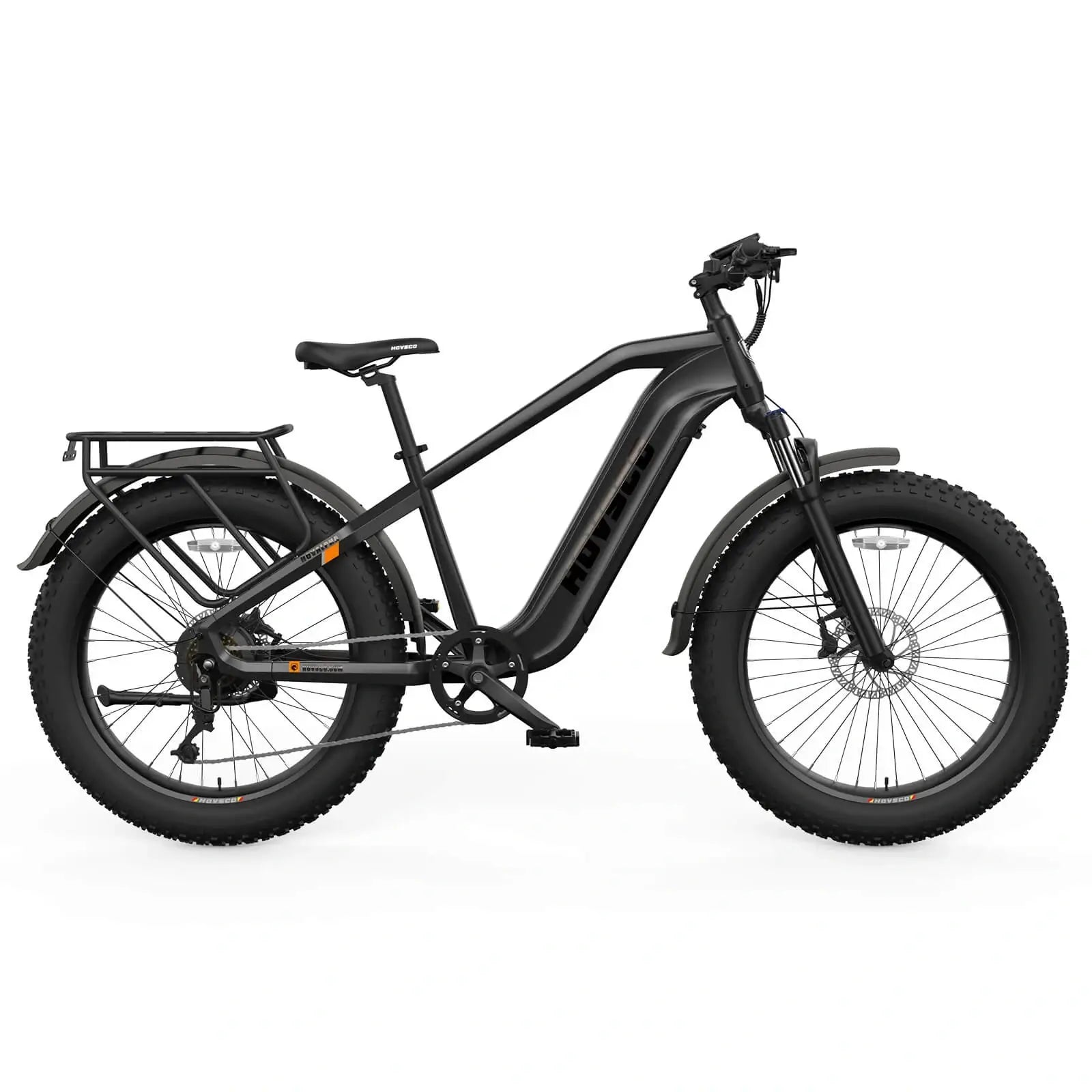
The HovAlpha Step-Thru is built around full-size stability and longer-range riding. Its 26 x 4-inch tires, 80 mm suspension fork, 960Wh battery, hydraulic disc brakes, and 450 lb maximum payload suit riders who need a more substantial all-terrain platform. Its removable battery also gives riders more flexibility when charging at home or preparing for longer outings.
The HovBeta uses 20 x 4-inch tires and a folding configuration to solve a different problem: limited storage space and travel flexibility. It remains a low-step fat-tire model, but it is not a “lightweight” bicycle. A 66.4 lb ebike still requires a realistic plan for lifting and transport.
Before purchasing, measure the storage route—not just the parking space. Check doorway widths, steps, elevator dimensions, garage turns, and vehicle rack capacity. This simple audit prevents the most common ownership mismatch.
Fat tires and suspension should divide the work: tires smooth high-frequency vibration and small surface chatter, while a quality fork controls larger impacts and keeps the front wheel tracking predictably. More suspension travel is not automatically better for every rider.
A 4-inch tire is already a form of suspension. Its large air chamber can absorb road texture that would otherwise travel through the fork, handlebar, and saddle. This is why a low-quality suspension fork can add weight without adding meaningful control.
For pavement, light gravel, and everyday comfort, a front fork with lockout is especially useful. Locking the fork on smoother roads reduces energy loss from unwanted bobbing. Opening it on rough pavement or dirt paths improves comfort and helps the wheel remain in contact with the surface.
The HovAlpha Step-Thru uses an 80 mm lockout suspension fork, providing more travel for rougher pavement and mixed-terrain exploration. The HovBeta’s 45 mm lockout fork is more compact and suitable for urban bumps, campground roads, and light trail use.
Look beyond travel numbers. During a test ride, compress the fork while holding the front brake. It should move smoothly without clunking, hesitation, or excessive side-to-side flex. On the road, the benefit should be better steering control—not merely a softer feeling.
Brakes, torque, and payload must be evaluated as one system because a heavier rider, cargo load, fat tires, and a powerful motor all increase the demands on acceleration, downhill control, and stopping distance. Hydraulic disc brakes are a meaningful advantage on this type of ebike.
Motor wattage alone can be misleading. A large peak-power number may sound impressive, but usable hill performance also depends on torque delivery, battery voltage under load, controller tuning, wheel size, rider weight, tire pressure, and gradient.
For example, both the HovAlpha Step-Thru and HovBeta list a 750W sustained rear-hub motor, 1,300W peak output, 90 Nm torque sensing, hydraulic disc brakes, and a 450 lb payload capacity. Their systems are designed to support more than casual flat-road riding, but their formats create different priorities:
Select the HovAlpha Step-Thru for longer distances, higher-volume 26-inch tires, and a more substantial rough-surface ride.
Select the HovBeta when folding convenience and a compact 20-inch platform matter, while still retaining fat tires, hydraulic brakes, and a low center of gravity.
Choose based on the total mass you will actually stop: bike, battery, rider, clothing, water, accessories, and cargo.
In my experience inspecting high-load ebike setups, brakes are where a specification sheet becomes real. Check lever feel, rotor size, pad availability, and whether a local service shop can support the braking system. A network of 500+ partner bike shops can also make ongoing maintenance more convenient. After the first 100–200 miles, bedding-in and cable or caliper checks are also important because new rotors, pads, spokes, and fasteners settle under load.
A step-through fat tire ebike may be the wrong choice if you ride only smooth pavement, must lift the bike frequently, have very limited storage, or value quick handling and maximum efficiency over comfort and stability. In those cases, a lighter step-through commuter ebike may be more practical.
The category is ideal when it solves a clear problem:
You want easier mounting and dismounting.
Your route includes cracked pavement, gravel, dirt, or uneven shoulders.
You appreciate a planted, stable ride at low speeds.
You carry cargo or want a high payload rating.
You can store, charge, and move a heavier ebike safely.
It may be excessive when your daily trip is a short, smooth bike-lane commute and you must carry the bike up stairs. The same 4-inch tires that inspire confidence on rough roads can become unnecessary mass in a fifth-floor walk-up.
Always consider local ebike classifications and trail rules before riding. A capable fat-tire ebike does not automatically have access to every trail, beach, or park route.
Choose HovAlpha Step-Thru for longer rides and larger-wheel all-terrain confidence; choose HovBeta for folding storage, travel, and compact handling. Both combine a low-step design with 4-inch fat tires, but they serve different ownership routines.
The HovAlpha Step-Thru is the stronger match for riders who see their ebike as a primary recreation and transport machine. Its 26-inch wheels carry momentum over rough pavement, while its 960Wh removable battery supports longer planned routes. Its stated 60–80-mile range is a useful planning figure, but real range will vary with assist level, wind, terrain, rider and cargo weight, tire pressure, and temperature.
The HovBeta is the practical answer for riders who need to put the bike away in a compact space or take it to a trailhead, campsite, or vacation destination. Its folding layout, 20-inch wheels, and lower center of gravity can feel reassuring in parking lots and stop-start riding. Yet its folding hinge should be treated as a critical inspection point: confirm it locks positively, has no visible play, and remains secure after repeated folding.
For a broader overview of compatible low-step, wide-tire options, use the natural shopping path of a [step-through fat tire electric bike collection] rather than comparing unrelated high-step or narrow-tire products.
“The best step-through fat tire ebike does not feel ‘big’ when you live with it. At HOVSCO, we look beyond the headline specification and focus on the moments riders repeat every day: stepping on at a busy intersection, turning tightly in a garage, controlling speed with cargo, and rolling over uneven pavement without being thrown off line. A 4-inch tire, suspension fork, battery, brakes, and frame must work as a coordinated system. If the bike fits your route but not your storage, it is not the right fit. If it has power but lacks confident stopping control, it is not complete. Choose the configuration that makes you want to ride again tomorrow.”
Before ordering, test your fit, measure your storage route, verify your local riding rules, and compare the bike’s full system—weight, tires, braking, suspension, payload, and battery—not only its motor claim. This approach helps you buy for daily use rather than a product-page fantasy.
Use this final purchase checklist:
Confirm the recommended rider-height range and try the real step-through motion.
Compare battery watt-hours, not only stated mileage.
Confirm whether the battery is removable and where you will charge it.
Check total bike weight with the battery installed.
Verify vehicle rack capacity if you plan to transport the bike.
Look for hydraulic brakes and consider replacement pad availability.
Check tire size, tread style, and the manufacturer’s pressure guidance.
Inspect suspension function and use a lockout when conditions justify it.
Add up rider weight, cargo, accessories, and trailer tongue load against the payload rating.
Review the 2-year warranty, 15-day return policy, service options, and local legal requirements before you ride.
HOVSCO offers U.S. shipping, typically dispatches orders within 1–3 business days, and ships from its California warehouse. Where available, local pickup can simplify collection. Riders can also use 24/7 customer support and a network of 500+ partner bike shops when they need help with ownership or service.
The right step-through fat tire ebike gives you low-step confidence, appropriate tire volume, controllable weight, useful suspension, and stopping power matched to your terrain. Start with the route and storage reality, then select the platform that supports those needs every day.
For long-range mixed-surface comfort, the HOVSCO HovAlpha Step-Thru offers a full-size 26 x 4-inch configuration, 80 mm fork travel, and a 960Wh removable battery. For riders who need a foldable, lower-center-of-gravity platform, the HOVSCO HovBeta combines a step-through frame with 20 x 4-inch tires and compact storage potential.
The winning decision is not the bike with the largest motor, the widest tire, or the longest stated range. It is the one you can mount easily, park confidently, maintain realistically, and enjoy riding on the roads and paths you actually use. That is the practical answer to how to choose step through fat tire ebike
Are step-through fat tire ebikes good for beginners?
Yes. The low-step frame can make mounting and stopping less intimidating, while wide tires can add stability on rough pavement. Beginners should still practice braking, slow turns, and walking the bike before riding in traffic.
What tire pressure should I use for 4-inch ebike tires?
Use the tire manufacturer’s marked pressure range as the starting point. Adjust gradually based on rider weight, cargo, terrain, and ride feel; too much pressure reduces comfort, while too little can increase rolling resistance and rim-impact risk.
Can I carry a step-through fat tire ebike on a car rack?
Yes, if the rack is rated for the bike’s full weight and tire width. Remove the battery when allowed to reduce lifting weight, and avoid hanging racks unless they are explicitly rated for heavy ebikes.
Does a 750W fat tire ebike need hydraulic brakes?
Hydraulic brakes are strongly preferable for heavy fat-tire ebikes, especially when riding hills, carrying cargo, or using higher assist levels. They typically provide more consistent braking force and better control than basic mechanical systems.
Are folding fat tire ebikes easy to lift?
They are easier to store and transport in a smaller footprint, but not necessarily light. Check the full weight with battery installed, folded dimensions, hinge security, and your own ability to lift or roll the bike safely.
Share:
Can an E-Bike Replace Your Car?
What Should You Check Before Buying a Grocery E-Bike?