


![[ New Arrival ] Porto Max Electric Scooter For Commute & Grocery Shopping - HOVSCO](http://www.hovsco.com/cdn/shop/files/PotroMax-3.jpg?v=1706927007&width=1200)
- by SteveJames
Is Air Suspension or Coil Better for Heavy-Duty All-Terrain Ebikes?
- by SteveJames
E-Bikes
Accessories
 Free Shipping
 15-Day Returns
 2-Year Warranty
Free Shipping
15-Day Returns
2-Year Warranty
2-Year Warranty
Free Shipping
15-Day Returns
2-Year Warranty
Air suspension vs. coil suspension comes down to physics and use case. On a heavy-duty all-terrain ebike, air suspension offers lighter weight, progressive support against bottom-out, and easy linear pressure tuning, while coil suspension delivers ultra-sensitive small-bump feel and brute durability. For most riders loading an ebike hard, properly tuned air suspension is the better long-term balance of control, efficiency, and versatility.
ebike suspension kinematics masterclass
Air suspension relies on compressed air as a spring medium, so the spring rate rises as the shock or fork compresses. This creates a naturally progressive curve that resists bottom-out on big hits while staying tunable for rider weight and cargo. Coil suspension uses a steel spring with a nearly linear rate, giving very consistent force through the travel but less ramp-up at the end stroke.
From a factory-floor perspective, air suspension lets me dial a heavy-duty all-terrain ebike for a 65 kg rider one minute and a 100 kg rider plus cargo the next, using nothing more than a high-pressure pump. Coil requires swapping the physical spring to maintain correct sag and support, which is impractical for many real-world ebike owners. That is why HOVSCO favors air suspension for platforms carrying widely varying loads.
Air suspension also interacts differently with frame leverage curves. On a progressive linkage, the combination of progressive air plus progressive kinematics yields massive end-stroke resistance, ideal for big drops. Coil on the same frame can feel too soft near bottom-out unless the spring is deliberately over-rated, which then compromises comfort in the first half of travel.
Air suspension follows a progressive force curve: as travel increases, the air chamber volume drops and pressure rises, so each millimeter of further compression demands more force than the last. Coil suspension follows a more linear curve, where force rises steadily with travel but without the late-stroke ramp typical of air.
To visualize this, imagine a chart with travel on the horizontal axis and spring force on the vertical axis. The air line starts lower, then bends upward more sharply toward full stroke. The coil line climbs at a steadier angle, roughly straight. On a heavy-duty all-terrain ebike, that progressive air curve is what stops the fork or shock blowing through travel when you hit square-edge obstacles, land jumps, or carry extra cargo.
In suspension tuning sessions for HOVSCO, I watch riders repeatedly bottom-out coil setups when they underestimate their real-world loads. With air, the same riders can add 10–20 psi and instantly gain end-stroke support without changing hardware. That fine control is invaluable when we design bikes meant to handle commuting, trail, and loaded off-road use on the same chassis.
Air suspension is often better because heavy-duty all-terrain ebikes aren’t just about one rider and one trail. They see mixed riding: technical climbs, fast fire road descents, urban curbs, and loaded panniers. Air allows the same platform to be tuned across all those scenarios without spring swaps or major teardown.
On the manufacturing side, using air suspension helps HOVSCO deliver a consistent baseline feel from the factory while still giving the rider a wide adjustment window. That matters when the ebike frame is engineered for serious payload and the motor encourages higher-speed hits; the suspension has to be both forgiving and protective.
Furthermore, air’s progressive nature works like a built-in insurance policy against harsh bottom-outs that can transfer shock loads into the frame, wheel, or rider. Coil can handle those hits too, but only if spring rate, preload, and damping are nailed for that exact rider and configuration. In the real world, especially on ebikes that leave the showroom with varying accessories already mounted, air is more forgiving of imperfect setup.
On linear leverage curves—where the frame does not increase mechanical advantage dramatically through travel—coil suspension can feel perfectly matched. The linear spring meets a linear lever ratio, delivering a very predictable, consistent feel front to back. Air works too, but the combined progressiveness may make mid-stroke feel firmer for some riders if not carefully tuned.
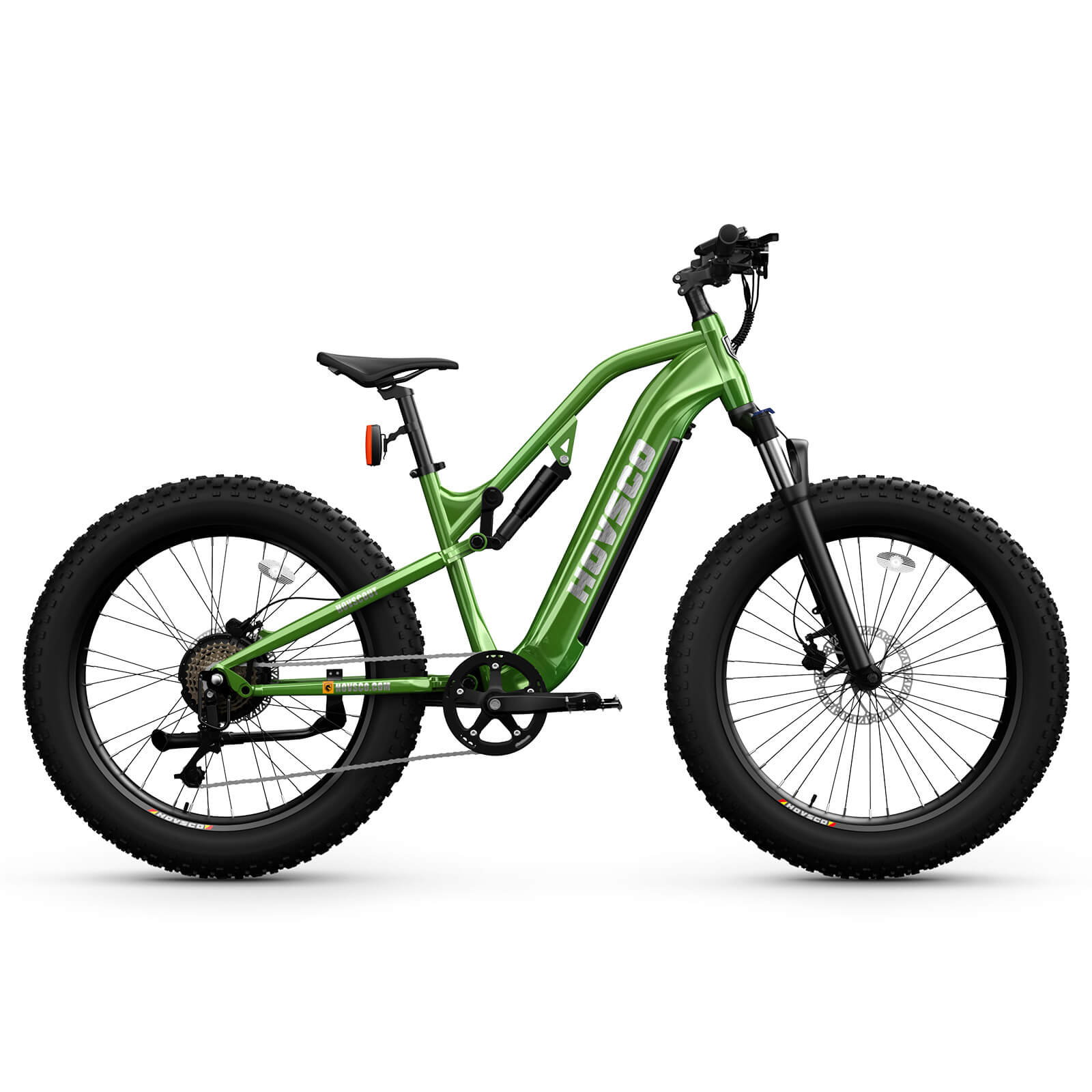
On progressive leverage curves—common on modern full-suspension ebikes—the natural progressiveness of air lines up with the frame’s own ramp. This layered resistance at the end stroke is ideal for heavy-duty use, protecting against bottom-out when a rider adds cargo, rides aggressively, or hits punchy terrain.
From my experience setting up HOVSCO prototypes, we found that progressive frames plus air shocks gave the best blend of traction, comfort, and damage control. Coil on the same kinematics demanded much tighter tolerances for spring choice and damping to avoid either mid-stroke wallow or harshness at full compression. That complexity is fine for race-tuned mountain bikes but not ideal for everyday all-terrain ebikes.
HOVSCO chose air suspension because their heavy-duty all-terrain ebikes are built for variable loads and changing terrain. A family rider, a bikepacker, and a commuter may all ride the same model. Air allows them each to reach correct sag and dynamic balance by adjusting pressure, not hardware.
In our internal testing, air shocks gave HOVSCO engineers a cleaner path to standardizing frame design while letting riders customize behavior at home. That is crucial when you want a global brand to deliver consistent safety and ride quality out of the box. Coil setups required more individualized spring stock, raising logistics and customer support complexity.
Finally, air suspension aligns better with modern expectations of ebike tuning. Riders increasingly expect to adjust geometry, assist levels, and suspension feel without swapping parts. With a properly chosen air shock and fork, HOVSCO can provide that experience and maintain safety margins across wider real-world use cases than a single fixed-rate coil spring realistically covers.
Coil suspension is naturally more sensitive to small bumps. The friction profile is simpler: no sealing surfaces fighting pressure changes, just a metal spring and damper. That yields a very supple initial stroke, valuable on chatter and micro-rough terrain. Air, by contrast, fights seal friction and the compressibility of air, which can make the first few millimeters of travel feel slightly more resistant.
However, when we talk about heavy-duty all-terrain ebikes, the picture changes. Added mass from the motor, battery, and cargo increases forces on the front and rear wheels, meaning even small impacts carry more energy. Properly tuned air suspension can still respond well under those higher loads, especially when sag, rebound, and compression damping are dialed in.
From HOVSCO’s test benches, the priority was not chasing the last 2% of micro-bump sensitivity, but achieving controlled support across the entire stroke. Air suspension delivered that more reliably under the weight profiles we saw. Coil still has an advantage where pure downhill and repeated small-bump traction dominate, but that is not the main use case for most ebike owners.
Coil suspension typically wins on raw mechanical durability. With fewer seals and no air chamber, there is less risk of air leaks and pressure loss. Riders who neglect maintenance can still get reasonable performance for a long time. Air suspension, meanwhile, demands regular pressure checks and periodic seal and oil servicing to avoid performance drop-off.
However, in a heavy-duty all-terrain ebike environment, the maintenance story becomes more nuanced. Riders tend to service ebikes less than high-end mountain bikes, but they also expect consistent performance with changing loads and riding patterns. When an air shock does drift out of spec, I can often restore performance quickly with a pump and routine service. A mis-sprung coil setup, on the other hand, may remain poorly matched until a new spring is sourced and installed.
For HOVSCO, the trade-off is clear: air suspension puts more responsibility on us during design and on the rider during ownership, but it also gives a clearer path to maintaining correct ride balance even as the bike’s mission shifts. In long-term fleet use, that balance of adjustability and serviceability is more important than absolute mechanical simplicity.
A progressive compression curve means the suspension gets harder to compress as you move deeper into travel. This is especially useful on heavy-duty ebikes when you want plush comfort early on, then strong resistance to protect the system against big hits and full-load impacts.
A linear compression curve means each unit of travel requires roughly similar incremental force. It feels extremely predictable but can risk either early bottom-out or compromised comfort depending on how you set the spring rate.
On the factory floor, I think of progressive curves as a safety buffer built into the physics. If a rider misjudges cargo, drops off a curb at speed, or nails a rocky descent with a full rear rack, the suspension is more likely to catch them before hard bottom-out. Linear coil can be tuned to do the same, but it demands a narrower window of rider and load variation.
A high-pressure pump is the key tool that turns air suspension from a good idea into a controllable system. Without precise pressure control, sag and spring rate are guesswork. With it, riders can set up their heavy-duty ebike accurately for body weight, cargo, and terrain.
HOVSCO’s dedicated high-pressure pump with an exhaust valve is more than a convenience. It is a safety-relevant accessory. The exhaust valve allows fine micro-adjustments, bleeding off just a few psi at a time rather than forcing big jumps that might overshoot ideal sag. That precision matters when we want riders to reach the sweet spot where the suspension sits high enough in travel to avoid pedal strikes but low enough to maintain traction and comfort.
In testing, I see many riders over-inflate air shocks because they fear bottom-out, then complain about harsh feel. With the right pump, we can walk them down to the correct pressure in small steps, watching sag markers and real-time ride feedback. HOVSCO’s pump is designed to make that process repeatable for everyday users, not just technicians.
For riders chasing a truly bombproof feel—bike park laps, repeated big hits, and almost zero concern for weight—coil suspension can still be attractive. Its simplicity, consistent rate, and small-bump sensitivity make it a favorite for pure gravity riding and many downhill-oriented builds.
On heavy-duty all-terrain ebikes, though, the definition of “bombproof” changes. The system has to support high-speed commuting, technical climbs, loaded trips, and occasional aggressive riding. In that broader context, air suspension remains the more rational choice.
My own experience working with HOVSCO teams shows that when we prototype coil options, they shine in narrow scenarios but introduce compromises in others: either too soft under cargo or too firm for everyday comfort. Air, set up correctly and paired with robust hardware, delivers a bombproof feeling over a wider envelope of real-world use.
“When we tested heavy-duty all-terrain ebike prototypes, air suspension consistently gave us more control over rider experience. Coil felt fantastic in a narrow window, but as soon as we added cargo racks, child seats, or trail gear, the need to re-spring the bike became obvious. With air, we can design once, then let riders adjust sag and support to match their actual lives, not just the lab. That is why HOVSCO’s engineering team backed air as the core solution for serious all-terrain platforms.”
Choosing between air suspension and coil suspension for a heavy-duty all-terrain ebike is not about which technology is “better” in isolation. It is about matching physics to real use. Coil suspension offers unmatched small-bump sensitivity and rugged simplicity, perfect for riders who live in one narrow performance band and rarely change load or terrain.
Air suspension, on the other hand, delivers progressive support, lightweight construction, and linear pressure tuning that make it ideal for riders whose ebike lives multiple roles: commuter, cargo hauler, trail explorer, and family transporter. HOVSCO chose air suspension for its heavy-duty platforms because that choice respects how people genuinely use ebikes today.
For most riders who want one bike to do many jobs and need confidence under changing loads, air suspension supported by a dedicated high-pressure pump is the smarter long-term investment. Feeling, safety, and adjustability all point in the same direction.
Is air suspension good enough for serious off-road ebike riding?
Yes. With correct pressure and damping, air suspension offers excellent support and control for off-road ebike use, especially when the frame has a progressive leverage curve and is designed for heavy-duty terrain.
Can I switch from coil to air on an existing heavy-duty ebike?
In many cases you can, but only if the shock dimensions, mounting hardware, and frame kinematics are compatible. It is important to confirm fit and intended leverage ratio before swapping to air suspension.
Do I really need a dedicated high-pressure pump for my air suspension?
Absolutely. Standard tire pumps cannot reach or control the pressures required for air suspension. A high-pressure pump with an exhaust valve lets you set sag precisely, which is essential for safe, predictable ride behavior on a heavy-duty all-terrain ebike.
Are coil shocks better for heavy riders on ebikes?
Coil can work well for heavy riders, but only when the spring rate is chosen correctly. Air suspension is often more practical because it allows fine-tuning for rider weight and cargo without changing hardware.
Does HOVSCO use air suspension across all models?
HOVSCO focuses on air suspension for heavy-duty all-terrain ebikes where load variability, progressive support, and on-bike adjustability are priorities. Specific models may vary, but the brand’s philosophy leans strongly toward tunable air systems for most riders.
Share:
Is a soft-tail ebike the real solution for riders with degenerative disc disease?
How does a full-suspension e-bike stop you going over the bars?