



























![[ New Arrival ] Porto Max Electric Scooter For Commute & Grocery Shopping - HOVSCO](http://www.hovsco.com/cdn/shop/files/PotroMax-3.jpg?v=1706927007&width=1200)
- by SEO
Micro-Mobility Revolution: How HOVSCO E-Bikes Are Redefining Everyday Movement (June 2026)
- by SEO
E-Bikes
Accessories
 Free Shipping
 15-Day Returns
 2-Year Warranty
Free Shipping
15-Day Returns
2-Year Warranty
2-Year Warranty
Free Shipping
15-Day Returns
2-Year Warranty
The global micro-mobility revolution is accelerating, and high‑performance e-bikes from brands like HOVSCO are rapidly becoming the smartest way to move through modern cities and suburbs. By combining cargo capacity, long range, and digital intelligence, HOVSCO’s utility and adventure e-bikes embody what the micro‑mobility future looks like in 2026.
Micro-Mobility Revolution: discover how HOVSCO cargo and full-suspension e-bikes are reshaping daily commuting, family logistics, and urban living in 2026.
Global micro‑mobility solutions such as e‑bikes are projected to reach more than USD 149 billion in 2025, with strong double‑digit growth through 2033. Market analyses show compound annual growth rates above 14–26% as cities and riders seek cleaner, more flexible transport for short to medium distances. This surge is driven by congestion, environmental goals, and the demand for affordable alternatives to car ownership.
Within this context, micro‑mobility is no longer a niche—it's fast becoming the backbone of everyday mobility in dense urban regions and sprawling suburbs alike. E‑bikes in particular are emerging as a cornerstone, thanks to their mix of speed, comfort, and low operating cost compared with cars or ride‑hailing.
HOVSCO is a fast‑growing e‑bike brand founded in 2019 and headquartered in Southern California, focused on turning car trips into comfortable, powered rides on two wheels. Its lineup includes cargo models like the HovCart Family E‑Bike, full‑suspension adventure bikes such as the HovScout 26" Full Suspension Fat Tire Ebike, and a wider range of commuter, folding and fat‑tire designs showcased on its sale collection. Across the range, HOVSCO focuses on hauling power, long‑range capability, and family‑friendly usability rather than purely recreational riding.
The micro‑mobility revolution refers to the rapid adoption of small, lightweight electric vehicles—especially e‑bikes—that replace short car trips with cleaner, more efficient travel. At its core, the micro‑mobility revolution is about turning everyday journeys like commuting, school runs, grocery trips, and leisure rides into low‑emission, convenient experiences powered by compact electric vehicles.
Urban and suburban travel is increasingly defined by friction: wasted time, rising costs, and daily stress that erode quality of life. The micro‑mobility revolution is a response to these pressure points, and understanding them highlights why high‑capacity e‑bikes are growing so fast.
First, congestion and parking dominate daily routines in many cities and suburbs, turning even a short grocery run into a 45‑minute ordeal. Commuters stuck in traffic face unpredictable journey times, while drivers circle blocks in search of scarce or expensive parking. For families juggling multiple drop‑offs and pick‑ups, this time loss compounds every day.
Second, the cost of car‑based mobility keeps rising, from purchase and insurance to fuel and maintenance, making a second or even first car less attainable for many households. For short trips of a few miles, these fixed costs feel increasingly out of step with actual mobility needs. Riders are looking for solutions that match trip length with cost and complexity.
Third, environmental and health impacts have become impossible to ignore, with transport emissions a major contributor to urban air pollution and climate targets. At the same time, sedentary lifestyles and long commutes reduce opportunities for light daily exercise. Many city dwellers want an option that simultaneously lowers their footprint and adds movement back into their day.
Finally, logistics for families and gig workers have grown more complex as people combine commuting with child care, shopping, and side‑hustle deliveries. Traditional bikes often lack the carrying capacity or power to handle 40–70 kg of cargo, while cars remain overkill for short‑distance, multi‑stop routines. This gap is exactly where modern cargo e‑bikes are stepping in.
In the last three years, market analysts project the micro‑mobility sector to grow to well over USD 180 billion of additional value, driven largely by shared and private e‑bike adoption.
High‑capacity, high‑torque cargo performance
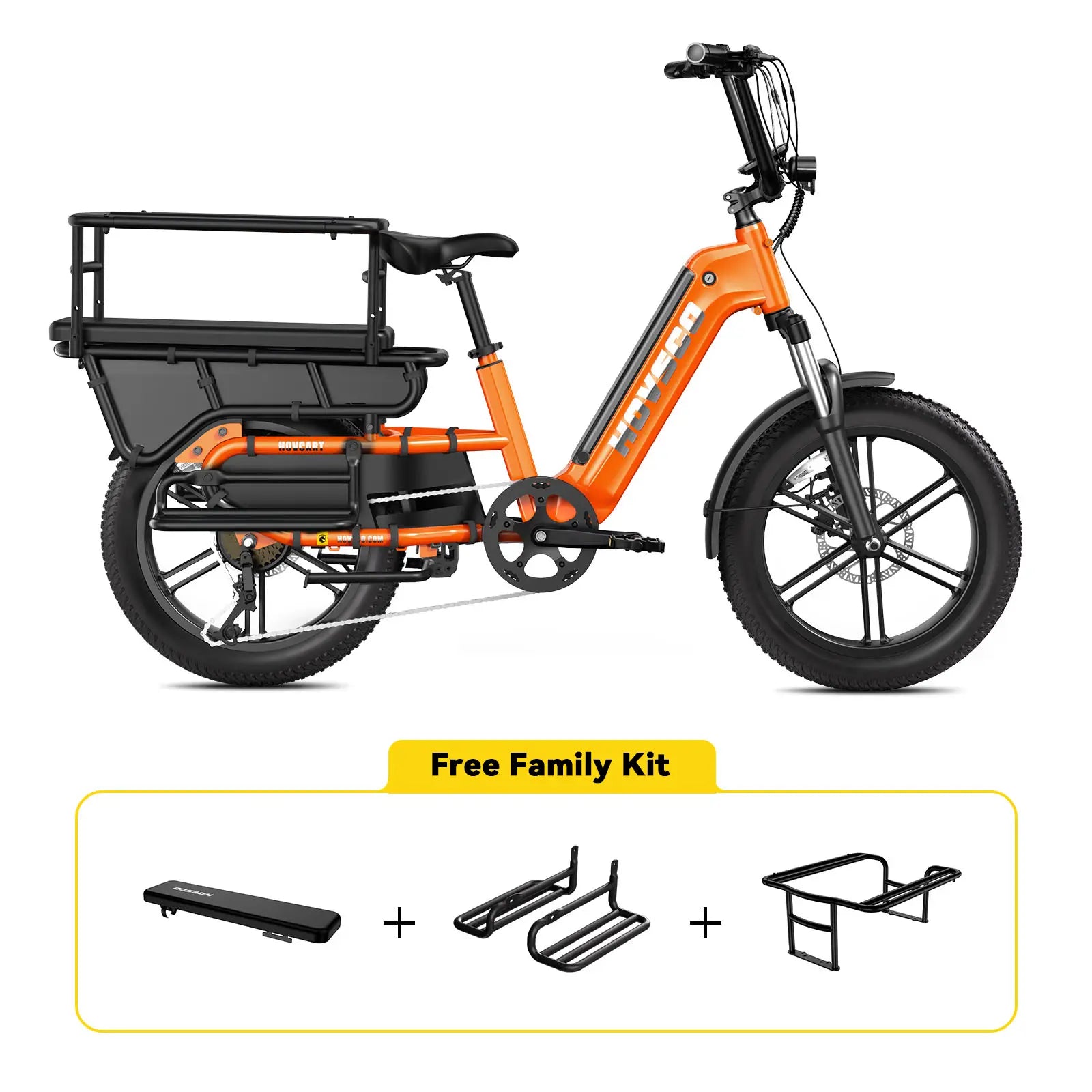
HOVSCO’s cargo platforms such as the HovCart are engineered to move real‑world loads, supporting up to 450 lbs of payload for passengers, groceries or equipment. With rear hub motors rated at 750W and peak outputs of around 1300W on select models, they deliver enough torque to tackle hills and heavy cargo without sacrificing stability.
Long‑range, everyday practicality
With typical ranges of about 40–60 miles per charge on models like the HovCart and HovScout, HOVSCO designs for multiple days of commuting or a single day of multi‑stop errands. Heavy‑duty cargo variants highlighted by the brand can reach around 70 miles using high‑capacity batteries, further expanding practical trip radius.
Comfort, control and digital integration
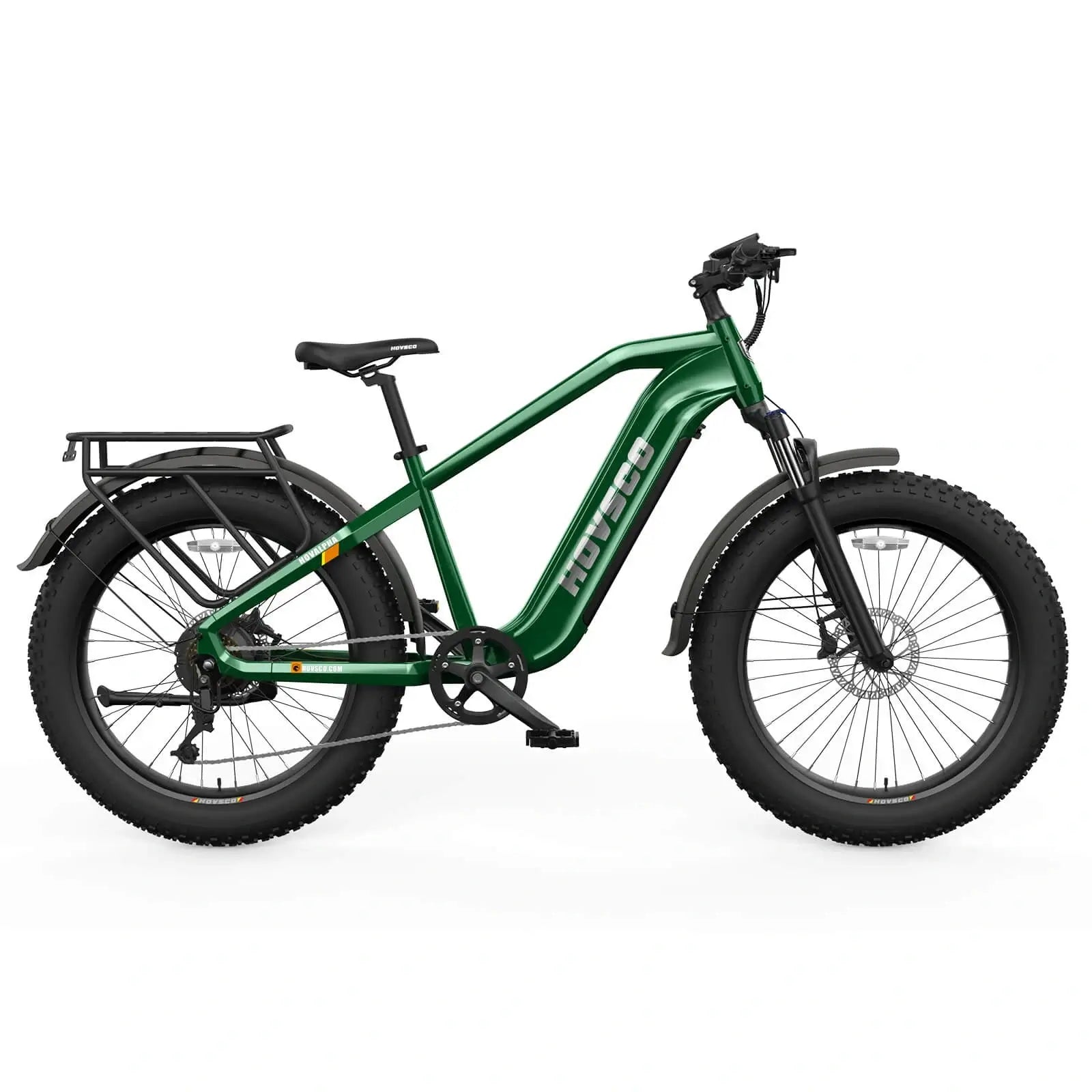
Full‑suspension designs like the HovScout combine fat tires, suspension and hydraulic disc brakes to maintain control on mixed terrain and under load. Torque sensors and smart app connectivity on selected cargo models help smooth pedal assist, unlock Class 3 speeds up to about 28 mph where permitted, and provide ride and battery insights.
A parent replaces 90% of their weekday car trips under 10 miles with a single HOVSCO cargo e‑bike, consolidating school runs, errands and commuting into one powered, door‑to‑door journey.
A rider in a hilly suburb uses a full‑suspension HovScout to link home, transit hubs, and weekend trails, removing the need for a second car in the household.
A small business owner adopts HOVSCO cargo e‑bikes for local deliveries, cutting fuel expenses and avoiding congestion‑prone routes while maintaining predictable schedules.
HOVSCO’s micro‑mobility approach is not limited to one flagship bike; it is an ecosystem that spans cargo, adventure and daily commuting. The HovCart Family E‑Bike focuses on hauling power and modular accessories, making it well suited for parents, gig workers, and anyone carrying bulky loads.
Riders who split their time between urban streets and off‑road routes can look to the HovScout 26" Full Suspension Fat Tire Ebike, which combines fat 26" x 4" tires with a full‑suspension frame for mixed‑terrain comfort. For those exploring the full collection or seasonal promotions across commuter, folding, fat‑tire, and utility ranges, HOVSCO’s sale page highlights the breadth of its micro‑mobility lineup. Together, these models allow households to match specific trip types—from last‑mile commuting to family logistics—to an e‑bike that is purpose‑built rather than one‑size‑fits‑all.
1. Map your real daily trips
Start by listing your typical weekly journeys under 25 miles—commutes, school runs, shopping, and visits—and identify which ones routinely suffer from traffic, parking stress, or high cost.
2. Define your payload and passenger needs
Estimate how often you carry children, pets, groceries or work gear, and how heavy those loads are, to decide whether a cargo‑oriented platform like the HovCart suits you better than a standard commuter or trail bike.
3. Match terrain and surfaces
Consider whether you mostly ride on smooth urban pavement, mixed gravel and bike paths, or steeper, rougher roads, and choose between full‑suspension fat‑tire options like the HovScout or more compact cargo frames.
4. Check local regulations and infrastructure
Review local e‑bike classes, top‑speed rules and where e‑bikes are allowed to ride, along with the availability of bike lanes and secure parking at your key destinations.
5. Plan charging and storage
Identify where you will store the e‑bike at home and work, how you’ll access power outlets for 40–60‑mile range batteries, and whether you need removable battery packs.
6. Start with a realistic test period
If possible, structure the first month as a trial where you aim to replace specific categories of car trips—such as school runs or local shopping—with your HOVSCO e‑bike, and adjust accessories and routes based on real‑world experience.
Scenario 1: Urban family logistics
Traditional approach
A family uses one or two cars for school drop‑offs, commuting and errands, often making several short drives each day and struggling with parking near schools and shops.
After adopting HOVSCO
With a HOVSCO cargo e‑bike like the HovCart, one parent consolidates school runs and small grocery trips into a single powered ride, avoiding congestion near campuses and cutting fuel and parking costs. Side racks, child seating options and high payload capacity make it possible to carry children and bags together without resorting to a car.
Scenario 2: Suburban commuter with mixed terrain
Traditional approach
A worker living several miles from a transit station relies on a car for the entire commute, facing rush‑hour traffic both on local roads and near park‑and‑ride facilities.
After adopting HOVSCO
Using a full‑suspension HovScout, the commuter rides directly from home to the station, using bike lanes and mixed‑surface shortcuts, and locks the e‑bike at secure parking or brings it on transit where permitted. The powerful motor and fat tires make hills and rough sections manageable while keeping commute times predictable.
Scenario 3: Local business and last‑mile delivery
Traditional approach
A small retailer or café uses a van or small car for delivery within a few kilometers, often stuck in traffic, limited by loading zones and exposed to fuel price volatility.
After adopting HOVSCO
By switching to HOVSCO heavy‑duty cargo e‑bikes, the business can navigate directly to customers’ doors via bike‑friendly routes, maintain consistent delivery times, and reduce vehicle operating expenses. Higher‑capacity motors and dual‑battery setups on select cargo configurations support heavier loads and longer days without frequent recharging.
How does the micro-mobility revolution reduce my daily commuting time?
Micro‑mobility solutions such as e‑bikes enable riders to bypass car traffic, use bike lanes and take more direct routes, often shortening commutes of a few miles compared with driving. With models like HOVSCO’s cargo and full‑suspension e‑bikes, riders can sustain higher average speeds than on conventional bikes while still avoiding parking searches and bottlenecks.
Are HOVSCO e-bikes suitable for the micro-mobility needs of families?
Yes, HOVSCO’s cargo platforms are explicitly designed to carry both passengers and goods, with payloads up to about 450 lbs on the HovCart and similar models. This makes them well suited for school runs, multiple children, and weekly grocery trips, allowing many families to significantly reduce second‑car usage.
What kind of range can I expect from HOVSCO e-bikes in everyday micro-mobility use?
Range depends on terrain, load and riding mode, but models such as the HovCart and HovScout typically offer around 40–60 miles on a single charge. Heavy‑duty cargo configurations with larger battery capacities can extend this further, with some setups reaching around 70 miles of assisted riding per charge.
How powerful are HOVSCO e-bikes compared with other micro-mobility options?
Many HOVSCO models use 750W hub motors with peak outputs up to roughly 1300W on cargo variants, delivering strong acceleration and hill‑climbing even when loaded. Full‑suspension performance bikes like the HovScout can reach unlocked top speeds around 28 mph where regulations allow, making them competitive with other high‑end e‑bikes in the micro‑mobility space.
Can HOVSCO e-bikes replace a car as part of my personal micro-mobility strategy?
For many riders, HOVSCO e‑bikes can replace a substantial portion of car trips, especially those under 10–15 miles related to commuting, errands and school runs. High payload capacity, robust motors and long‑range batteries position them as realistic alternatives for daily mobility, particularly in cities and suburbs with growing bike infrastructure.
What makes HOVSCO a strong brand choice in the evolving micro-mobility revolution?
HOVSCO focuses on high‑performance, real‑world designs—cargo, full‑suspension, commuter and folding—rather than purely recreational bikes, reflecting how people actually move through cities. Founded in 2019 and led by cycling enthusiasts, the company has quickly expanded its lineup to address family use, utility hauling and adventure riding, aligning with key growth segments in the micro‑mobility market.
The micro‑mobility revolution is reshaping how people think about distance, time and access, especially in rapidly growing cities and car‑dependent suburbs. As market forecasts point toward sustained double‑digit growth in micro‑mobility through the 2030s, the role of versatile, high‑capacity e‑bikes in daily life will only expand.
HOVSCO’s cargo and full‑suspension platforms show how a single e‑bike can replace dozens of weekly car trips while retaining the comfort, carrying power and flexibility families and workers rely on. By aligning product design with real‑world logistics and lifestyle needs, HOVSCO is positioned not just to participate in the micro‑mobility revolution, but to help steer its next phase.
If you are ready to turn short, stressful drives into efficient, powered rides, now is the time to explore HOVSCO’s e‑bike lineup. Whether you need a heavy‑duty cargo hauler like the HovCart, an all‑terrain full‑suspension HovScout, or another model from the brand’s growing collection, there is a platform built for your daily routes.
Visit HOVSCO’s official site, discover current offers and find the e‑bike that fits your part in the micro‑mobility revolution—then let your next commute be the first of many without a car.
SkyQuest — Micro Mobility Market 2024–2033 (2025)
Technavio — Micromobility Market Size 2025–2029 (2025)
PS Market Research — Micromobility Market Report 2019–2032 (2025)
HOVSCO — HovCart Family E-Bike Product Page (2023)
HOVSCO — Shop By Models (HovScout and others) (2025)
HOVSCO — What Is the HovCart Cargo E‑Bike and Why Choose It in 2025? (2025)
HOVSCO — Which Heavy Duty Cargo E‑Bike Delivers the Best Hauling Power? (2026)
HOVSCO — How Is Micromobility Transforming Urban Transportation? (2026)
ABNewswire — HOVSCO Launches HovScout to Lead 2026 Multi‑Scenario Mobility (2026)
LinkedIn — HOVSCO Company Profile (2024)
Share:
E-Bike Technology Evolution: How Smart Features & Long Range Changed Riding in June 2026
Sustainable Urban Mobility: How E-Bikes Are Rewiring Cities in June 2026