
























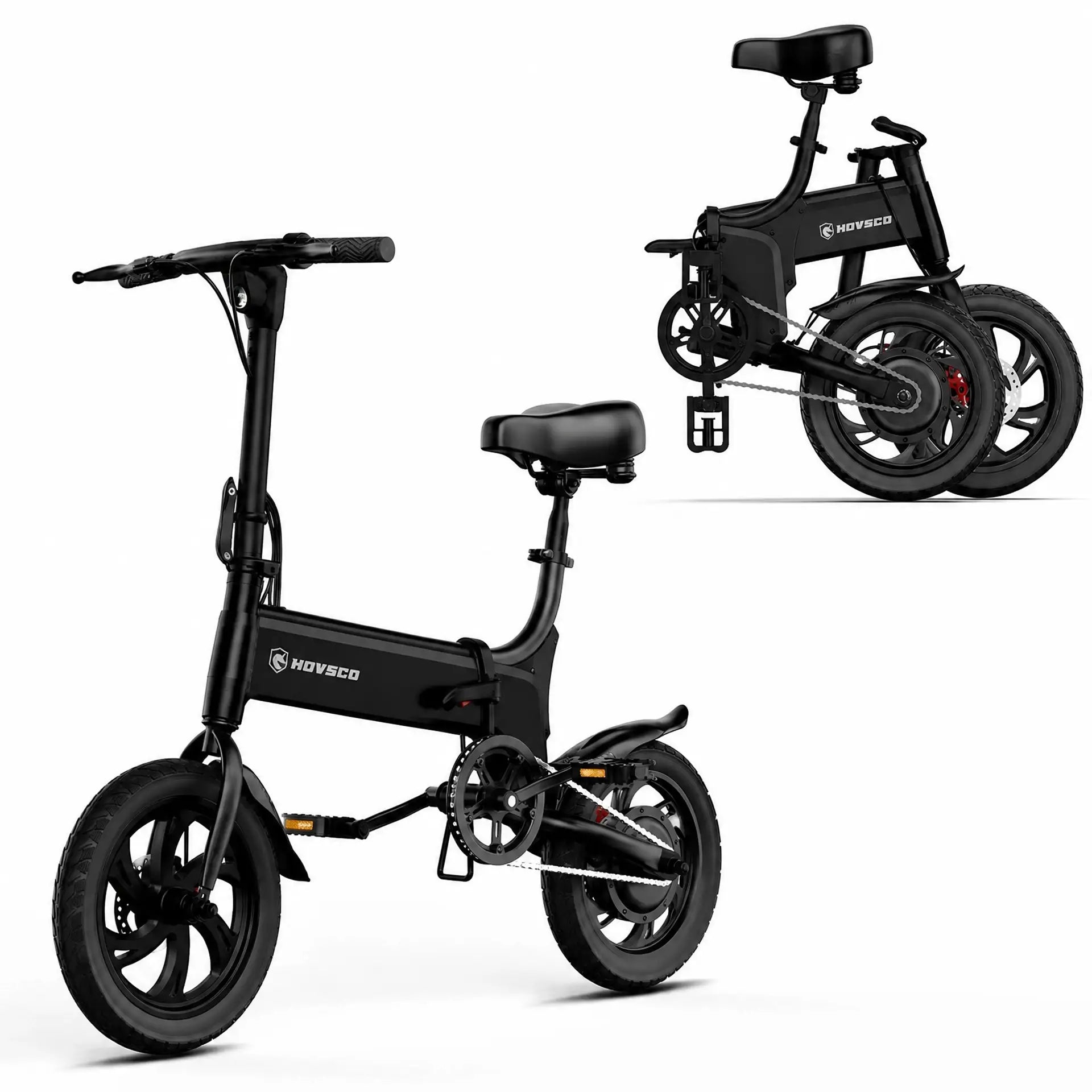
![[ New Arrival ] Porto Max Electric Scooter For Commute & Grocery Shopping - HOVSCO](http://www.hovsco.com/cdn/shop/files/PotroMax-3.jpg?v=1706927007&width=1200)
- by SEO
Sustainable Urban Mobility: How E-Bikes Are Rewiring Cities in June 2026
- by SEO
E-Bikes
Accessories
 Free Shipping
 15-Day Returns
 2-Year Warranty
Free Shipping
15-Day Returns
2-Year Warranty
2-Year Warranty
Free Shipping
15-Day Returns
2-Year Warranty
Sustainable urban mobility is reshaping how cities move people, cut emissions, and reclaim public space in 2026, and e-bikes are at the heart of that shift. HOVSCO’s high-torque, long-range electric bikes give everyday riders a practical way to swap short car trips for cleaner, faster, and more flexible journeys.
Sustainable urban mobility now anchors many city climate strategies, with e-bike markets worth tens of billions of dollars and still expanding as governments push for net-zero transport. Road vehicles currently generate around three-quarters of transportation-related CO₂ emissions worldwide, so shifting even a fraction of urban trips to micromobility has an outsized climate impact. In North America alone, shared micromobility systems supported more than 170 million trips in 2023, signaling that urban riders are ready for smaller, lighter, and more sustainable vehicles.
HOVSCO’s portfolio—including city commuters like the HOVSCO™ HovCity 27.5" Step-Thru Cruiser Electric Bike For Adults and versatile models such as the HovRanger step-thru commuter bike highlighted in the commuter collection—is designed to help riders turn sustainable urban mobility from a policy goal into a daily habit. With punchy 730–970 W peak motor outputs, up to 60 miles of range, and integrated app connectivity, these bikes are tuned for real-world commuting rather than lab specs.
Sustainable urban mobility is the idea that cities should move people and goods in ways that are low-carbon, safe, inclusive, and efficient, with the core goal of meeting today’s mobility needs without compromising those of future generations. In practice, sustainable urban mobility combines public transport, walking, cycling, and micromobility—especially e-bikes—as realistic alternatives to private car dependence in dense urban areas.
Urban transport now represents close to one-third of total greenhouse gas emissions in many regions, with road traffic as the dominant source. Cars and trucks account for roughly three-quarters of transport CO₂ worldwide, making them the single biggest lever for reducing the sector’s climate footprint. At the same time, congestion is eroding productivity and quality of life, with commuters losing hours each week in traffic that also damages air quality and public health. Against this backdrop, cities are investing heavily in bike lanes, low-emission zones, and shared micromobility systems to diversify how people move.
E-bikes are uniquely positioned to replace short car trips, which often make up the majority of urban vehicle journeys but the minority of total miles traveled. These are exactly the distances where a 40–60 mile e-bike range, such as that on the HovCity commuter model, is more than sufficient for a day’s errands, commuting, and leisure rides. Compared with cars, e-bikes consume a fraction of the energy per kilometer and produce zero tailpipe emissions, even when accounting for battery manufacturing and grid electricity. Because they are compact and easy to park, they also reduce the spatial footprint of mobility, freeing up curb space and parking lots for housing, trees, and public life.
HOVSCO focuses on making sustainable urban mobility tangible through robust, thoughtfully specified e-bikes that riders can rely on every day. The HOVSCO™ HovCity 27.5" Step-Thru Cruiser Electric Bike For Adults pairs an up-to-60-mile range with a 730 W peak motor, hydraulic disc brakes, and an upright geometry for relaxed daily riding. Within the Electric Commuter Bikes collection, models such as the HovRanger step-thru commuter bike extend similar range and 28 mph top speeds, giving riders options to match their terrain and loads. Across the lineup, payload capacities up to 300 lbs on commuter bikes and higher on cargo models make it realistic to carry children, groceries, or work gear instead of defaulting to a car.
Sustainable urban mobility is a city-wide approach to transportation that prioritizes low-emission, space-efficient, and people-centered modes such as walking, cycling, micromobility, and public transit over private car use. For individual riders, it means using solutions like e-bikes to make daily trips more climate-friendly, affordable, and time-efficient while still enjoying comfort and flexibility.
Sustainable urban mobility is a coordinated system of policies, infrastructure, and vehicles that allows people to meet their daily travel needs with minimal environmental impact, equitable access, and high safety. It typically centers on walking, cycling, micromobility, and public transit, with private cars playing a smaller, more targeted role rather than dominating every trip type.
Urban residents often feel locked into car dependence because distances seem too long and infrastructure too hostile for walking or conventional cycling. Long commutes by car or crowded buses translate into lost time, higher stress, and unpredictable arrival times, especially in congested corridors. For many households, rising fuel prices, parking fees, and vehicle maintenance costs eat into budgets, making “cheap” car trips far more expensive than they appear at first glance.
At the same time, many cities still struggle with fragmented bike infrastructure that makes cycling feel risky, especially for new riders or parents carrying children. This discourages people from trying more sustainable options even when they recognize the environmental and health benefits. Finally, traditional bikes, though efficient, can be intimidating in hilly cities or for riders with limited fitness, physical limitations, or who simply do not want to arrive sweaty at work.
This combination of distance, time pressure, cost, and perceived physical effort keeps millions of short trips in private cars that could be shifted to micromobility with the right vehicles and infrastructure. In other words, the barrier is less about distance itself and more about how hard and inconvenient it feels to move differently—precisely where well-designed e-bikes can change the equation.
“In 2023, at least 172 million shared micromobility trips were taken in 421 cities across North America, showing that when convenient options exist, people are ready to change how they travel.”
Efficient electric assistance
HOVSCO commuter models such as the HovCity combine a 730 W peak, 500 W sustained rear hub motor with pedal assist up to 28 mph, allowing riders to tackle hills, headwinds, and longer distances without excessive effort. This makes cycling viable for a broader range of ages, fitness levels, and city topographies, increasing the pool of potential riders who can realistically leave the car at home.
Urban-ready range and payload
With a 36 V 15 Ah Samsung/LG battery delivering an advertised 40–60 mile average range, the HovCity comfortably covers daily commutes, detours, and errands without mid-day charging anxiety. A maximum payload capacity of 300 lbs gives headroom for the rider plus groceries, a laptop bag, or child seat, supporting real-world substitution of car trips instead of purely recreational use.
Digital integration and safety
The HovCity’s BC280 LCD display with app connectivity lets riders monitor speed, distance, and battery status and sync key data through the HOVSCO app. Combined with features like hydraulic disc brakes, ebike-rated 27.5 x 2.2" tires, and a suspension fork, this setup helps increase confidence when navigating busy urban streets in mixed conditions.
A downtown office worker replaces a 10 km round-trip car commute with a HOVSCO commuter e-bike, saving on parking fees while cutting daily travel time in traffic.
A parent uses a cargo-capable HOVSCO bike with racks and baskets to handle school drop-offs and grocery runs in one loop, eliminating several short car trips each week.
A student in a hilly neighborhood adopts a step-thru commuter e-bike to reach campus and part-time work quickly without arriving sweaty or waiting for delayed buses.
When riders start replacing car trips, they often discover additional mobility needs that a single bike cannot fully cover—family trips, off-road escapes, or extremely compact storage. HOVSCO’s broader lineup allows them to build a small, personalized fleet around one core commuter.
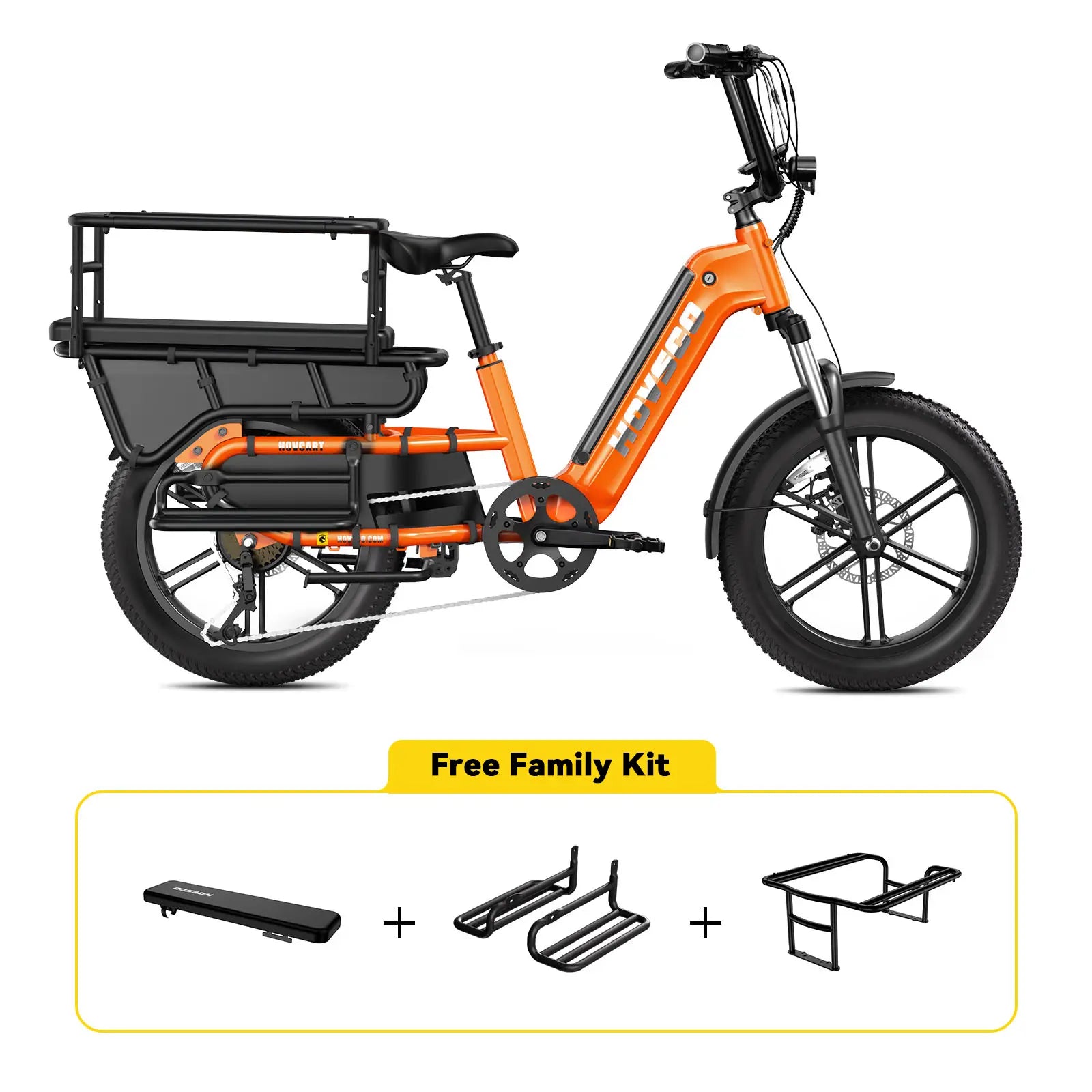
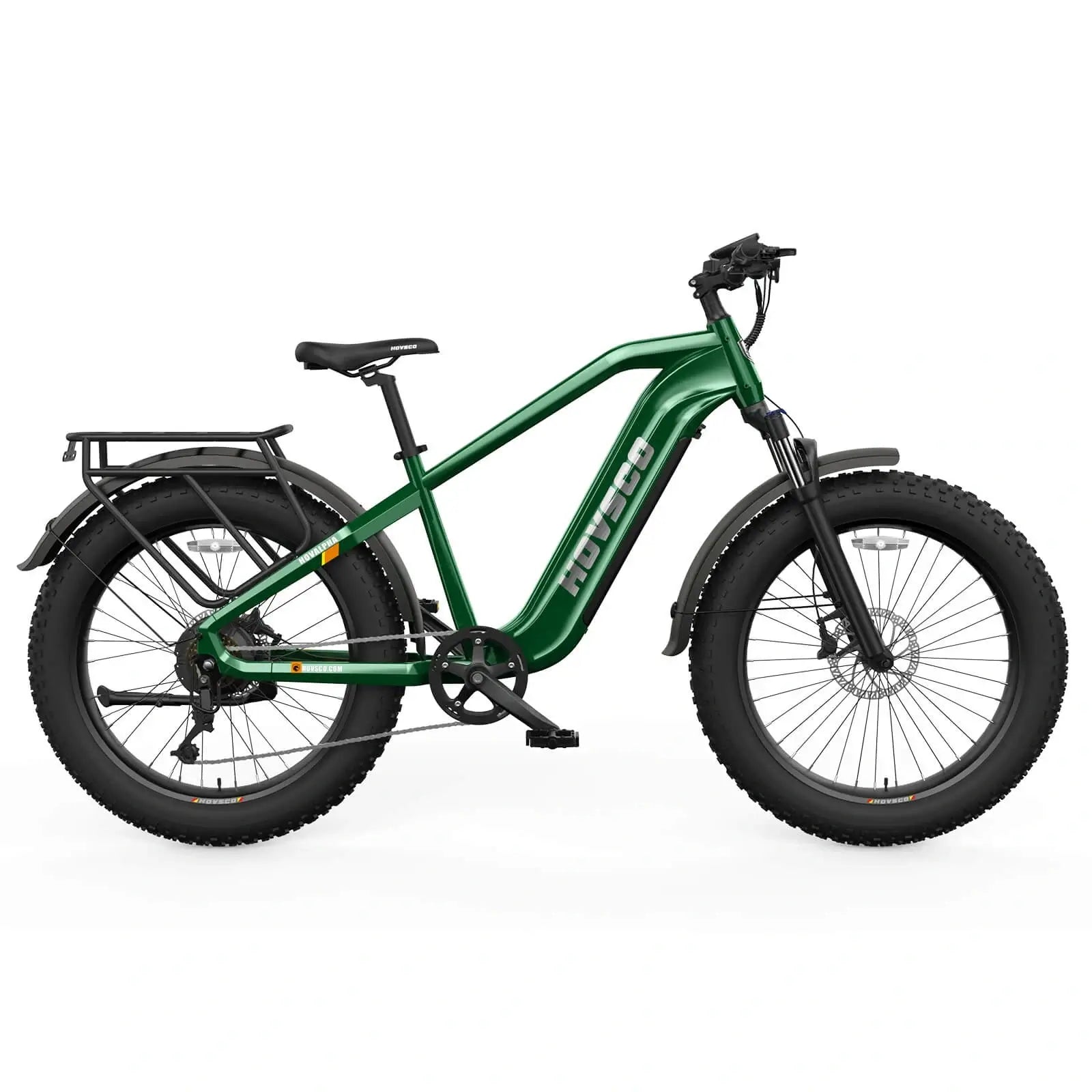
For riders whose primary goal is sustainable city commuting but who also want weekend exploration, combining the HOVSCO™ HovCity 27.5" Step-Thru Cruiser Electric Bike For Adults with a more rugged fat-tire model like the HovAlpha Fat Tire Electric Bike (featured on the homepage) delivers both efficient weekday riding and all-terrain capability for trails or snowy conditions. Families can pair a compact city bike such as the HovCity with the HovCart cargo ebike, using the latter for school runs and weekend outings where carrying children and gear is essential.
For riders with limited storage or multimodal commutes involving trains or subways, the HovBeta Foldable Fat Tire Ebike complements a full-size commuter by providing a collapsible option that fits in small apartments and car trunks. Those who prioritize comfort and safety over rough terrain may find that adding a HovScout full-suspension ebike helps maintain active mobility even on broken pavement or gravel paths leading into the city. In each case, the goal is the same: create a tailored set of tools that makes sustainable urban mobility not just possible but preferable to driving.
Map your weekly trips List your recurring journeys—commuting, school runs, groceries, leisure—and note distances, terrain, and what you need to carry. This helps you identify which trips are easiest to transition from car or transit to e-bike first.
Choose the right HOVSCO platform If most of your travel is on paved city streets with moderate cargo, a step-thru commuter like the HOVSCO™ HovCity 27.5" Step-Thru Cruiser Electric Bike For Adults is a strong starting point. Riders needing more carrying capacity or off-road capability might look at cargo and fat-tire models highlighted on HOVSCO’s homepage and commuter collection.
Plan your infrastructure and storage Identify safe routes with bike lanes, calmer side streets, or dedicated paths, drawing on local sustainable mobility plans where available. At home and work, confirm you have secure bike parking and access to power outlets for charging.
Set up accessories for everyday life Add racks, panniers, child seats, or baskets so that the bike can replace the functional storage of a car trunk. Consider lights, fenders, and locks as standard to handle all-weather conditions and urban parking.
Start with a few days per week Instead of aiming for 100% car replacement immediately, begin by shifting two to three weekly commutes or errands to the e-bike. This phased approach builds confidence and helps you dial in comfort settings such as saddle height and assist levels.
Track impact and iterate Use the HOVSCO app and your own notes to track distance, time saved, and estimated car trips avoided. Reviewing these metrics every month makes your environmental and financial benefits visible, reinforcing the new habit and revealing when a second specialized e-bike might make sense.
Scenario 1: The urban office commuter
Traditional approach: A city-center worker drives 8 km each way in slow-moving traffic, spending 30–45 minutes per leg plus parking fees, and emitting unnecessary CO₂ for a short trip. The commute is stressful, unpredictable, and physically inactive, leaving little time for exercise or mental decompression.
With HOVSCO: Switching to a HovCity step-thru commuter e-bike, the rider covers the same distance in roughly 20 minutes with consistent travel time, zero tailpipe emissions, and minimal parking hassle. The moderate physical activity built into the commute improves fitness and well-being, while reduced car use lowers monthly transport costs.
Scenario 2: The multi-stop family caregiver
Traditional approach: A parent chains together school drop-off, grocery shopping, and after-school activities in a car, battling congestion and parking at each location. Short drives add up to a surprising amount of fuel use, and kids spend more time buckled in than moving their bodies outdoors.
With HOVSCO: Using a cargo-capable HOVSCO e-bike like the HovCart alongside a city commuter, the parent can carry children, backpacks, and groceries on a single, carefully planned route. Electric assist makes the extra weight manageable, and riding becomes an enjoyable shared experience that strengthens family time while cutting car miles and emissions.
Scenario 3: The student and part-time worker
Traditional approach: A student relies on buses for a 5 km trip to campus and a 4 km trip to work, often waiting in the cold or heat and missing connections, especially at off-peak times. Owning a car is financially unrealistic, but the lack of reliable options limits job choices and social activities.
With HOVSCO: A step-thru model like the HovCity turns both trips into quick, predictable rides that fit around irregular schedules. The student gains independence without committing to the upfront and ongoing costs of a car, while still traveling efficiently across the city.
How does sustainable urban mobility with e-bikes reduce my personal carbon footprint?
Shifting short trips from car to e-bike eliminates tailpipe emissions and dramatically cuts per-kilometer energy use, which is significant because cars account for the majority of transport CO₂. Over a year of regular commuting, these small daily changes can add up to hundreds of kilograms of avoided emissions, especially in car-dependent cities.
Are HOVSCO e-bikes powerful enough for hilly urban areas and heavier riders?
Yes, many HOVSCO models are built with peak motor outputs between roughly 730 W and 970 W, top speeds up to 28 mph, and payload capacities as high as 300–450 lbs depending on the model. This combination of torque and carrying capacity allows riders in hilly districts or with additional cargo to climb confidently while maintaining reasonable speeds.
What range do I need for sustainable urban commuting on an e-bike?
For most city riders, a 30–60 mile range is sufficient to cover daily commutes, errands, and detours without charging more than once every one to two days. With the HovCity’s claimed 40–60 mile average range, many users can comfortably complete a full week of moderate riding with only a few charging sessions.
Is an e-bike really cheaper than owning a car for city mobility?
While a quality e-bike requires a meaningful upfront investment, ongoing costs are far lower than those associated with fuel, parking, insurance, and maintenance for a car. Over several years, many riders find that the total cost of ownership is substantially lower for an e-bike-based mobility strategy, especially when it replaces a second household car.
How do HOVSCO e-bikes support safe and comfortable urban riding?
HOVSCO integrates features such as powerful hub motors for quick acceleration, hydraulic or mechanical disc brakes, and in many models wide or fat tires that increase grip and comfort over uneven surfaces. Combined with upright or step-thru geometries on commuter bikes, these design choices help riders stay balanced and visible, which is crucial in complex city traffic.
Can e-bikes and sustainable urban mobility work in cities without perfect bike infrastructure?
Even in cities with incomplete bike lanes, e-bikes can be highly effective when riders choose calmer streets, shared-use paths, and appropriate speeds. As city governments observe growing micromobility adoption—evidenced by shared systems reaching record ridership—they are more likely to invest further in protected infrastructure that makes riding safer for everyone.
The data suggests that micromobility is not a niche experiment but a structural shift in how cities move. E-bike markets are expanding globally, powered by rising environmental awareness, health consciousness, and pragmatic concerns about congestion and cost. For individual riders, sustainable urban mobility anchored by e-bikes offers a rare combination of faster trips, lower expenses, and improved well-being in a single lifestyle choice.
HOVSCO’s rapid growth since launch and focus on versatile, high-spec e-bikes reflects this long-term trajectory. By designing bikes that handle both daily commuting and broader life scenarios—family rides, grocery runs, weekend escapes—the brand makes it easier for riders to commit to using bikes as primary vehicles rather than occasional accessories. As more people make this shift, cities can reallocate road space, redesign parking, and focus on human-centered streets, amplifying the impact of each individual purchase.
If you want your daily travel to align better with your values on climate, health, and liveability, sustainable urban mobility is the most direct way to start, and an e-bike is often the most practical first step. HOVSCO’s lineup—from the commuter-friendly HOVSCO™ HovCity 27.5" Step-Thru Cruiser Electric Bike For Adults to powerful all-terrain and cargo models—gives you the tools to replace more car trips than you might think, without sacrificing comfort or convenience. Explore the range, imagine your weekly routes without traffic jams, and take one ride that could permanently change how you move through your city.
If you were prioritizing just one benefit from sustainable urban mobility—saving time, saving money, or reducing emissions—which matters most to your brand’s target readers right now?
Sources
European Environment Agency — Greenhouse gas emissions from transport 2025
NABSA — 2023 State of the Shared Micromobility Industry 2024
OurEnergyPolicy — 2023 Shared Micromobility State of the Industry 2024
U.S. ITS JPO / NACTO — 2024 Micromobility Executive Briefing
HOVSCO — HOVSCO™ HovCity 27.5" Step-Thru Cruiser Electric Bike For Adults
Share:
Micro-Mobility Revolution: How HOVSCO E-Bikes Are Redefining Everyday Movement (June 2026)
Green Transportation Solutions: How HOVSCO E-Bikes Help Cities Move Smarter (June 2026)