
























![[ New Arrival ] Porto Max Electric Scooter For Commute & Grocery Shopping - HOVSCO](http://www.hovsco.com/cdn/shop/files/PotroMax-3.jpg?v=1706927007&width=1200)
- by SEO
Why did we build HovScout for never‑stop explorers?
- by SEO
E-Bikes
Accessories
 Free Shipping
 15-Day Returns
 2-Year Warranty
Free Shipping
15-Day Returns
2-Year Warranty
2-Year Warranty
Free Shipping
15-Day Returns
2-Year Warranty
We built HovScout for riders who see a dirt road as an invitation, not a boundary. HOVSCO’s mission is to turn everyday trips into small expeditions, so the HovScout combines long‑range power, full‑suspension control, and fat‑tire confidence. It lets you scout further, link city and wild spaces, and keep that “first‑ride” excitement alive years into ownership.
Check: exploration spirit of the Best Full Suspension Ebikes
At HOVSCO, the spirit of exploration means designing e‑bikes that encourage you to ride beyond your routine—into new trails, new neighborhoods, and new versions of yourself. It’s the belief that every rider, not just athletes, deserves a machine that quietly expands their map.
Inside the company, “scout further” is more than a tagline; it’s the filter we run product decisions through. If a frame design, battery layout, or suspension choice doesn’t genuinely help you go farther, discover more, or feel safer doing it, it doesn’t make it onto the final spec sheet. Our background in hoverboards and e‑scooters taught us that people keep using vehicles that feel fun and frictionless, so we engineered HOVSCO e‑bikes to carry that same sense of play into more serious terrain.
For the HovScout, the spirit of exploration shows up in the details: geometry that feels stable loaded with bags, tire volume that floats over loose surfaces, and torque‑sensor tuning that rewards curiosity instead of punishing it with harsh surges. As an engineer, I’ve watched test riders start on a short demo loop and, almost without realizing it, keep extending the ride—because the bike quietly tells them, “Yes, you can go see what’s around the next bend.”
The HOVSCO mission to get more people smiling on bikes shapes our explorer e‑MTB design by forcing every component to earn its place in real‑world riding. If a feature doesn’t help you ride more often, more safely, or more joyfully, it doesn’t fit our mission.
Our engineering meetings start with rider stories, not just CAD drawings. Commuters who want to hit dirt on the way home, parents linking parks on weekends, backpack‑carrying photographers chasing sunset vantage points—all of them sit in our mind when we sketch the next frame. That’s why a HOVSCO trail platform emphasizes all‑day comfort, robust range, and easy maintenance over pure race‑weight minimalism. Exploration riders need a trustworthy partner, not a fragile trophy.
On the HovScout, that mission shows up in choices like reinforced rack‑mount points for bikepacking bags, sealed connectors that keep electronics alive in dust and rain, and a battery system tuned for predictable range rather than marketing‑inflated numbers. I’ve personally pushed development bikes until the low‑battery warnings flash, just to verify how far “farther” really is. The mission only matters if the numbers hold up when you’re 20 miles from the trailhead.
We chose a full‑suspension fat platform for non‑stop explorers because it turns unknown terrain from a risk into a playground. Long‑travel suspension and wide tires forgive imperfect lines, letting you scout further even when the trail surface, lighting, or weather aren’t perfect.
From a factory‑floor perspective, I’ve seen how riders actually use “adventure” bikes: they cross curbs, washboard fire roads, snow patches, sandy cuts, and rooty singletrack all in one day. A rigid or short‑travel frame forces you to tiptoe through that mix, but a well‑tuned full‑suspension layout keeps the tire in contact with the ground, which is where safety and control live. Fat tires add a second layer of compliance, spreading your weight over soft surfaces and smoothing smaller chatter before it even reaches the suspension.
Of course, the trade‑off is weight and rolling resistance. We countered that by carefully choosing tire casings, rim widths, and leverage ratios so HovScout still accelerates willingly on pavement and bike paths. The result is a HOVSCO platform that doesn’t ask you to swap bikes when plans change mid‑ride. If you’re the type who starts on asphalt, detours onto gravel, then ends up on a rocky overlook, a full‑suspension fat setup simply fits the way you already explore.
HovScout helps you scout further without burning out by using torque‑sensing assist, efficient power delivery, and comfortable geometry to stretch your energy instead of replacing it. The bike amplifies every pedal stroke so you can ride longer and finish with that “I could keep going” feeling.
In tuning sessions, we focus on how assistance ramps up when you first push the pedals. Cadence‑only systems can feel like on/off switches; they either under‑help on climbs or over‑surge on flats. With a torque‑sensor system calibrated for trail use, HOVSCO engineers can make the motor mirror your effort: a little push on smooth ground, a stronger hand when you stand into a steep pitch, a gentle taper as you crest a hill. When I ride HovScout prototypes, I monitor not just speed but heart rate; the aim is a steady, sustainable zone rather than spikes.
Ergonomics complete the equation. A slightly more upright cockpit, dropper‑post‑friendly frame, and room for wider bars let your upper body share the work. Add a battery sized for real‑world mixed riding—not laboratory loops—and the “scout further” promise becomes simple math. Instead of budgeting your energy around the ride home, you can push deeper, knowing the bike will carry you back with power and comfort in reserve.
Specific engineering decisions—like reinforced pivot hardware, overbuilt rack bosses, water‑resistant electronics, and heat‑managed motor tuning—make HovScout an exploration tool before a trail toy. We assume riders will load it, thrash it, and keep it for years.
Pivot bolts and bearings, for example, are sized with dirty, under‑lubed, real‑world abuse in mind. In the lab, I’ve kept sample frames cycling under mud‑contaminated loads to see which seal designs survive. The result is linkage hardware that stays quiet and tight even after long seasons of weekend adventures. We also designed the rear triangle with enough stiffness to carry bikepacking bags or child seats without turning the handling vague when the motor kicks in.
On the electronic side, we learned from our hoverboard and e‑scooter history that connectors and harnesses are often the first failure points. That’s why HOVSCO exploration platforms use locking, gasketed connectors and routing paths that avoid tight bends near moving parts. Motor controllers are mounted where they see airflow, not just where they’re easy to assemble. Those choices don’t show up in flashy marketing, but when you’re an hour from the trailhead and a cold front rolls in, they’re the reason you get home with everything still working.
HOVSCO’s mission differs from pure speed‑or‑spec brands by prioritizing real‑world ride experience over headline numbers. We care less about theoretical top speed and more about how confidently you’ll ride a new trail, commute in sketchy weather, or bring a friend along.
On the engineering side, it’s tempting to chase “biggest battery” or “highest peak watts” just because they photograph well. Instead, we focus on continuous power, brake performance under load, and what I call “recovery friendliness”—how fresh you feel the next day. When we test HovScout, we purposely include mixed terrain, heavy backpacks, and stop‑and‑go traffic, because that’s how actual explorers ride. Specs still matter, but they’re tuned to support adventure, not Instagram.
Community feedback shapes our priorities too. HOVSCO riders talk about their favorite views, routes, and group rides more than they talk about lap times. That tells us we’re on the right path. Where some companies see an e‑bike as a gadget, we’re building a long‑term companion. It’s the difference between selling a product and inviting someone into a way of traveling.
We engineered HovScout with three main explorers in mind: the weekend trail scout, the everyday commuter‑adventurer, and the all‑weather, all‑season rider who refuses to park their bike when the forecast turns ugly. Each persona shaped specific frame and component decisions.
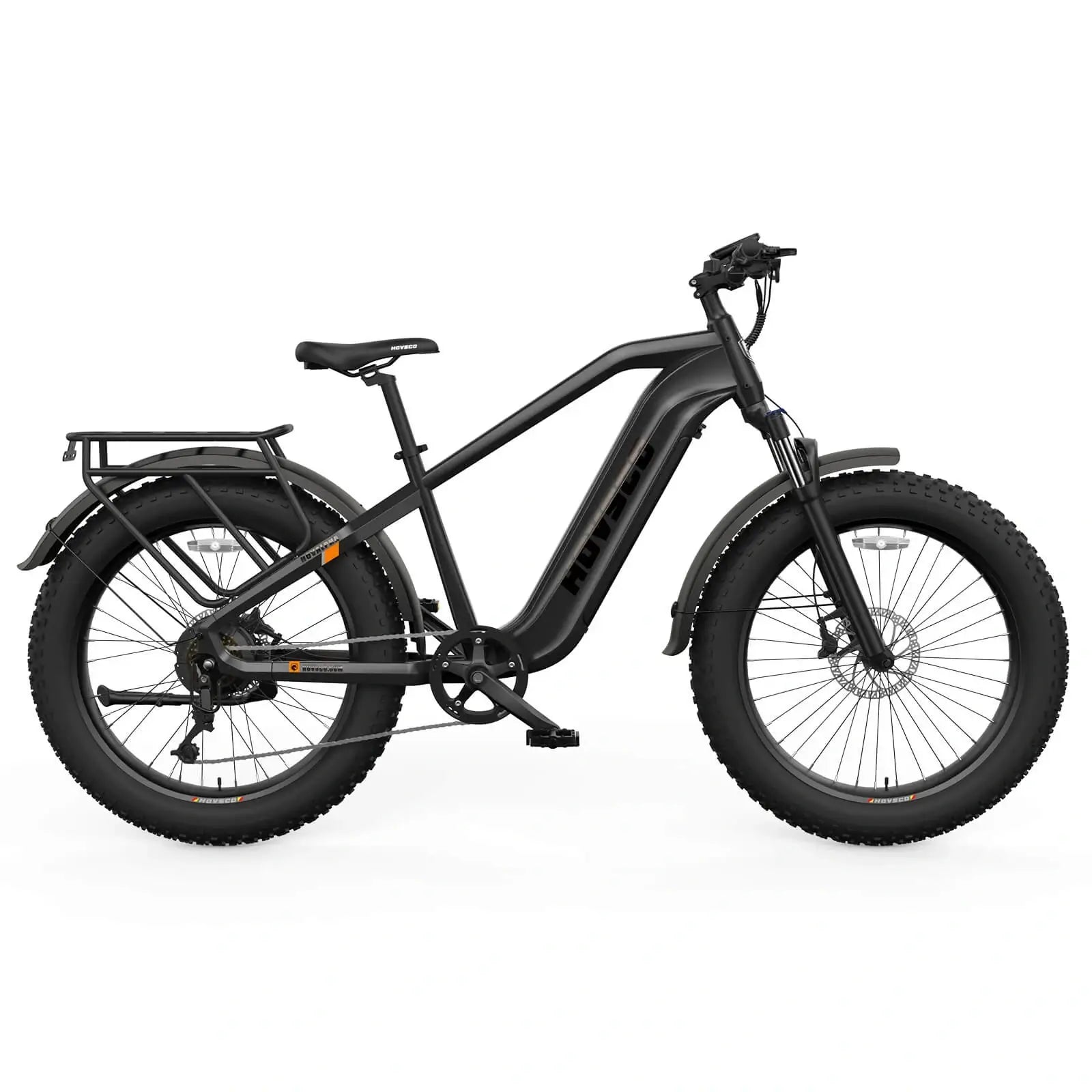
The weekend trail scout wants a bike that can handle off‑road weekends and still roll smoothly during the week. For them, HovScout offers suspension and tire choices that feel composed on rock gardens but not sluggish on bike paths. The commuter‑adventurer needed mounting points for fenders and racks without compromising suspension performance, so we reinforced frame sections where accessories attach and validated handling with real cargo on board.
Finally, the all‑season rider forced us to think about mud clearance, cable sealing, and brake performance in cold, wet conditions. I still remember test days where we deliberately rode through puddles and slush to see where grit accumulated. HOVSCO’s exploration focus meant we couldn’t treat those riders as edge cases; they are central to why the bike exists. When you never stop exploring, you need a bike that behaves like a tool, not a toy.
HovScout fits in HOVSCO’s exploration ecosystem as the multi‑scenario backbone—the bike that connects our city, cargo, and folding platforms into one “go anywhere” philosophy. It’s the tool you pick when you don’t know exactly where the day will lead.
Our cargo and family models focus on hauling people and gear through urban landscapes, while folding designs excel at mixed train‑and‑ride commutes. HovScout, by contrast, is built for when the pavement ends or when your route intentionally meanders off the map. In design reviews, we describe it as the frame that ties “from trails to tarmac” together; it shares electronics DNA with our urban bikes but stretches the geometry, suspension, and tires for more rugged scenarios.
From a practical standpoint, that means a HOVSCO owner can move between platforms without learning a new control language. Assist behavior, app integration, and maintenance philosophy remain consistent. HovScout simply occupies the end of the spectrum where the spirit of exploration is strongest—the one you choose when the question isn’t “Can I get there?” but “What new place can I reach today?”
Our hoverboard and e‑scooter experience has deeply changed how we build explorer e‑bikes by sharpening our instincts for safety margins, quality control, and rider behavior under stress. Small‑wheel, high‑torque platforms taught us lessons we now bake into every HOVSCO frame.
Early in our mobility journey, we saw how abrupt power delivery could unbalance riders, even at low speeds. That’s why our torque‑sensor tuning on HovScout is deliberately progressive; as you add pressure to the pedals, power follows your intent instead of surprising you. Years of managing compact battery packs also made us fanatical about cell quality, thermal management, and BMS logic. Those same disciplines now protect you when you push deep into remote trails with limited exit options.
On the mechanical side, handling the warranty and service side of hoverboards and scooters exposed every weak fastener and poorly sealed bearing imaginable. We chose not to repeat those mistakes. HOVSCO explorer bikes use corrosion‑resistant hardware in critical joints, grease channels where techs can actually reach them, and modular harnesses that can be swapped in the field. As someone who has turned those wrenches, I can say that our past in other devices is exactly why our e‑MTBs feel “overbuilt” in the best possible way.
An e‑bike can absolutely change how far and how often you explore by shrinking distances, flattening climbs, and lowering the “activation energy” needed to choose a ride over a drive. The right platform turns exploring from a rare event into a weekly habit.
Riders who once reserved long routes for special occasions often report that HOVSCO bikes make 20–30 km loops feel casual. Hills that used to require mental budgeting become non‑issues; you know the motor and battery are there to help you home. That psychological shift is as important as the watt‑hours on the downtube. Once barriers fall, curiosity takes over: “What if I add one more trail segment?” “What’s beyond that ridge?” It’s the natural expression of the spirit of exploration.
In our community, we see this in shared ride stories and photos. People who bought HOVSCO bikes for commuting end up posting about sunrise lookouts, gravel farm roads, or city‑to‑forest connections they never knew existed. The machine doesn’t create the explorer in you—but it removes enough friction that the explorer finally shows up more often.
“When we sketched the first HovScout concepts on the whiteboard, we wrote one sentence above everything: ‘Build this for the rider who never turns around at the first puddle.’ Every weld, suspension tune, and wiring decision was tested against that idea. If it didn’t help someone scout further—physically or mentally—it didn’t belong on the bike. Exploration is not a side effect for us; it is the design brief.”
HovScout carries the spirit of exploration so strongly because it was engineered from day one as a bridge between your everyday life and the unknown waiting beyond it. The bike embodies HOVSCO’s mission: make more people smile on rides that travel farther than yesterday, on routes they once thought were out of reach.
For riders, the actionable path is clear. Choose tools that match your curiosity: a stable full‑suspension fat platform, honest range, and durable components that won’t flinch when plans change. Maintain it like the long‑term companion it’s meant to be, and use it often—even for short trips—so exploration becomes routine, not rare. When you do, HovScout stops being just an e‑bike and becomes the vehicle for a more adventurous version of your daily story.
Is the HovScout only for advanced off‑road riders?
No, it’s designed for progressing riders—confident beginners through enthusiasts—who want extra stability and comfort while they expand their skills and routes.
Can I use a HOVSCO explorer bike for commuting and weekend trails?
Yes, that multi‑scenario use is exactly what we design for; add fenders and racks for weekday commuting, then strip down or re‑pack for weekend adventures.
Does full suspension make the bike harder to maintain?
There are more pivots to check, but quality bearings and hardware keep service intervals reasonable; most riders handle basic care with periodic shop visits.
Can an e‑MTB like HovScout replace my car for some trips?
For many riders, yes—especially medium‑distance errands, work commutes, and social visits where parking and traffic used to be barriers.
Are HOVSCO explorer bikes suitable for bikepacking and multi‑day rides?
With proper racks, bags, and route planning, they work very well for bikepacking; the motor lets you carry gear and still enjoy the scouting, not just the suffering.
Share:
How does 90Nm of torque really feel on an off-road ebike?
How can you ride a high-power ebike politely on shared trails?