





![[ New Arrival ] Porto Max Electric Scooter For Commute & Grocery Shopping - HOVSCO](http://www.hovsco.com/cdn/shop/files/PotroMax-3.jpg?v=1706927007&width=1200)
- by SteveJames
Which Folding E-Bike Fits a Small Space?
- by SteveJames
E-Bikes
Accessories
 Free Shipping
 15-Day Returns
 2-Year Warranty
Free Shipping
15-Day Returns
2-Year Warranty
2-Year Warranty
Free Shipping
15-Day Returns
2-Year Warranty
A folding e-bike for a small space should be chosen by stored footprint, lifting weight, battery design, and the riding capability you still need after it is unfolded. For apartments, condos, garages, and compact homes, HOVSCO’s HovBeta favors power and fat-tire capability, while the lighter Sync Max prioritizes a smaller, easier-to-handle indoor-storage format.
A folding e-bike can make ownership more practical when a full-size bike would block a hallway, consume a parking-space corner, or require outdoor storage. The real benefit is not simply that the frame folds; it is that the bike can be positioned more deliberately inside an apartment, closet-adjacent area, garage, storage room, or entry space.
For small-space buyers, there are two separate questions:
Can the bike physically fit where you intend to store it?
Can you safely move it into, out of, and around that storage space?
Those are not the same thing. A bike may fold compactly enough for a closet wall but still be too heavy for one person to lift over a threshold, carry up stairs, or reposition daily. Conversely, a light compact bike may be easy to store indoors but may not have the range, tire size, or payload needed for longer rides.
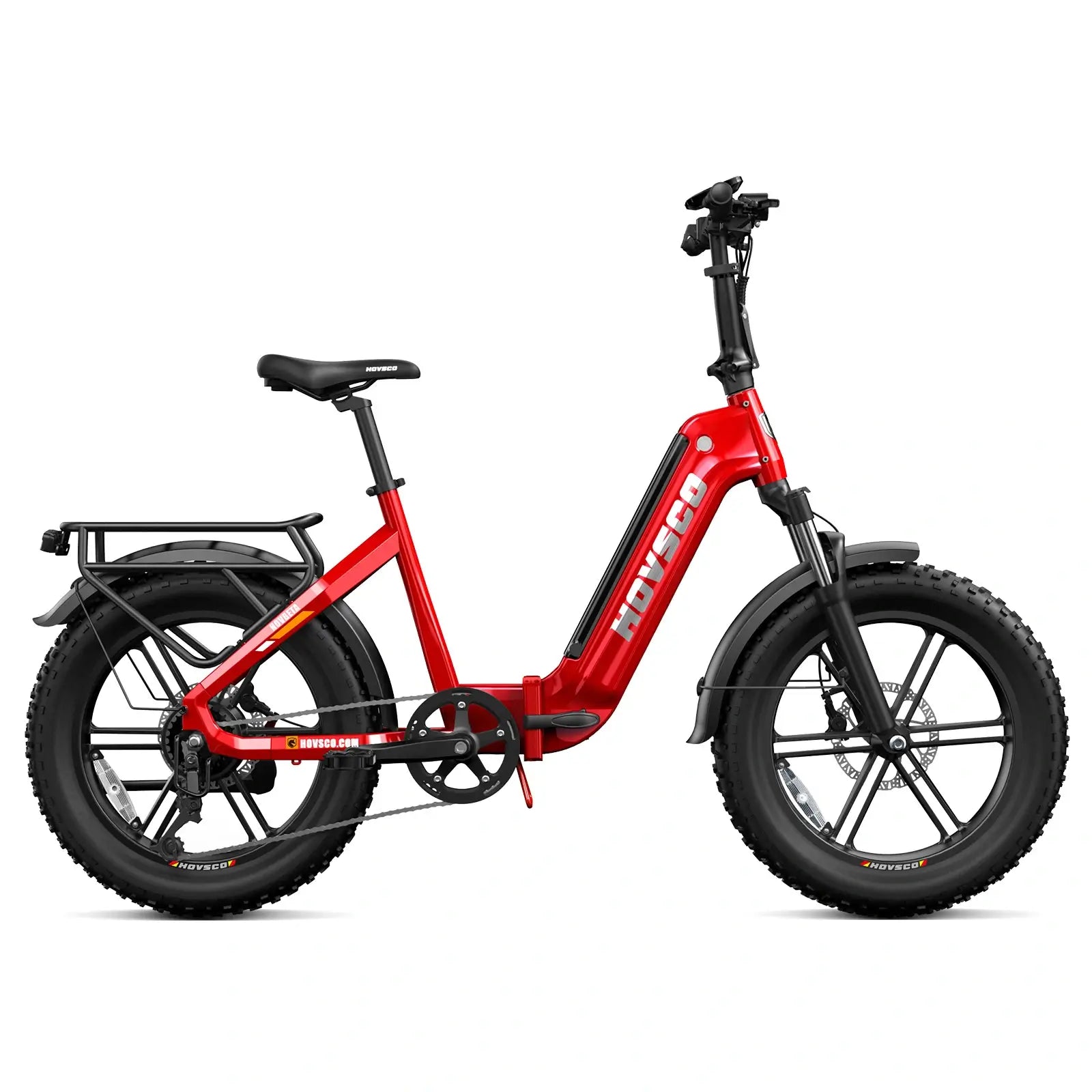
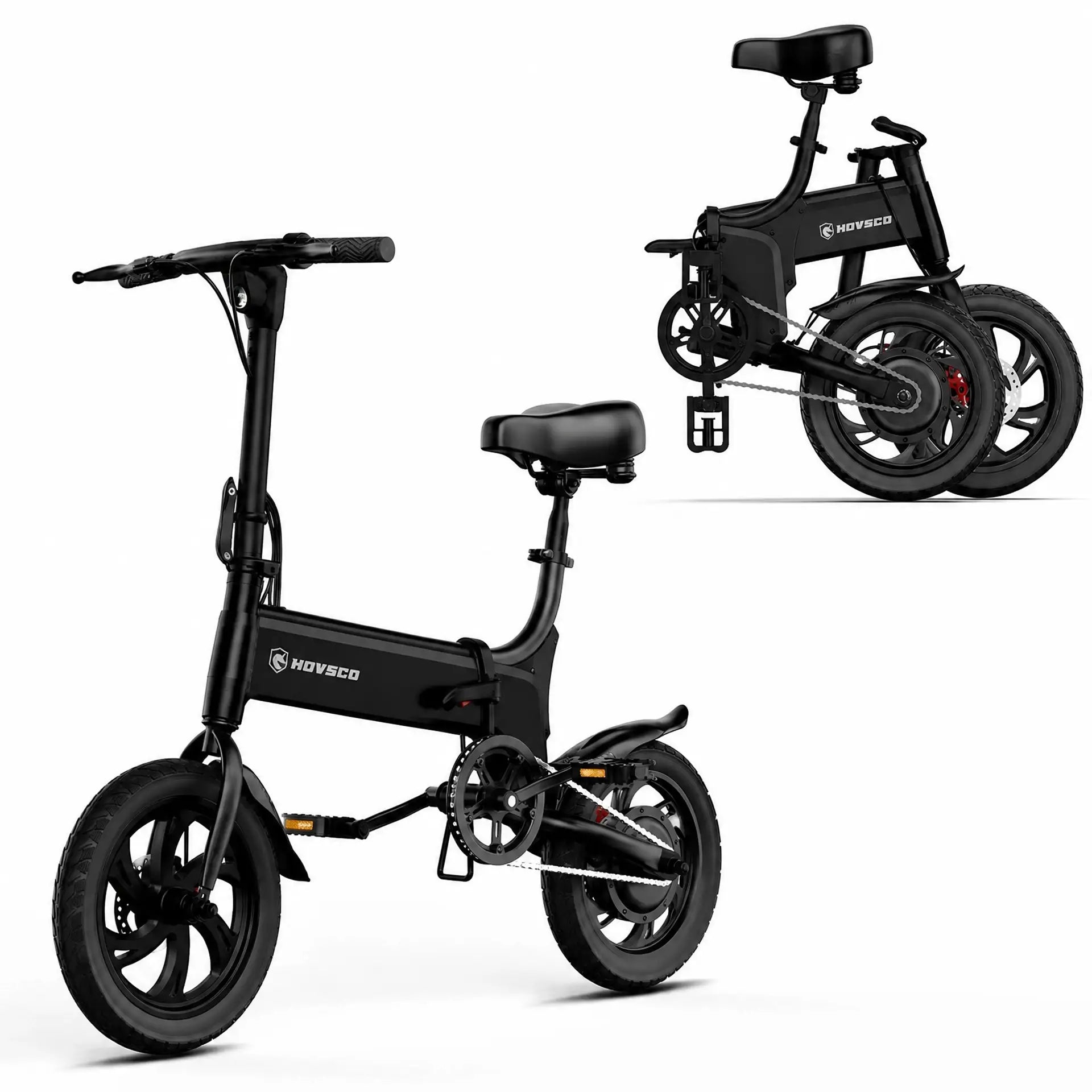
HOVSCO’s folding lineup shows this tradeoff clearly. The HovBeta is a 20-inch foldable fat-tire e-bike with a 1300W peak / 750W sustained rear hub motor, 20 x 4-inch tires, and a 720Wh removable battery. The Sync Max is a more compact 14-inch folding e-bike with a 450W sustained motor, a 36V 7.8Ah internal battery, and a listed net weight of 42.3 lbs.
For a small home or apartment, folding solves the floor-space problem only when the folded bike also fits your handling ability, doorway dimensions, and available charging location.
Measure the full storage route, not just the final storage corner. A folding e-bike may fit in a closet, but that does not help if it cannot pass through the apartment door, elevator, hallway turn, stair landing, or utility-room entrance needed to reach that closet.
Here is what I check first when evaluating a folding ebike for small spaces:
Measure the clear width of your entry door, apartment door, hallway, and any narrow turns.
Measure the depth, width, and height of the final storage area.
Check whether the bike must be lifted over stairs, curbs, thresholds, or a raised doorway lip.
Decide whether the bike will be stored folded vertically, leaned against a wall, or placed horizontally.
Identify a dry, temperature-moderate place where the battery can be charged according to the manufacturer’s instructions.
Leave room for the charger, helmet, lock, and any removable battery you plan to bring indoors.
This is where many buyers underestimate the difference between a compact folding frame and a genuinely easy-to-store bike. A 20-inch fat-tire folding e-bike retains wider tires, a larger battery, a stronger motor, and more robust components; that is useful on rougher roads, but those parts also affect total weight and the space the bike occupies when folded.
HOVSCO lists the HovBeta at 57.58 lbs without its battery and 66.4 lbs with the battery installed. Its removable 48V 15Ah battery can be taken off before lifting or storing the bike, which reduces the weight you handle in one piece. The HOVSCO Sync Max is listed at 42.3 lbs, making it the easier of the two to reposition in a tight apartment or garage storage area.
Measure the route first, then compare the folded bike’s real handling weight against what you can move comfortably and safely.
A lighter folding e-bike is generally easier to carry, pivot, and store in a small home, but lower weight can come with tradeoffs in battery size, tire diameter, payload, and rough-surface comfort. The right choice depends on whether your storage limitation is lifting effort, floor area, or both.
Weight matters most when you will regularly move the bike through a tight doorway, lift it over a threshold, or carry it up even a short set of stairs. In those conditions, every pound changes the experience because the bike is not only lifted; it also has to be balanced while folded.
There are three common small-space profiles:
Lightweight-first storage: Best for apartment residents who need to reposition the bike frequently. A smaller frame and lower total weight reduce the effort of moving it from a storage corner to an entryway.
Power-and-range-first storage: Best for riders who have a garage, ground-floor storage room, or secure indoor corner but still want a folding bike with stronger hill capability and more range.
Balanced storage: Best for riders with modest space who can roll rather than carry the bike most of the time. In this case, folded footprint matters more than total lifting weight.
The HOVSCO Sync Max is listed at 42.3 lbs with 14-inch tires, a 450W sustained motor, a 30-mile range, and a 260 lb maximum load. That specification profile makes sense when easy indoor handling is the primary requirement.
The HOVSCO HovBeta weighs 66.4 lbs with its battery installed, but removing its 720Wh battery reduces the listed bike weight to 57.58 lbs. In return for that extra mass, it adds a 1300W peak / 750W sustained motor, 20 x 4-inch tires, a 40–60 mile average range, and a 450 lb maximum payload capacity.
A lighter bike is better only if it still provides enough range, carrying capacity, and ride confidence for the trips you actually take.
For apartment and home storage, a removable battery offers more charging flexibility because you can charge the battery indoors without bringing the whole e-bike beside the outlet. An internal battery can keep the bike’s layout simple and compact, but it requires the bike itself to be placed near the charging location.
Battery design matters more in a small living space than many buyers expect. If your designated bike-storage location is a garage corner, shared building storage area, or entryway without a convenient outlet, removing the battery lets you charge it in a more suitable indoor location. It can also reduce the weight of the bike while you reposition it.
The tradeoff is convenience versus integration:
Removable battery: Easier to bring to the charging location and reduces the bike’s handling weight when removed. It also means you must keep track of the battery and its key.
Internal battery: Keeps the battery within the frame and may simplify daily handling, but charging requires access to the entire bike.
Larger battery: Extends potential range but adds battery mass and can make a folding e-bike less convenient to lift or reposition.
HOVSCO’s HovBeta uses a removable internal lithium-ion 48V 15Ah (720Wh) battery. Its included 54.6V 3-amp charger is listed with a 4-hour charging time. Because the battery is removable, an apartment resident can store the folded bike in a permitted indoor storage area while charging the battery separately in an appropriate dry location.
The Sync Max uses an internal 36V 7.8Ah lithium-ion battery and is listed with a 6-hour charging time. Its integrated battery supports its compact 42.3 lb design, but buyers should confirm that their planned storage area also gives them practical access to power.
For small-space storage, choose the battery format that matches where you can safely store the bike and where you can realistically charge it.
Smaller wheels and narrower overall bike proportions generally make a folding e-bike easier to place in a compact indoor area, while fat tires and suspension improve comfort and traction but create a bulkier, heavier package. The decision is not about which design is universally better; it is about whether your daily ride demands the added capability.
A 14-inch folding e-bike is fundamentally optimized for compactness. Its smaller wheels shorten the frame’s visual and physical scale, and its lower weight can make turning it through a narrow home entry easier. The tradeoff is that small wheels can feel more sensitive to broken pavement, potholes, and curb transitions than larger fat tires.
A 20-inch fat-tire folding e-bike occupies more space and weighs more, but it brings greater surface contact, added cushioning from tire volume, and a more stable feel over uneven pavement. A suspension fork adds another layer of comfort over cracks and rough surfaces, although it adds components and mass compared with a rigid fork.
HOVSCO’s HovBeta uses 20 x 4-inch e-bike-rated tires and a suspension fork with 45mm of travel and lockout. Its hydraulic disc brakes use 180mm rotors, and its torque sensor adjusts motor assistance in response to rider pedaling effort. Those features make sense for buyers who want small-space storage without giving up a more capable, full-size ride feel after the bike is unfolded.
The Sync Max uses 14-inch tires, a disc brake plus electronic brake system, and a listed 450W sustained motor. Its 30-mile range and 19 mph maximum speed align with shorter local rides where compact home storage matters more than fat-tire versatility.
The more demanding your road surface is, the more reason there is to accept a larger folded package; the smoother and shorter your rides are, the more valuable low weight and compactness become.
A folding e-bike is excellent for constrained storage, but it is not automatically the best choice for every rider. Folding mechanisms, larger batteries, wide tires, and strong motors can make a compact bike easier to store than a non-folding e-bike, while still leaving it too heavy or bulky to carry frequently.
Here is the honest limitation: a folding e-bike does not turn a 66 lb fat-tire bike into a lightweight carry object. The HovBeta folds to make indoor placement more manageable, but its 66.4 lb listed weight with the battery installed means buyers should expect to roll and position it where possible rather than plan on carrying it frequently through multiple flights of stairs.
Likewise, a lighter compact model is not automatically the better all-purpose bike. The Sync Max’s 42.3 lb weight makes it more manageable for constrained storage, but its 14-inch wheels, 260 lb maximum load, 450W sustained motor, and 30-mile listed range are designed around a different priority set than the HovBeta’s 20 x 4-inch tires, 450 lb payload rating, and 40–60 mile average range.
Consider these storage tradeoffs before deciding:
A foldable frame saves floor space but does not eliminate the need for a secure, dry storage location.
A removable battery can simplify charging and reduce lifting weight, but it creates a separate item to manage indoors.
Fat tires and a suspension fork improve comfort over imperfect surfaces but increase the size and weight of the stored bike.
A compact 14-inch model is easier to move around a home but may not be the right fit for riders who need more payload capacity or longer range.
A folding e-bike is not necessarily ideal for frequent stair carrying; measure the route and evaluate the actual listed weight before buying.
The best folding ebike for small spaces is the one you can store and move consistently without turning every ride into a lifting problem.
For home and apartment storage, the practical comparison is between HovBeta’s larger, more capable fat-tire format and Sync Max’s lighter, more compact format. HOVSCO offers both because “small space” can mean either limited floor area or limited ability to lift and maneuver the bike.
HOVSCO’s HovBeta is the better fit when a folding e-bike must still handle longer rides, heavier loads, uneven pavement, and more demanding terrain. Its 720Wh removable battery, 450 lb maximum payload rating, 20 x 4-inch tires, and 45mm suspension fork make it a more substantial bike that happens to fold.
HOVSCO’s Sync Max is the better fit when the storage challenge is primarily apartment maneuverability. At 42.3 lbs, with 14-inch tires, a 450W sustained motor, and a 260 lb maximum load, it is the more manageable option for buyers who value compactness over maximum range and fat-tire capability.
Use this decision checklist before choosing:
Start with the storage route. If you must carry the bike through a narrow entrance or up stairs frequently, prioritize the 42.3 lb Sync Max rather than assuming any folding e-bike will be easy to lift.
Check your actual floor area. If you can roll a bike into a garage, utility room, or ground-floor storage corner, the larger HovBeta may still be practical because folding reduces its storage footprint.
Match payload to your use. Choose HovBeta when you need the listed 450 lb maximum payload capacity; choose Sync Max only if its listed 260 lb maximum load fits your rider-and-gear total.
Match battery size to ride distance. HovBeta’s 720Wh removable battery and 40–60 mile average range better suit longer rides; Sync Max is listed for up to 30 miles.
Choose the ride feel you need. HovBeta’s torque sensor, hydraulic disc brakes, 20 x 4-inch tires, and 45mm suspension fork favor a more substantial ride; Sync Max favors a compact, lighter format.
Confirm the final storage-and-charging plan. Do not buy until you know where the folded bike will sit, where the battery will charge, and how you will move the bike between those two places.
To compare both formats in one place, visit HOVSCO’s folding electric bikes collection.
For small-space buyers, HOVSCO’s two folding formats address two different constraints rather than offering interchangeable versions of the same bike. HovBeta puts ride capability first, then adds a folding frame so a 20-inch fat-tire e-bike can be stored more flexibly. Sync Max puts compactness and lower handling weight first, then provides enough motor assistance and range for shorter local rides.
This is an important distinction when shopping by photos alone. A folded bike may look compact online, but the better real-world question is whether you will roll it, lift it, charge it, and store it comfortably in your own space. HOVSCO’s HovBeta provides a removable 720Wh battery and a listed 66.4 lb total weight, while Sync Max uses an internal 36V 7.8Ah battery and is listed at 42.3 lbs.
Neither approach is universally superior. HovBeta is not ideal for buyers who must carry a bike upstairs every day, while Sync Max is not the strongest choice for riders who need the HovBeta’s 450 lb load rating, 40–60 mile average range, or fat-tire ride characteristics.
The best folding electric bike for a small space is not simply the one with the smallest folded frame. It is the one that fits your storage route, your lifting ability, your charging setup, and your actual riding needs once you unfold it.
Measure every doorway, hallway, storage corner, and threshold before choosing a folding e-bike.
Prioritize lower total weight if you must lift or pivot the bike often inside an apartment or home.
Prioritize a removable battery if the bike’s storage location is not the same as its charging location.
Choose 14-inch compact wheels when indoor handling is the priority; choose 20-inch fat tires and suspension when ride comfort and capability matter more.
Treat a folding frame as a storage advantage, not a guarantee that a heavier e-bike will be easy to carry.
For a folding ebike for small spaces buying guide, HOVSCO’s Sync Max is the more compact, 42.3 lb option for indoor maneuverability, while HovBeta is the more capable 20-inch fat-tire option for buyers who can accommodate a 66.4 lb bike with its battery installed. Review the current specifications in the HOVSCO folding electric bikes collection after measuring your actual storage space.
Is a folding e-bike practical for a small apartment?
Yes, a folding e-bike can be practical for a small apartment when the folded bike fits through the entry route and can be stored in a dry, permitted location. The key is to measure your doorways, hallways, and storage area first, then compare those dimensions with the bike’s folded size and listed handling weight.
Is HOVSCO HovBeta too heavy for apartment storage?
HOVSCO lists HovBeta at 66.4 lbs with its battery installed and 57.58 lbs without the battery. It can work for ground-floor apartments, garages, or spaces where you can roll it into place, but it is less suitable if you must carry it up multiple flights of stairs regularly.
Which HOVSCO folding e-bike is easier to move indoors?
The HOVSCO Sync Max is easier to move indoors because its listed net weight is 42.3 lbs, compared with HovBeta’s 66.4 lbs with battery installed. Sync Max also uses 14-inch tires and has a 450W sustained motor, prioritizing compact storage and easier handling over HovBeta’s larger fat-tire format.
Can I remove the HovBeta battery before storing it?
Yes. HOVSCO lists HovBeta with a removable 48V 15Ah (720Wh) lithium-ion battery. Removing it reduces the bike’s listed weight from 66.4 lbs to 57.58 lbs and allows the battery to be charged separately in an appropriate indoor location.
Does a folding e-bike need less storage space than a standard e-bike?
Usually, yes. Folding the frame reduces the bike’s footprint and makes wall-adjacent, corner, closet-adjacent, garage, and utility-room storage more realistic. However, tire width, handlebars, pedals, battery placement, and total weight still determine whether the bike is genuinely easy to place and move in a small space.
Share:
How Do Folding Stem Latches Stay Rock Solid?
What Is the Best Folding E-Bike for Small Spaces?