
























![[ New Arrival ] Porto Max Electric Scooter For Commute & Grocery Shopping - HOVSCO](http://www.hovsco.com/cdn/shop/files/PotroMax-3.jpg?v=1706927007&width=1200)
- by SteveJames
What Is the Best Folding E-Bike for Small Spaces?
- by SteveJames
E-Bikes
Accessories
 Free Shipping
 15-Day Returns
 2-Year Warranty
Free Shipping
15-Day Returns
2-Year Warranty
2-Year Warranty
Free Shipping
15-Day Returns
2-Year Warranty
The best folding e-bike for small spaces is the one that fits your real storage path, lifting ability, daily distance, and local riding rules—not simply the one that folds. For compact urban storage, HOVSCO’s Sync Max emphasizes lower weight and a 14-inch format. For longer rides and rougher surfaces, the HOVSCO HovBeta adds 20 x 4-inch tires, suspension, and a larger 720Wh battery.
A folding e-bike only solves a storage problem if it can move through the doorway, elevator, hallway, vehicle opening, and final parking spot in your routine. Before comparing power or range, measure the entire route from outside to where the bike will rest.
Here is the nuance most buyers skip: the usable storage footprint is not just the folded bike’s dimensions. It also includes the space needed to turn the bike, open the folding mechanism, remove or charge the battery, and access a wall outlet without stretching a cable across a walkway.
For a small apartment, office, RV, or trunk, use this checklist:
Measure the narrowest doorway, elevator entrance, storage locker, and vehicle opening.
Measure the available floor space with room to unfold and move the bike safely.
Check whether the bike must go upstairs or over thresholds.
Confirm where charging will happen and whether the battery can be removed.
Consider the lock, helmet, charger, and any accessories as part of the storage footprint.
The HOVSCO Sync Max has a listed net weight of 42.3 lb and 14-inch tires, while the HOVSCO HovBeta weighs 66.4 lb including its battery and uses 20 x 4-inch tires; the difference matters when the bike must be carried or maneuvered in tight spaces.
Weight, wheel size, battery placement, tire width, and folding design matter more in an apartment than headline motor output alone. The best folding e-bike for small spaces should match the distance you ride while remaining manageable at the end of the trip.
A compact wheel size can make a folded package easier to place beside a desk or inside a vehicle, but smaller wheels also react more sharply to potholes and broken pavement. Larger fat tires can add cushioning and confidence on uneven surfaces, but they require more room and make the overall bike heavier to move.
Use the following tradeoffs as a buying filter:
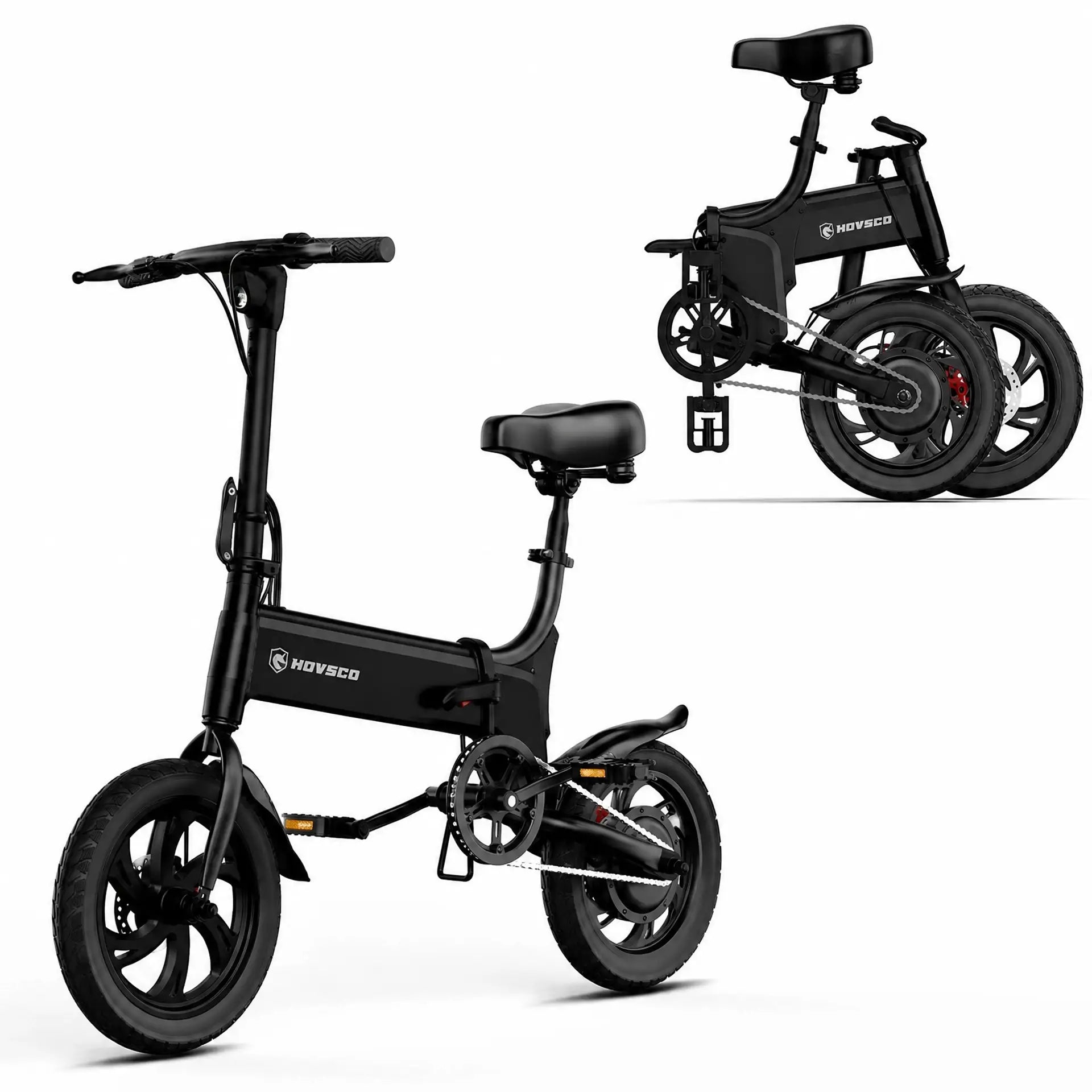
The HOVSCO Sync Max uses a 450W sustained motor, a 36V 7.8Ah internal battery, a listed 30-mile range, and a 260 lb maximum load, making it a compact option for shorter everyday trips where storage is the first constraint.
Choose range based on a complete round trip, not a one-way commute. Battery capacity and stated range matter, but rider weight, hills, wind, tire pressure, cargo, temperature, throttle use, and assist level can all change the result.
Battery capacity is measured in watt-hours, or Wh. It describes stored energy, while range describes how far the bike may travel under particular riding conditions. A larger battery usually supports longer rides, but it can also contribute to a heavier and less convenient bike for stairs, elevators, or frequent folding.
Compare the ownership question behind each range figure:
Short urban rides: Can the bike complete errands, transit connections, and the ride home without requiring a mid-day charge?
Longer commutes: Is there a dependable charging location at home, work, or another destination?
Cold conditions: Lithium-ion batteries commonly provide less practical range in cold weather, so avoid treating a maximum range figure as a guaranteed daily distance.
Hills and cargo: Higher assist and throttle use are useful when climbing or carrying a load, but they use stored energy faster.
The HOVSCO HovBeta has a removable 48V 15Ah battery rated at 720Wh and a listed 40–60 mile average range, depending on riding conditions and how much assistance is used.
A torque sensor can make pedal assistance feel more connected to how firmly the rider pedals. It is especially useful for riders who want assistance to build naturally when starting, climbing, or riding into wind rather than arriving at a fixed level once the pedals rotate.
A cadence sensor detects that the pedals are moving, while a torque sensor also responds to pedaling force. Neither is universally better: cadence sensing can suit relaxed, low-effort riding, while torque sensing often feels more intuitive to riders who want to modulate assistance through pedal pressure.
For a folding e-bike, sensor choice is only one part of the experience:
Choose a torque sensor if you value a more pedal-responsive feel.
Choose a compact model if lifting and indoor handling are the decisive issues.
Choose a larger-wheel, fat-tire format if surface comfort matters more than the smallest possible storage footprint.
The HOVSCO HovBeta uses a torque sensor rated at 90 N.m, 5 levels of pedal assist, and a throttle from a complete stop, giving riders multiple ways to manage assistance on mixed urban routes.
A folding fat-tire e-bike can work in a small space if the storage area and transport route can accommodate its weight and wider tires. It is not the best choice when the bike must be carried up several flights of stairs or placed into an exceptionally narrow storage space every day.
The tradeoff is between ride capability and physical footprint. HovBeta’s wider 20 x 4-inch tires and suspension fork are useful for uneven pavement, gravel, and rougher paths, yet those same features make it a more substantial object to lift, roll, and park than a compact 14-inch folding bike.
Here is what to check before choosing a fat-tire folding e-bike:
Whether the bike can be rolled all the way to storage rather than carried.
Whether its folded form clears doors, lifts, and vehicle cargo openings.
Whether there is stable floor space for a heavier bike.
Whether you need comfort on rougher surfaces often enough to justify the extra bulk.
Whether a removable battery makes indoor charging more practical.
The HOVSCO HovBeta combines 20 x 4-inch tires, a suspension fork with 45 mm travel and lockout, and hydraulic disc brakes with 180 mm rotors; it is a capability-focused folding bike rather than the most compact indoor-storage option.
Local laws, building policies, transit rules, and land-access rules can affect whether a folding e-bike works for your actual routine. Confirm these constraints before purchase, especially if the bike will be used on shared paths, public transit, or inside a managed residential building.
In general, Class 1 e-bikes provide pedal assistance up to 20 mph, Class 2 e-bikes may use throttle assistance up to 20 mph, and Class 3 e-bikes provide pedal assistance up to 28 mph. State and local rules can differ, and paths or transit systems may apply their own restrictions.
Ask these ownership questions:
Is e-bike storage permitted in the building or designated storage area?
Is battery charging allowed in the intended location?
Are e-bikes permitted on the routes and paths you plan to use?
Does the local rule distinguish between pedal assist, throttle operation, and speed capability?
Does your bus, train, elevator, or workplace have a separate policy for folded e-bikes?
The HOVSCO HovBeta product page lists a maximum speed of 28 mph after unlocking, so riders should follow the speed and access rules that apply where they ride rather than treating the bike’s capability as automatic permission.
HOVSCO offers two distinct folding approaches: Sync Max focuses on compact daily storage, while HovBeta focuses on longer range, larger tires, and more robust mixed-surface capability. The right choice depends on which limitation—space, lifting, distance, or terrain—appears most often in your week.
Follow this buying checklist:
Primary use: Pick Sync Max for compact, shorter everyday transport; consider HovBeta for longer routes and mixed surfaces.
Storage constraint: Measure every doorway, elevator, stair landing, trunk opening, and indoor parking space.
Typical load: Include rider weight, clothing, lock, bag, groceries, and accessories when assessing the rated payload.
Range need: Use the expected round-trip distance, hills, weather, cargo, and assist level to choose between 30 miles and 40–60 miles of listed range.
Assist feel: HovBeta’s torque sensor is suited to riders who want assistance to respond to pedal pressure; verify Sync Max sensor details on the product page.
Terrain: Choose the 14-inch Sync Max for compactness; choose HovBeta’s 20 x 4-inch tires and front suspension when rougher surfaces are a recurring part of the ride.
HOVSCO lists the Sync Max at 42.3 lb with a 260 lb maximum load, whereas HovBeta is listed at 66.4 lb including its battery with a 450 lb maximum payload; measure and lift-test your storage routine before deciding which tradeoff is acceptable.
The most useful folding e-bike checklist begins after the bike is folded: can it be moved, secured, charged, and parked safely without turning the end of every ride into a difficult task? That practical question prevents buyers from choosing more battery, wider tires, or higher power than their space can realistically support.
A folding e-bike is not always the right answer. A non-folding commuter e-bike may be the simpler choice if there is secure, ground-level bike storage and the rider values a full-size wheel format over compact storage. Likewise, a very compact folding e-bike may not be ideal for riders who regularly carry heavy cargo or ride broken roads.
HOVSCO’s HovBeta battery is removable, allowing riders to charge the 48V 15Ah battery away from the parked bike when that better fits their storage arrangement.
The best folding e-bike for small spaces is the one that fits the whole ownership routine: storage, carrying, charging, riding distance, terrain, and legal access.
Measure the narrowest point of your storage route before comparing specifications.
Match battery range to a round trip under real conditions, not just a published maximum.
Choose HOVSCO Sync Max when lower weight, 14-inch tires, and a listed 30-mile range match short, space-limited rides.
Choose HOVSCO HovBeta when a 720Wh removable battery, 40–60 mile average range, 20 x 4-inch tires, and front suspension match the route better.
Check local e-bike laws, transit policies, and building rules before ordering.
For a compact folding option, review the HOVSCO Sync Max. For a folding bike designed around longer range and mixed-surface capability, explore the HOVSCO HovBeta Foldable E-Bike. Buyers who need a non-folding city alternative can also browse the HOVSCO commuter e-bike collection.
What is the best folding e-bike for a small apartment?
The best folding e-bike for a small apartment is one that fits the doorway, elevator, hallways, storage location, and charging setup. HOVSCO Sync Max is the more compact option, with 14-inch tires, a 42.3 lb listed net weight, a 450W sustained motor, and a listed 30-mile range for shorter daily travel.
Is the HOVSCO HovBeta too heavy for apartment storage?
The HOVSCO HovBeta weighs 66.4 lb including the battery, so it may be less practical when daily carrying upstairs is required. It can fit a small-space routine better when it can be rolled to storage and when its removable 48V 15Ah battery, 20 x 4-inch tires, and 40–60 mile average range match the rider’s needs.
How much space does a folding e-bike need?
The required space depends on the bike’s folded dimensions, which should be verified on the product page, plus the clearance needed to move and unfold it. Measure the narrowest door, elevator, hallway, vehicle opening, and the parking area. Also leave accessible space for charging, locking, and safely handling the folded bike.
Can I charge a folding e-bike battery inside an apartment?
Charging suitability depends on building rules, the manufacturer’s instructions, and the availability of a safe indoor location. HOVSCO HovBeta has a removable 48V 15Ah battery, which can simplify charging away from the bike. Keep the charging area clear, dry, and appropriate for the equipment; do not run cables across walking paths.
Does the HOVSCO HovBeta have a torque sensor?
Yes. HOVSCO lists the HovBeta with a 90 N.m torque sensor, 5 pedal-assist levels, a 1300W peak and 750W sustained rear hub motor, and a maximum speed of 28 mph after unlocking. A torque sensor adjusts assistance in response to pedal force, which can feel more natural during starts and climbs.
Share:
Which Folding E-Bike Fits a Small Space?
Are Folding E-Bikes Good for Short Riders?