



![[ New Arrival ] Porto Max Electric Scooter For Commute & Grocery Shopping - HOVSCO](http://www.hovsco.com/cdn/shop/files/PotroMax-3.jpg?v=1706927007&width=1200)
- by SteveJames
How to Choose a Folding Electric Scooter?
- by SteveJames
E-Bikes
Accessories
 Free Shipping
 15-Day Returns
 2-Year Warranty
Free Shipping
15-Day Returns
2-Year Warranty
2-Year Warranty
Free Shipping
15-Day Returns
2-Year Warranty
To choose a folding electric scooter, match its folded dimensions and carrying weight to your daily route, then verify the hinge and locking system before comparing range, brakes, tires, and comfort. Felicity, Xander Max, and Porto Max illustrate three different portability trade-offs. Measure your car, stairs, doorway, and transit space instead of relying on “foldable” alone.
A folding electric scooter is genuinely portable when its folded size, net weight, carrying points, and locking system fit the owner’s real transport routine—not merely when the stem collapses. For most commuters, portability is determined by the heaviest lift of the day: stairs, a platform gap, a bus step, or the distance from a parking lot to a desk.
The first specification to check is net weight. A scooter weighing 30–35 lb may be manageable for frequent carrying, while a 40 lb-plus scooter can become tiring after several flights of stairs. However, lower weight often means smaller tires, less suspension, a smaller battery, or a lighter frame. Portability is therefore a system trade-off, not a race toward the lowest number.
Folded dimensions matter just as much. Check:
Folded length for a trunk, train luggage area, or under-desk storage.
Folded height for closets, shelves, and vehicle hatch openings.
Folded width for narrow aisles and public-transport storage.
Whether the folded scooter remains stable or must lie on its side.
The practical method I use is to measure the actual carry path before choosing. Record stair count, doorway width, elevator dimensions, trunk opening, and the distance you will carry the scooter. Then compare those measurements with the manufacturer’s folded-size diagram.
A model that fits the specification sheet but catches on a doorway is not portable in practice. This is why a natural starting point is the HOVSCO electric scooter collection, where shoppers can compare intended use and model specifications in one place.
Folded length usually matters most for car trunks and transit storage, folded height matters for closets and under-desk storage, and folded width matters in tight aisles. Always compare all three dimensions, including accessories such as a seat, basket, kickstand, or protruding brake controls.
A common mistake is to compare only folded length. A scooter may be short enough for a trunk but too tall for the hatch to close. Another may fit beneath a desk but be too wide to stand beside a train seat.
Use this simple fit test:
Measure the usable—not advertised—trunk opening.
Leave clearance for the handlebar, brake lever, and latch.
Measure diagonally if the scooter will lie across the trunk.
Include the charger, basket, or removable seat if you carry them.
Confirm whether the folded scooter can be secured without pressing the throttle or display.
The HOVSCO product pages currently publish detailed operating specifications for Felicity and Porto Max, but their accessible pages do not provide complete folded-dimension figures. Do not invent a dimension from a product photograph; request the current dimensional drawing before purchasing if vehicle or transit fit is decisive. The same caution applies to Xander Max.
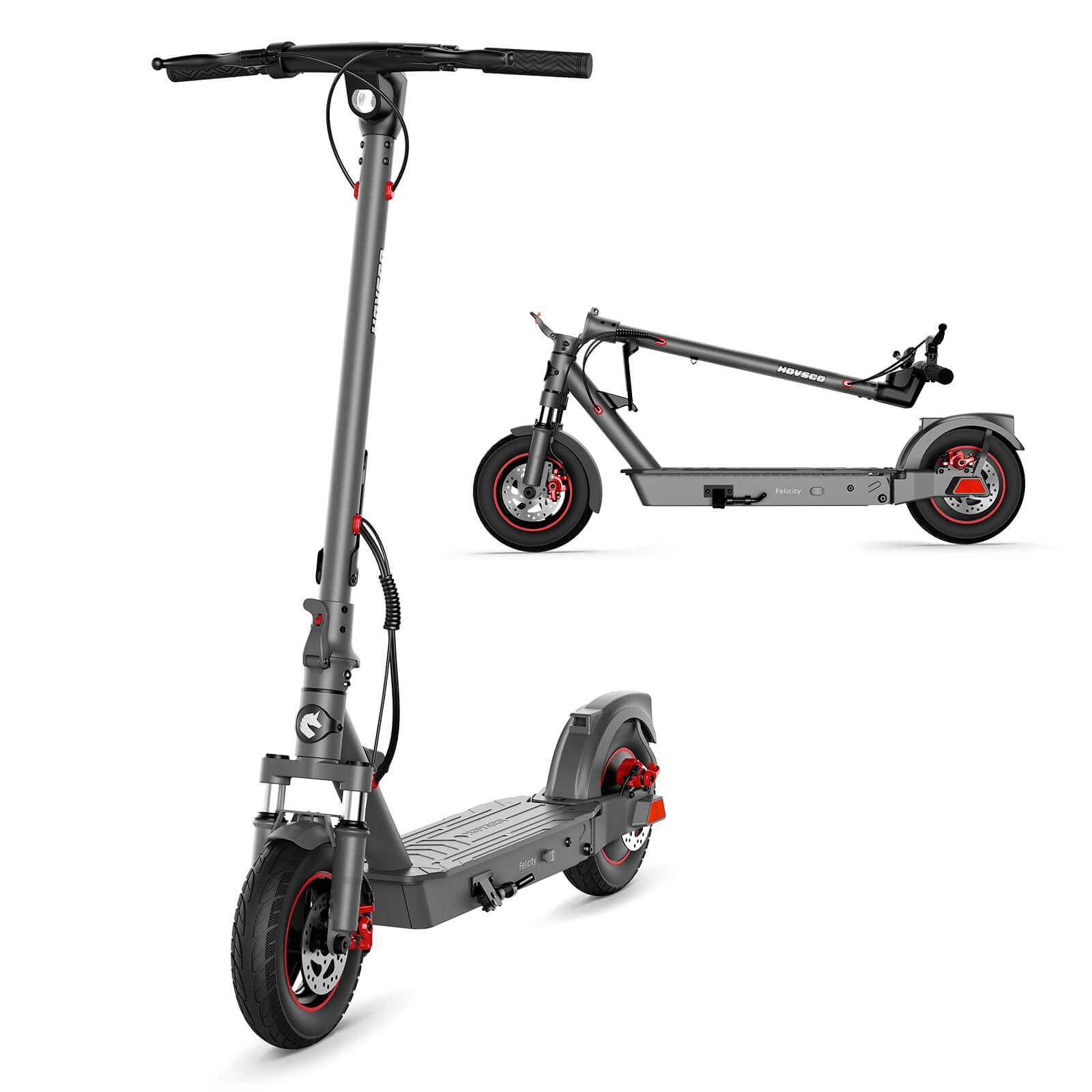
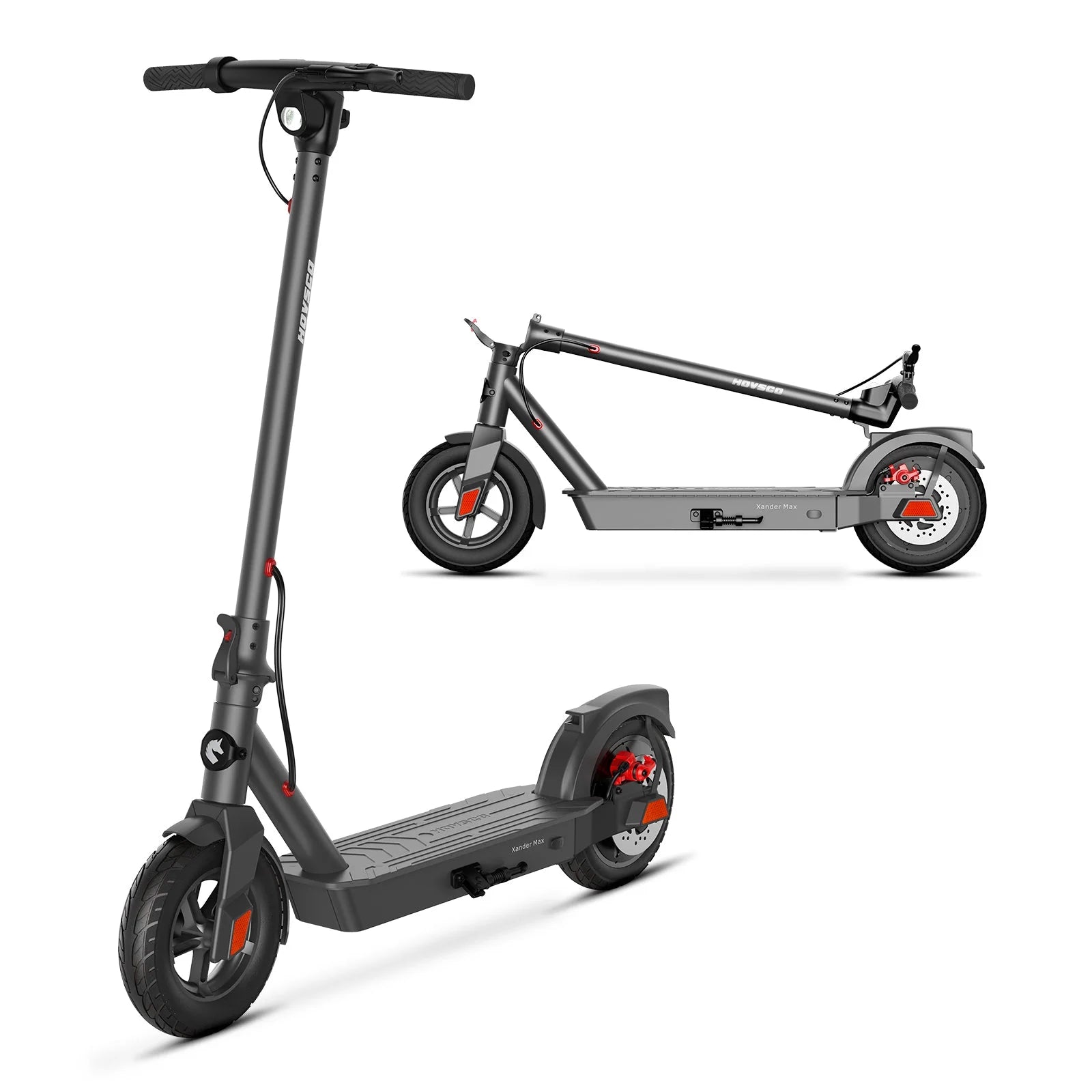
The three models show why portability must be judged against function. Felicity is listed at approximately 40.12 lb and includes dual suspension. Xander Max is listed at approximately 36.2 lb and omits suspension. Porto Max is listed at 43.1 lb, uses 12-inch tires, and includes a saddle and rear basket. Those published figures make Porto Max the least carry-oriented option, while Xander Max is the lightest of the three.
This is not a universal performance ranking. Larger tires can improve stability over cracks, while suspension can reduce impact transmitted through the stem. Conversely, every additional component adds mass or bulk. The right folding electric scooter is the one whose folded envelope matches your transport pattern.
Check the folding lock by inspecting both the riding-position latch and the folded-position capture. The stem should close without forcing, the latch should fully seat, and the folded scooter should not spring open when lifted. Any stem play, incomplete engagement, or rattling deserves attention before regular use.
A folding joint carries repeated loads from acceleration, braking, potholes, and steering. From a factory-floor perspective, the critical issue is not whether a latch clicks once; it is whether the hinge remains aligned after hundreds of cycles.
Look for:
A primary release lever plus a secondary safety catch.
A clear visual indication that the latch is fully engaged.
A metal hinge and protected pivot hardware.
No lateral stem wobble when the front wheel is held still.
A folded catch that retains the stem during carrying.
A release action that does not require excessive force.
Test the mechanism five times. Fold and unfold slowly, then repeat while wearing the gloves you normally use. Listen for inconsistent clicks and look for metal dust, uneven contact marks, or a latch that gradually shifts position.
Never ride with the stem partly folded or with a safety catch bypassed. If the mechanism becomes loose, stop riding and follow the manufacturer’s adjustment or service instructions. A lightweight scooter with a poor lock is less useful—and less safe—than a heavier scooter with a stable, repeatable hinge.
For daily carrying, approximately 30–35 lb is a practical target for many adults, while 40 lb or more is better treated as liftable rather than comfortably portable. Your strength, stairs, carrying distance, and whether the battery is removable should determine the limit.
Weight also affects how the scooter behaves. A heavier frame and larger wheel assembly can improve stability, but they increase the effort needed to lift it into a trunk or onto public transport. A lighter scooter may be easier to carry but transmit more vibration if it has smaller tires and no suspension.
Use a 20-second carry simulation before buying when possible:
Lift the scooter from floor to waist height.
Carry it with one hand and then with two hands.
Turn through a doorway.
Place it down without dropping the deck.
Repeat after walking several minutes.
Felicity’s approximately 40.12 lb weight may make more sense for riders who prioritize dual suspension and ride comfort over frequent stair carrying. Xander Max’s approximately 36.2 lb figure may better suit a commuter who wants a somewhat lighter package. Porto Max’s 43.1 lb weight, seat, and basket indicate an errands-oriented design rather than a train-to-office carry tool.
Do not compare weight without considering what is included. A bare scooter can look competitive until the seat, basket, lock, charger, and weather gear are added to the daily load.
Yes, a folding scooter can work well with a car or public transit when its folded dimensions, mass, and containment method match the transport provider and vehicle. Folding does not automatically make a scooter acceptable on every bus, train, or aircraft, so check local rules and carrier policies before travel.
For car use, protect the scooter from sliding and prevent the stem from unfolding. A folded latch is not necessarily a cargo tie-down point. Place the scooter so the display, brake levers, and charging port are not pressed against hard surfaces.
For public transit, the best setup is one that:
Folds quickly without tools.
Has a reliable folded-state catch.
Can be lifted without blocking the aisle.
Does not leak, scrape, or expose sharp accessories.
Fits within the operator’s luggage or mobility-device rules.
A basket and seat can make Porto Max useful for grocery trips, but they may increase the practical envelope when moving through a bus or station. Remove detachable accessories only if the process is quick and the parts can be secured.
For multi-modal commuting, calculate carrying time rather than only riding time. A 15-minute ride followed by a 10-minute stair carry may favor Xander Max over a heavier comfort-oriented option. A car-based shopper may accept Porto Max’s greater mass because the basket and larger tires solve a different problem.
Tires, suspension, and deck design change portability because they determine both the folded envelope and the ride forces the frame must manage. Larger pneumatic tires and suspension improve comfort over broken pavement, but they generally add weight, height, or mechanical complexity.
Ten-inch tires are a common compromise for urban scooters: they can roll over modest cracks while keeping the chassis reasonably compact. Twelve-inch tires, as listed for Porto Max, can provide a calmer ride over uneven surfaces, but they contribute to a larger rolling assembly and a heavier scooter.
Suspension should be evaluated with the folding hinge. Suspension may reduce sharp impacts reaching the rider, but it does not excuse a loose stem lock. On a scooter without suspension, tire pressure and tire construction become more important; underinflation may improve comfort but increase rolling resistance and pinch-flat risk.
The deck also matters. A short deck may fold compactly but leave less room for both feet. A longer deck can improve stability while making a car or transit fit more difficult. Stand on the scooter with your normal footwear and check whether your feet can adopt a comfortable staggered position without touching the rear fender.
This is an area where HOVSCO’s Felicity and Xander Max create a clear use-case split: Felicity lists dual suspension, while Xander Max is lighter but lists no suspension. The choice should follow the pavement and carrying route, not a generic “best” label.
Verify usable range, charging time, brake redundancy, weather rating, and local speed rules rather than relying on a maximum-range headline. Published HOVSCO specifications list a 36V, 10.4Ah, 374.4Wh internal battery and approximately six-hour charging time for Felicity and Xander Max.
Range claims are normally measured under controlled conditions. Cold temperatures, hills, rider mass, stop-start traffic, tire pressure, and wind can reduce real-world distance. Plan to keep a reserve instead of treating the advertised maximum as your daily target.
Braking deserves equal attention:
Mechanical disc braking provides a physical stopping system.
Electronic braking can add control and energy recovery.
Brake levers should be easy to reach while wearing gloves.
Cables and hoses should not be sharply bent by folding.
Test braking progressively before riding in traffic.
The product pages list a disc brake plus electronic brake for Felicity and Porto Max. They also list IPX5 water resistance for Felicity and a 15% approximate gradeability figure. Treat these as product specifications, not permission to ride through deep water or exceed local regulations.
A folding electric scooter should also have visible front and rear lighting for the times when the final part of a commute occurs after sunset. Carrying convenience is irrelevant if the scooter cannot be used safely on the route you actually travel.
Choose Felicity when ride comfort and suspension matter more than minimum carrying weight, Xander Max when lower weight is the priority, and Porto Max when stability, cargo capacity, and seated utility outweigh frequent lifting. Confirm folded dimensions and locking details for each model before making a final decision.
The practical profiles are:
Felicity: A comfort-focused urban option with 10-inch tires, dual suspension, approximately 40.12 lb net weight, a listed 30-mile range, and a 220 lb maximum load.
Xander Max: A lighter 10-inch option at approximately 36.2 lb, with no suspension listed, a 30-mile listed range, and a 220 lb maximum load.
Porto Max: An errands-focused scooter with 12-inch tires, a supplied saddle and rear basket, approximately 43.1 lb net weight, a 35-mile listed range, and a 260 lb maximum load.
The Porto Max’s detachable seat and removable basket are useful design features for grocery shopping, but they should be included in the transport calculation. A scooter may be technically foldable yet poorly suited to carrying into a crowded train once accessories and cargo are installed.
“When I evaluate a folding scooter, I do not start with the claimed range or motor peak. I start with the carry path. We measure the folded envelope, lift the actual production unit, cycle the latch repeatedly, and inspect whether the hinge stays aligned under load. The engineering compromise is straightforward: larger tires, suspension, seating, and cargo hardware improve utility, but they also increase mass and transport bulk. That is why Felicity, Xander Max, and Porto Max should not be treated as interchangeable. Select the platform that solves your hardest daily transition—stairs, trunk loading, station storage, or grocery transport—then verify the current drawing and safety instructions before purchase.”
Test a scooter by simulating the complete ownership routine: fold it, lift it, place it in the intended vehicle, unfold it, inspect the latch, and ride over the surfaces you encounter. Five fold cycles reveal more than a product photograph, while a short carry test exposes whether the listed weight is realistic for you.
Use this checklist:
Measure the folded scooter against your storage location.
Fold and unfold it five times.
Check for stem play in the riding position.
Lift it from floor level to trunk height.
Carry it through a doorway and around a corner.
Confirm the folded catch holds when the scooter is lifted.
Test both braking systems at low speed.
Inspect cable routing around the hinge.
Verify charger storage and charging-port access.
Read the local rules for sidewalks, bike lanes, transit, and lighting.
Ask the seller for the current folded dimensions if the online page leaves the size diagram blank. Also confirm whether the stated weight includes the battery and whether the seat or basket changes the folded configuration.
This verification step is especially important because model pages can change during production updates. A reliable buying decision uses the current manual, dimensional drawing, warranty terms, and service contact—not an old review alone.
Prioritize portability when you carry the scooter at least once per riding day, combine it with transit, live above ground level without convenient storage, or regularly load it into a vehicle. Prioritize comfort and cargo capacity when most trips begin and end at ground level and the scooter is rolled rather than lifted.
A useful decision rule is to rank your route’s hardest task:
Stairs: prioritize lower mass and a secure carry point.
Trunk loading: prioritize folded length, height, and latch retention.
Train or bus: prioritize compact width and quick folding.
Rough pavement: prioritize tires, suspension, and deck stability.
Shopping: prioritize payload and removable cargo accessories.
Long rides: prioritize realistic range and charging access.
Do not buy a high-performance scooter to solve a storage problem. Motor power and range cannot compensate for a scooter that remains in the closet because it is awkward to carry. Conversely, an ultralight model may disappoint if your route includes potholes, steep grades, or long stretches between charging opportunities.
The best way to choose a folding electric scooter is to match the complete folded package to your real transport routine. Compare folded length, width, height, net weight, hinge security, accessories, and the hardest lift before considering speed or range.
Use this final sequence:
Measure your trunk, closet, doorway, and transit route.
Set a realistic carry-weight limit.
Verify the unfolded and folded locking mechanisms.
Compare tires, suspension, deck space, brakes, and range.
Check the current manual, warranty, local rules, and service support.
Choose the model that removes your biggest daily obstacle.
Felicity, Xander Max, and Porto Max represent different priorities rather than a single winner. HOVSCO gives shoppers a useful starting range, but the most trustworthy decision comes from verifying the exact current configuration and testing the fold as you will use it.
Are folding electric scooters easy to carry?
Only when their weight and folded dimensions suit your route. A 36 lb scooter may be manageable for some commuters but tiring for repeated stairs, while a 43 lb utility model may be better rolled or transported by car.
Does a folding latch need a secondary safety catch?
A secondary catch is strongly preferable because it helps prevent accidental unfolding if the primary latch is not fully engaged. Always confirm the mechanism in the current manual and inspect it before every ride.
Can Porto Max be treated like a lightweight commuter scooter?
Porto Max is foldable, but its approximately 43.1 lb weight, 12-inch tires, saddle, and basket make it more suitable for utility and errands than frequent stair carrying.
Which is lighter, Felicity or Xander Max?
Xander Max is listed at approximately 36.2 lb, while Felicity is listed at approximately 40.12 lb. Felicity adds dual suspension, so the weight difference reflects a comfort-versus-portability trade-off.
What should I verify before ordering?
Verify current folded dimensions, total weight with the battery and accessories, latch operation, warranty coverage, delivery restrictions, charging requirements, and local regulations.
Share:
How to Choose an Electric Bike With Throttle
How Do You Choose a Folding E-Bike for RV Travel?