
























![[ New Arrival ] Porto Max Electric Scooter For Commute & Grocery Shopping - HOVSCO](http://www.hovsco.com/cdn/shop/files/PotroMax-3.jpg?v=1706927007&width=1200)
- by SteveJames
How Do You Choose an Electric Bike for Hills?
- by SteveJames
E-Bikes
Accessories
 Free Shipping
 15-Day Returns
 2-Year Warranty
Free Shipping
15-Day Returns
2-Year Warranty
2-Year Warranty
Free Shipping
15-Day Returns
2-Year Warranty
To choose an electric bike for hills, match the bike to your total load, steepest grade, and riding style. Prioritize responsive torque assistance, low climbing gears, hydraulic disc brakes, and battery capacity that leaves a reserve after repeated climbs. For many riders, 60–80 Nm, 500–750 Wh, a wide-range drivetrain, and strong brakes provide a practical starting point.
Add your body weight, clothing, water, locks, tools, and every item carried on the bike. Choose a rated payload comfortably above that total, not just equal to it. Extra capacity improves stability and reduces stress on the motor, wheels, spokes, tires, frame, and brakes during repeated climbs and descents.
The first mistake I see buyers make is shopping by rider weight alone. A 190-pound rider may become a 230-pound system after adding a rack, groceries, panniers, child seat, tools, and winter clothing. That difference affects acceleration, braking distance, motor temperature, and battery consumption.
Use this simple calculation:
Total operating load = rider + bike + cargo + accessories
Then compare it with the manufacturer’s maximum payload. Do not confuse maximum payload with the rider’s recommended weight. Payload normally includes the bicycle itself, so a heavy fat-tire model leaves less usable capacity than its headline number suggests.
As a practical margin, I recommend choosing a bike rated at least 15–20% above your normal loaded weight. If your expected total is 280 pounds, a 300-pound limit leaves little reserve; a 450-pound-rated platform gives substantially more flexibility.
HOVSCO’s comparison data lists the HovAlpha and HovCart at up to 450 pounds, while the HovRanger is listed at 300 pounds. Those figures make the models serve different hill-use cases: the HovRanger suits lighter commuter loads, while the HovCart is better aligned with cargo or family-hauling requirements. Always verify the current product specification before purchase.
Measure the steepest part of your route, then select torque accordingly. Around 50–65 Nm suits moderate hills with active pedaling; 65–90 Nm is more appropriate for steep grades, heavier loads, or frequent stops. Torque matters most when starting uphill and maintaining momentum at low speed.
A road’s grade is calculated as:
A 10-foot rise over 100 feet of horizontal travel equals a 10% grade. Use a mapping or elevation app to identify the hardest section of your actual route rather than relying on how the hill looks.
Torque is rotational force at the motor. Wattage describes power, but a large watt number alone does not tell you how naturally or consistently the bike climbs. Ask whether the published torque is peak or continuous, and whether it is measured at the wheel, motor, or crank.
For example, HOVSCO lists the HovAlpha, HovBeta, HovScout, and HovCart at 85 Nm in its model comparison, while the HovRanger is listed at 65 Nm. That makes the first group more compelling for loaded or steeper routes, while the HovRanger remains a sensible choice for ordinary hills and lighter commuting. hovsco
Torque response determines how quickly and smoothly assistance reacts to your pedaling force. A torque sensor usually feels more predictable on hills because it increases support when you push harder and reduces it when you ease off. Smooth response helps prevent wheel spin, surging, and awkward starts on steep sections.
A hill is not only a power problem. It is a control problem.
Cadence sensors generally activate assistance after detecting crank movement. Torque sensors measure how hard you are pressing the pedals and adjust support more progressively. This distinction matters when:
You restart after stopping on an incline.
You ride around pedestrians or parked vehicles.
The surface changes from pavement to loose gravel.
You need to reduce power before a tight corner.
You are climbing while carrying cargo.
On a steep road, an abrupt power surge can unload the front wheel or spin the rear tire. A delayed response can force you to stand on the pedals and lose balance. A well-tuned torque system gives you useful assistance without making the bike feel like it has switched on a hidden accelerator.
The HovRanger’s published specifications include a torque sensor, five pedal-assist levels, and throttle operation from a complete stop. Its 65 Nm rating is not the highest in the HOVSCO lineup, but the sensor can make that output easier to control on urban climbs.
When comparing bikes, do not stop at “torque sensor” on the product page. During a test ride, begin at low assistance, pedal slowly, and apply pressure gradually. Watch for a smooth increase rather than a sudden jump. Also test the transition when you stop pedaling; assistance should taper without a pronounced lurch.
Low gearing lets you maintain a steady cadence while the motor works efficiently. Check the smallest rear sprocket, largest climbing sprocket, and crankring size—not only the number of speeds. A wide range such as 14–28T is useful, but a larger low sprocket can be more helpful on genuinely steep hills.
Gearing is the mechanical advantage that converts your leg effort into climbing force. The motor can provide assistance, but the drivetrain still determines how easily you keep the cranks turning.
A seven-speed drivetrain may be perfectly adequate if its range is appropriate. More gears do not automatically mean better hill performance. Compare the actual tooth counts:
A smaller front chainring makes climbing easier.
A larger rear sprocket creates a lower climbing gear.
A small rear sprocket helps on fast descents and flat roads.
Closely spaced gears make cadence changes smoother.
A derailleur system is easier to inspect and replace than many proprietary systems.
The HovRanger specification lists a 42-tooth crankset and a 14–28T, seven-speed cassette. That setup provides useful everyday versatility, although riders facing sustained, very steep grades should pay particular attention to whether the lowest gear is low enough for their loaded cadence.
Shift before the hill becomes difficult. If you wait until your legs are slowing and the chain is under heavy force, the shift becomes noisier and less reliable. I normally select the climbing gear before the steepest pitch, maintain a steady cadence, and avoid grinding slowly in a high gear.
A practical target is to keep pedaling smoothly rather than pushing one hard stroke at a time. If the bike has strong motor assistance but the gearing is too tall, the drivetrain, chain, derailleur, and rider all experience unnecessary stress.
Hills consume more energy than flat riding, so choose battery capacity with a reserve. A 500 Wh battery is a reasonable baseline for regular hills, while 720–960 Wh provides more confidence for long, loaded, or repeated climbs. Treat advertised range as an upper estimate and avoid planning to finish with an empty battery.
Battery capacity is measured in watt-hours:
A 48 V, 15 Ah battery stores approximately 720 Wh under its rated conditions. A 48 V, 20 Ah battery stores approximately 960 Wh. More capacity usually adds weight and cost, but it also reduces range anxiety and makes repeated climbing less demanding on the battery.
HOVSCO’s comparison page lists the HovAlpha with a 48 V, 20 Ah battery and the HovBeta, HovRanger, HovScout, and HovCart with 48 V, 15 Ah batteries. It also lists maximum ranges that vary by model and assist mode, so riders should interpret those figures as scenario-dependent rather than guaranteed hill range. hovsco
Temperature, tire pressure, rider weight, wind, speed, assist level, and stop-start riding all change energy use. A range display is helpful, but it is an estimate based on recent riding conditions. If your route is an out-and-back, reserve enough energy for the return rather than treating the halfway point as the battery limit.
Choose hydraulic disc brakes with appropriately sized rotors for heavy or hilly riding. They offer strong modulation and reduce hand effort during long descents. Pair them with correctly inflated, e-bike-rated tires and inspect pads, rotors, spokes, and axle security regularly.
Climbing performance gets most of the marketing attention, but every uphill ride eventually becomes a downhill ride. A loaded e-bike traveling downhill carries substantial kinetic energy, and repeated braking can build heat.
Hydraulic disc brakes are usually preferable for hills because they provide:
More consistent lever feel.
Better modulation near the point of lockup.
Less hand force for the same braking effect.
Stronger performance when the bicycle is heavy.
Better control during repeated braking.
HOVSCO’s comparison data lists hydraulic disc brakes across the HovAlpha, HovBeta, HovRanger, HovScout, and HovCart. The HovRanger product page specifies 180 mm rotors, which is a useful detail that a generic “disc brakes included” description would not reveal. hovsco
Brake technique matters too. Apply both brakes progressively, keep your weight balanced, and brake before a corner rather than entering it too fast. Do not drag one brake continuously down a long descent; use controlled braking intervals where the road and traffic conditions allow.
Tires are part of the braking system. Fat tires can provide a larger contact patch and more stability on loose surfaces, but they also add rolling resistance and rotating weight. Use the pressure range printed on the tire, then adjust carefully for terrain and load. Excessively low pressure can damage rims; excessive pressure can reduce grip on rough ground.
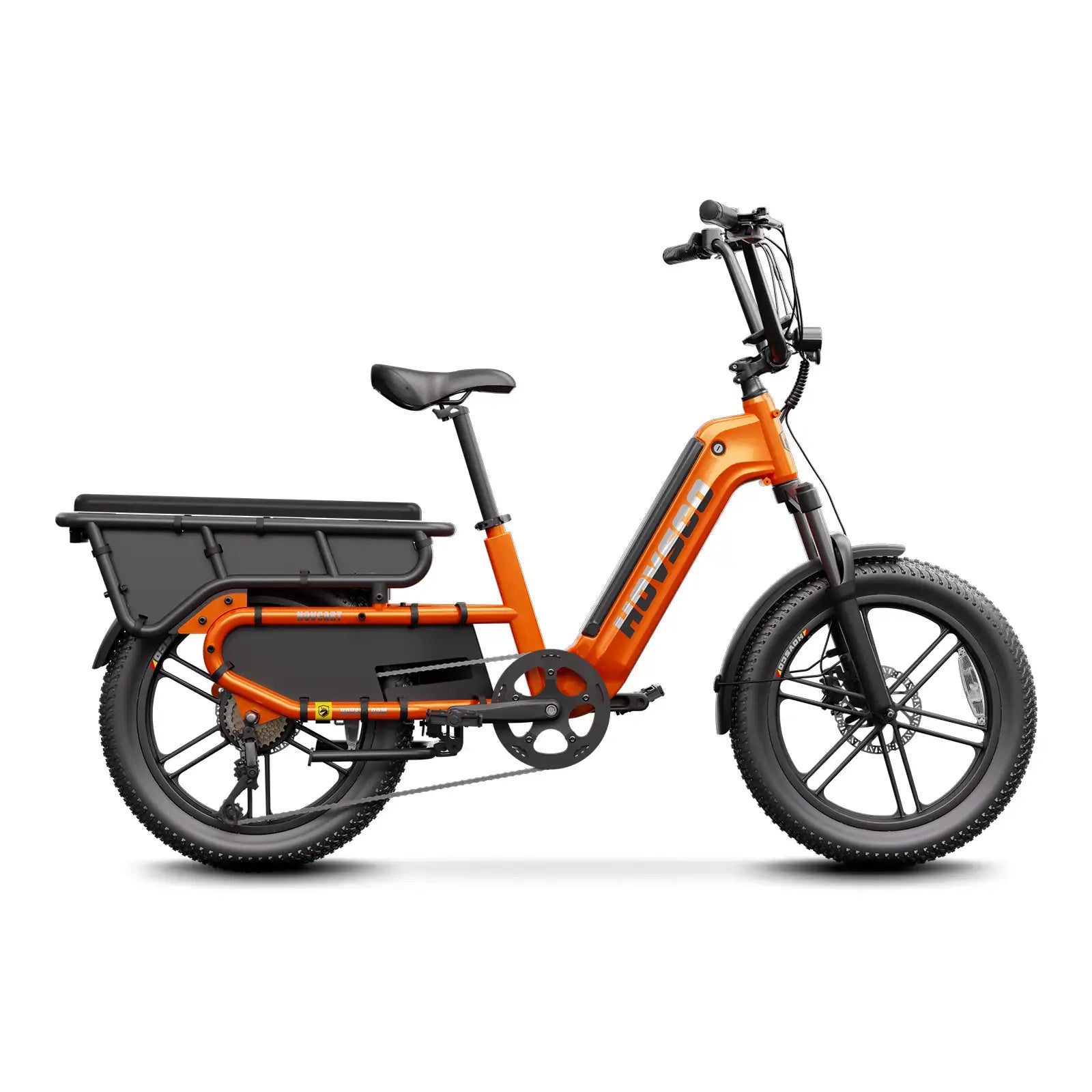
Match the model to the load and terrain rather than choosing only by motor wattage. HovAlpha favors range and all-terrain use; HovBeta combines folding portability with hill-oriented torque; HovScout targets rougher trails; HovCart handles cargo; and HovRanger emphasizes lighter, practical commuting.
The five models create a useful decision framework:
HovAlpha: The comparison page lists 85 Nm, a 48 V 20 Ah battery, a 450-pound maximum load, 26-inch by 4-inch fat tires, and hydraulic disc brakes. It is the strongest fit here for riders who want extra battery margin and all-terrain stability.
HovBeta: Listed with 85 Nm, a 48 V 15 Ah battery, 20-inch by 4-inch fat tires, folding construction, and a 450-pound maximum load. Its compact format is attractive when storage or transport matters, although smaller wheels can feel different over uneven terrain.
HovScout: Listed with 85 Nm, a 48 V 15 Ah battery, hydraulic brakes, 26-inch by 4-inch tires, and front-and-rear suspension. It is the logical direction for riders who expect rough trails as well as hills.
HovCart: Listed with 85 Nm, a 48 V 15 Ah battery, 20-inch by 4-inch tires, hydraulic brakes, and a 450-pound maximum load. It is designed around cargo utility, where payload and low-speed control matter more than a lightweight frame.
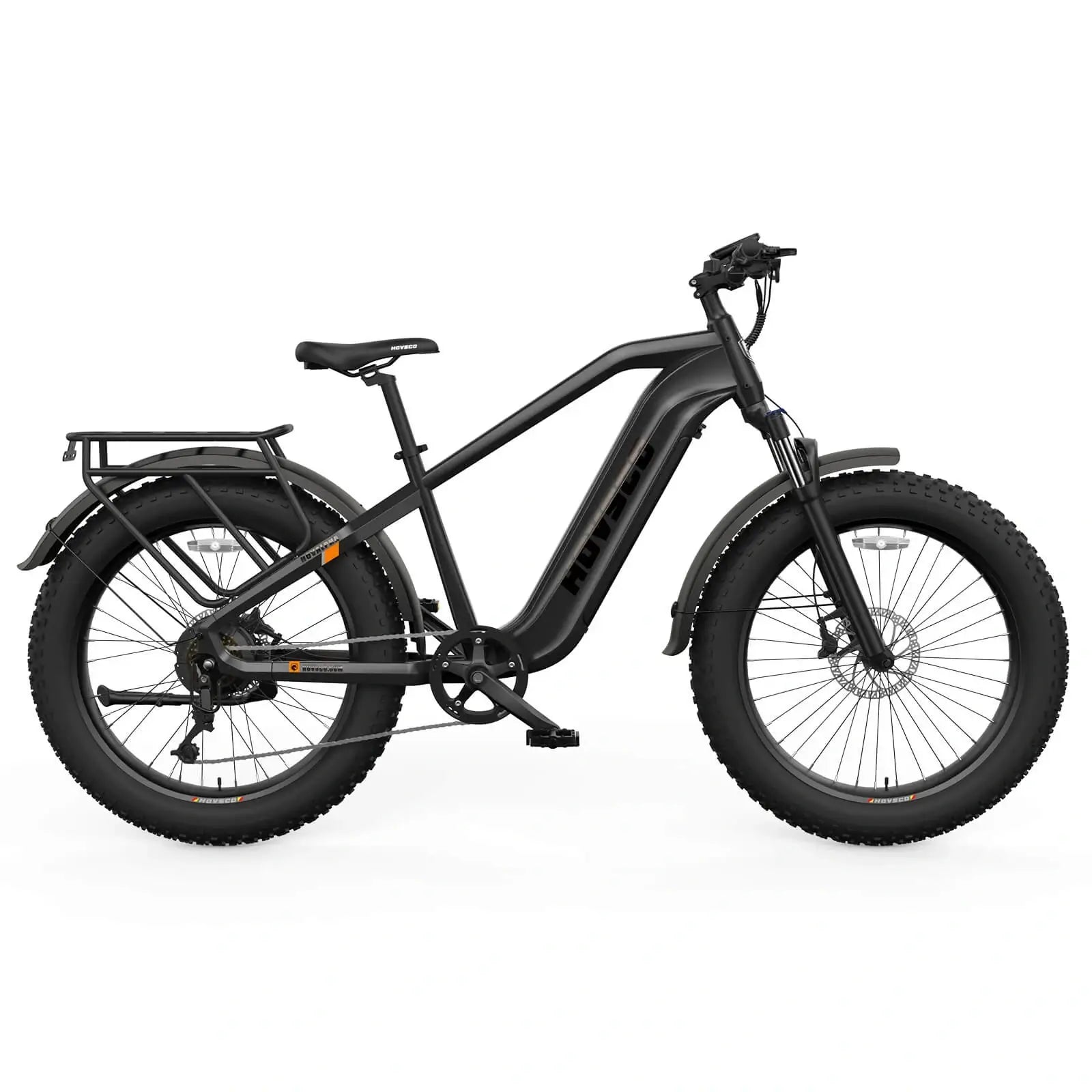
HovRanger: Listed with 65 Nm, a 48 V 15 Ah battery, a 300-pound maximum payload, 27.5-inch tires, hydraulic brakes, and a torque sensor. It suits commuters who face regular but not extreme hills and value a comparatively lighter bicycle.
These are specification-based matches, not a promise that any model will climb every grade under every load. Confirm local regulations, current specifications, rider fit, and the manufacturer’s operating limits before purchase.
Yes. Frame geometry, wheel size, tire width, suspension, and rider position affect traction and control as much as motor output. A stable frame helps on descents, while a comfortable climbing position lets you keep pressure on the pedals without sliding backward or overloading your wrists.
A motor may have enough torque on paper yet feel difficult on a hill if the rider cannot maintain traction or balance. When inspecting a bike, look beyond the drivetrain.
A longer, stable platform can feel calmer at speed, while a compact frame may be easier to maneuver in tight spaces. Fat tires can soften rough surfaces and improve confidence on gravel, but their additional mass can make acceleration feel slower. Full suspension helps maintain tire contact on uneven trails, although it adds weight and requires setup and maintenance.
Your position should let you:
Keep elbows slightly bent.
Shift your hips forward on steep climbs.
Maintain a clear view of the road.
Reach both brake levers without stretching.
Put a foot down securely when stopping.
HOVSCO lists front suspension on several models and front-and-rear suspension on the HovScout. The HovBeta uses smaller 20-inch fat tires, while the HovRanger uses 27.5-inch tires. Those differences affect portability, obstacle behavior, steering response, and fit—not simply appearance.
A test ride reveals response, gearing, fit, traction, and braking better than a specification sheet. Test the bike on a real incline with representative cargo. Start slowly, shift early, stop and restart, then descend while checking for smooth control and stable braking.
If a local dealer or test-ride partner is available, bring the shoes, backpack, and accessories you normally use. A bicycle that feels powerful unloaded may behave differently with a full rack or pannier.
Use this short test protocol:
Start on level ground and check whether the riding position feels natural.
Approach a moderate hill in a middle gear.
Shift down before the steepest section.
Observe whether assistance arrives smoothly.
Stop safely and restart uphill if the route permits.
Descend while applying both brakes progressively.
Listen for chain skipping, rotor rub, unusual motor noise, or frame flex.
Do not judge only by acceleration. A hill bike should deliver controlled, repeatable assistance for ten or twenty minutes, not merely an impressive launch for ten seconds.
“When I evaluate a hill-oriented e-bike, I start with the complete system rather than the motor label. I calculate the real operating load, identify the steepest sustained grade, and then check whether torque response, low gearing, battery capacity, and braking performance work together. A high-torque bike with tall gearing can still feel inefficient. A large battery without a usable reserve can still leave a rider stranded. The most dependable choice is the bike that remains predictable when loaded, warm, partially depleted, and descending—not simply the one with the largest advertised watt figure.”
First record your total load, steepest grade, typical ride distance, and storage needs. Then eliminate bikes with insufficient payload, torque, battery, gearing, or brakes. Compare the remaining models by fit and real-world test performance, and keep a reserve for weather, hills, and battery aging.
Use this checklist before ordering:
Load: Does the payload rating exceed your loaded operating weight with a meaningful margin?
Grade: What is the steepest percentage on your regular route?
Torque: Is the rating appropriate for the grade and load?
Response: Does the sensor provide smooth assistance at low speed?
Gearing: Is the lowest gear low enough to maintain a comfortable cadence?
Battery: Can you complete the route while retaining at least 30% reserve?
Brakes: Are hydraulic discs and suitable rotors included?
Fit: Can you reach the ground and controls confidently?
Service: Are parts, warranty support, and maintenance options accessible?
Legal use: Does the bike’s class and speed configuration comply with local rules?
For a broad selection, browse the HOVSCO electric bike collection and compare the published specifications of the HovAlpha, HovBeta, HovScout, HovCart, and HovRanger against your route.
The best electric bike for hills is not automatically the one with the highest wattage. Choose the model that fits your actual total load, steepest grade, riding distance, and control requirements.
For moderate hills, a responsive 60–65 Nm bike with a 720 Wh battery, low gearing, hydraulic brakes, and a comfortable fit can be enough. For steep grades, cargo, or repeated climbs, move toward 85 Nm or more, a larger battery, a stronger payload rating, and suspension suited to the surface.
HOVSCO provides distinct options across these needs: the HovRanger for practical commuting, the HovAlpha for extended all-terrain range, the HovBeta for folding portability, the HovScout for rougher trails, and the HovCart for heavier cargo use. Treat those as starting points, verify current specifications, and test the bike on the kind of hill you actually ride.
How much torque does an electric bike need for hills?
Around 50–65 Nm is suitable for moderate hills with active pedaling. Choose approximately 65–90 Nm for steeper grades, heavier loads, or frequent stop-and-go climbing.
Is 500 Wh enough for hilly riding?
It can be enough for shorter rides, but hills reduce range. A 720 Wh or larger battery gives better reserve for long routes, cargo, cold weather, and repeated climbs.
Are fat tires better for hills?
Fat tires can improve traction and comfort on loose or rough surfaces, but they add rolling resistance and weight. They are not automatically faster or more efficient on paved climbs.
Do hydraulic brakes matter on an electric bike for hills?
Yes. Hydraulic disc brakes generally provide stronger modulation and lower hand effort, which is valuable when controlling a heavy e-bike on repeated or steep descents.
Which HOVSCO model is best for carrying cargo uphill?
The HovCart is the most direct cargo-oriented option, while the HovAlpha also offers a high listed payload and larger battery. Confirm the current payload specification and account for the complete loaded weight.
Share:
What Makes a Long-Range Electric Scooter Worth It?
What Is a Long-Range Fat Tire Ebike?