


![[ New Arrival ] Porto Max Electric Scooter For Commute & Grocery Shopping - HOVSCO](http://www.hovsco.com/cdn/shop/files/PotroMax-3.jpg?v=1706927007&width=1200)
- by SteveJames
How Do Full Suspension and Fat Tires Deliver Absolute Off-Road Traction?
- by SteveJames
E-Bikes
Accessories
 Free Shipping
 15-Day Returns
 2-Year Warranty
Free Shipping
15-Day Returns
2-Year Warranty
2-Year Warranty
Free Shipping
15-Day Returns
2-Year Warranty
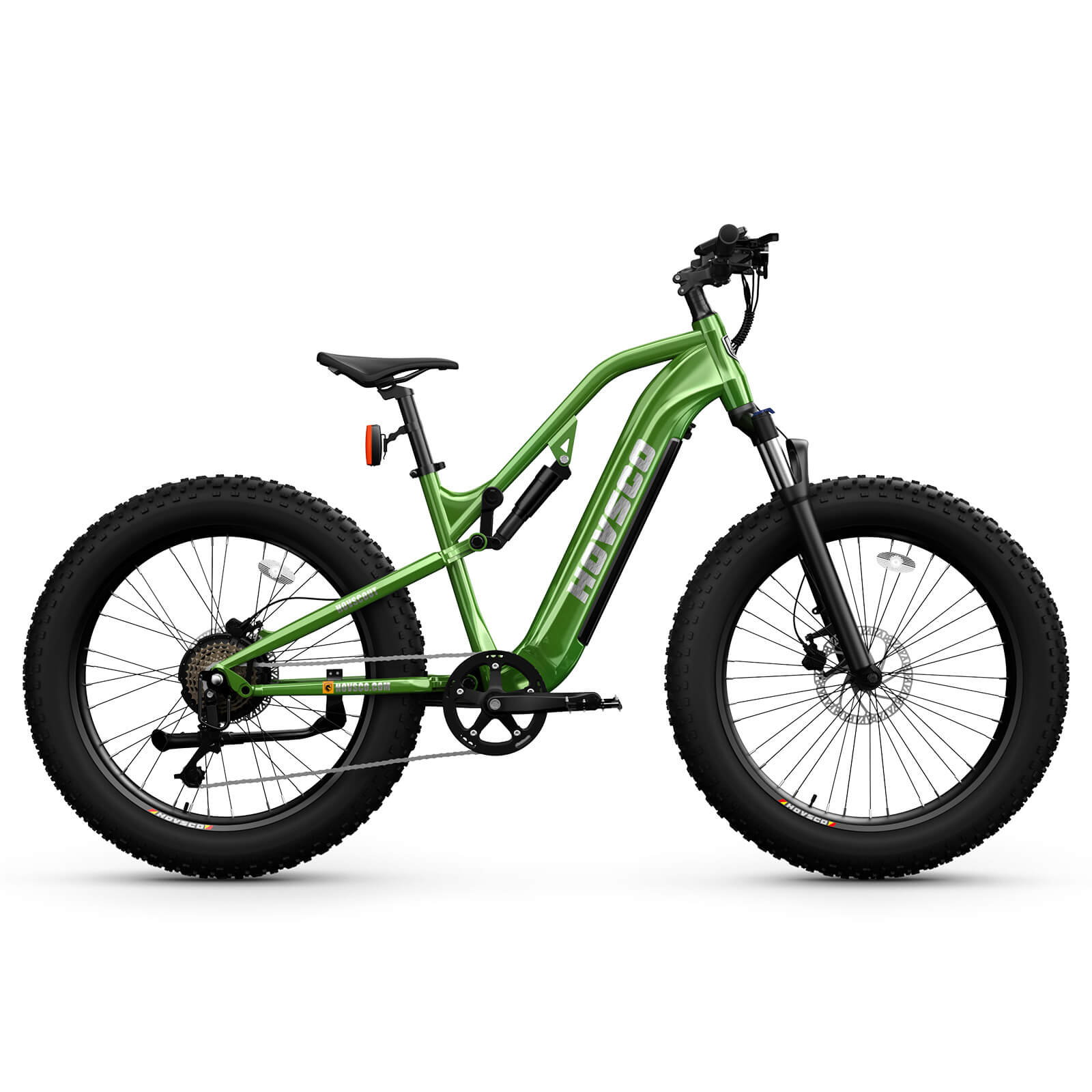
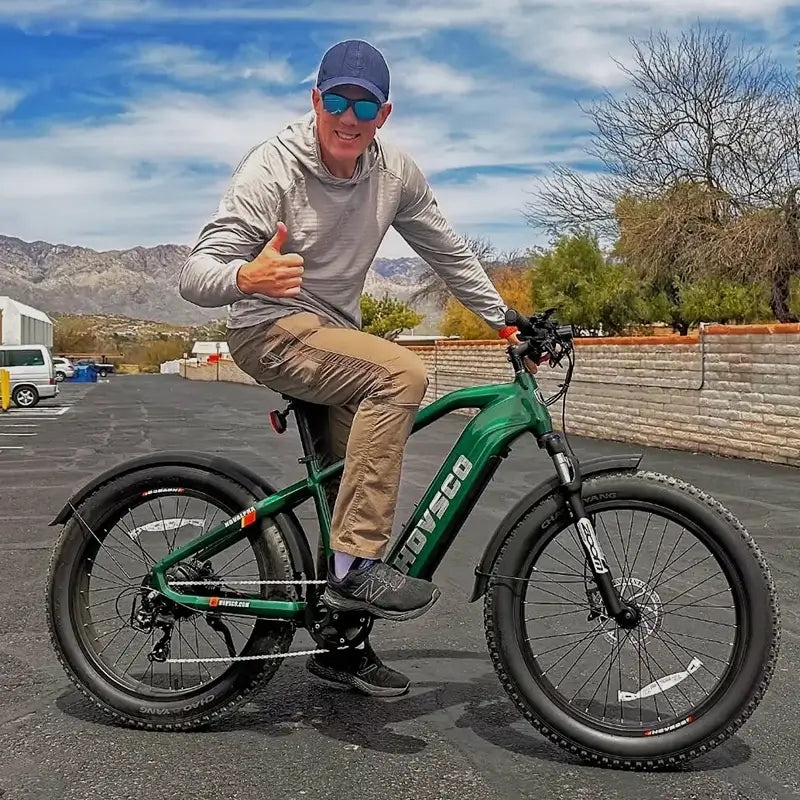
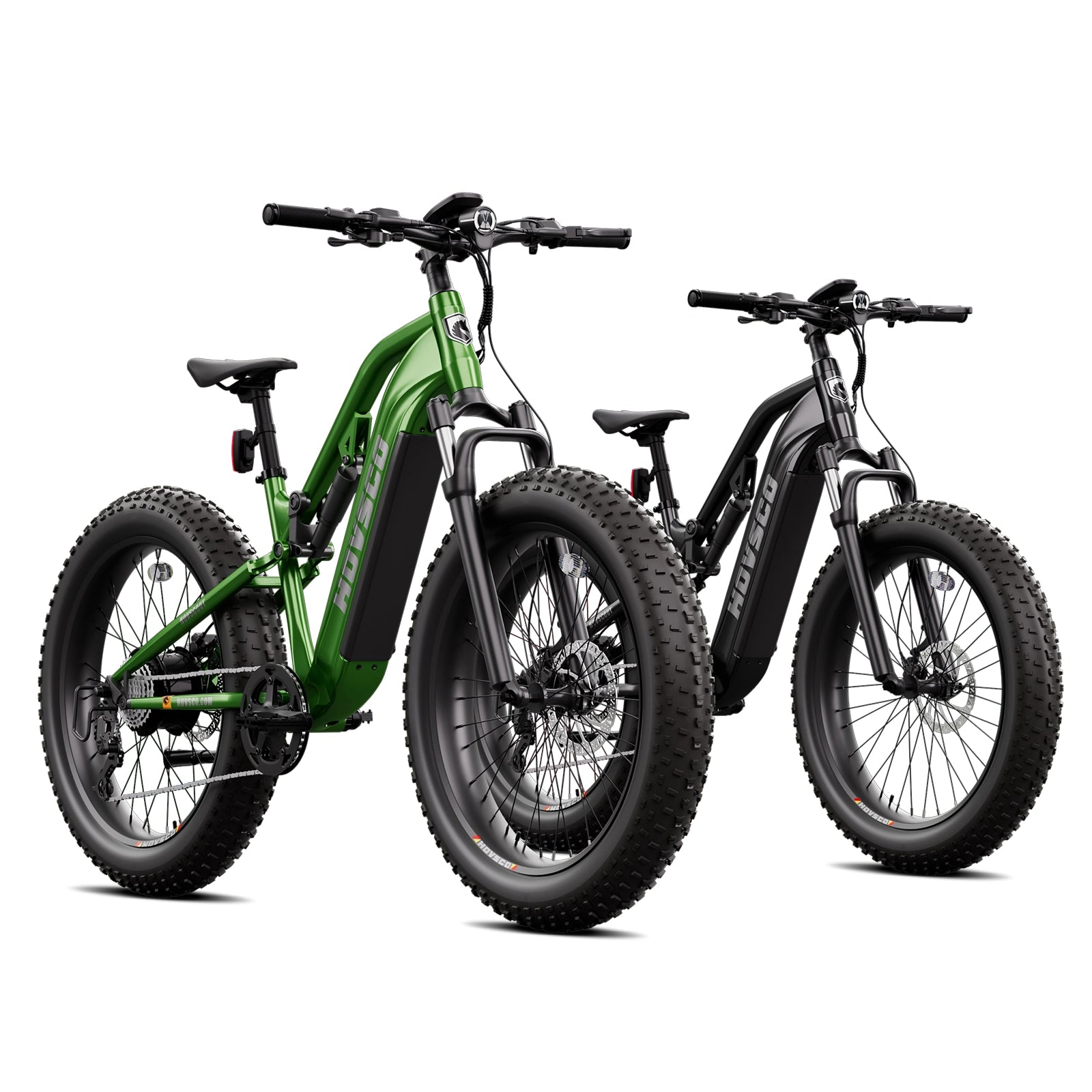
Full suspension paired with 26" x 4.0" fat tires creates “carpet-style traction” by keeping the rear wheel in continuous contact with uneven terrain instead of bouncing and losing drive. On a HovScout 26"x4.0" setup, the suspension absorbs impacts while the wide tire conforms to rocks and ruts, turning motor output into nearly 100% usable forward thrust instead of wasted spin or air time.
Full suspension lets the rear triangle move independently from the main frame, so instead of launching off rocks, the wheel tracks over them. On a HovScout design, the four‑bar linkage and shock compress when the tire hits a sharp edge, keeping tread in contact instead of kicking the bike upward. This continuous contact is the foundation of absolute traction and consistent motor delivery.
From a factory test point of view, we watch slow‑motion footage: on unsuspended frames the rear axle draws a jagged, airborne path; on full suspension, that path hugs the terrain with far fewer “white space” gaps between tire and ground. Every missed contact patch equals lost propulsion.
A 26"x4.0" fat tire spreads load across a wide, deformable footprint. Lower pressures let the casing wrap around rocks, roots, and loose rubble, dramatically increasing the number of knobs engaged at any moment. On the HovScout platform, we tune casing stiffness and recommended psi so the tire behaves like a soft conveyor belt rather than a rigid drum.
That “carpet” effect is visible in sand, snow, and rock gardens: instead of punching narrow ruts and surfing on the edge, the fat tire floats and grips. The tire becomes your first suspension stage, smoothing micro-impacts before they reach the shock and fork.
On a hardtail, the rear wheel is locked to the frame, so any vertical hit translates directly into an upward kick. At trail speeds, that kick turns into repeated short airborne phases where the tire is off the ground or skimming with minimal load. During those phases, the motor still spins, but there is no traction available to turn torque into motion.
The rider experiences this as “chatter”: rear-end skipping sideways, sudden loss of drive, and quick spin‑outs when trying to power up ledgy climbs. On lab rigs, we see clear gaps in contact-force graphs: power output remains, but ground reaction drops toward zero again and again.
A full-suspension HovScout 26" creates a smoother, lower-amplitude trajectory for the rear axle over chaotic surfaces. Instead of sharp peaks and troughs, the suspension compresses into hits and extends over holes, maintaining more constant tire load. On a 26"x4.0" fat casing, that means the tread “swallows” rocks while the shock neutralizes the vertical shock.
In practical terms, the rider feels less bucking and more forward surge. The bike climbs through chunky sections like a tracked vehicle, maintaining grip and line choice instead of skipping between random micro-lines dictated by impacts.
On the shop bench, we compare slow‑motion footage frame by frame: the hardtail shows clear daylight under the tire; the HovScout’s fat rear wheel stays visibly “stuck” to the surface.
Ground contact duty cycle is the percentage of time the tire carries useful load against the trail. For propulsion, anything below 100% is inherently wasteful: whenever the tire is airborne or barely loaded, the motor is free‑spinning and traction drops. Full suspension and fat tires push that duty cycle toward the upper end.
In engineering reviews, we model this as the product of suspension compliance, tire deformation, and rider position. On the HovScout, that product is deliberately tuned so the rear wheel spends the vast majority of its time in a traction-productive state, not bouncing on a sinusoidal path of hits and gaps.
Tire pressure determines how much the casing can conform to micro‑terrain. Too high, and even a 4.0" tire behaves like a harsh drum; too low, and the casing folds and squirms, losing precision. On a HovScout 26" off-road setup, we dial pressures in a range that balances footprint size with sidewall stability, often slightly lower than typical commuter settings.
Casing stiffness also matters. If the sidewalls are too soft, the tire rolls on the rim in corners. If they are too stiff, they ride on the outer knobs only. A well‑spec’d fat tire for the HovScout is stiff enough to resist folding but compliant enough to wrap around fore‑aft obstacles, preserving that “carpet” contact band under real load.
Most riders associate full suspension with downhill comfort, but the biggest hidden gain is climbing traction. On steep, loose climbs, any rear‑wheel hop instantly breaks grip and stalls momentum. With a shock and linkage absorbing compressions, the rear wheel loads and unloads smoothly, so tread blocks stay dug into the surface.
On factory torture-tests, we compare climb success rates: hardtails spin out or stall at specific ledgy sections; full-suspension HovScout builds continue to advance, often at lower speeds but with constant pressure. That slow, unstoppable crawl is the hallmark of a traction‑configured platform.
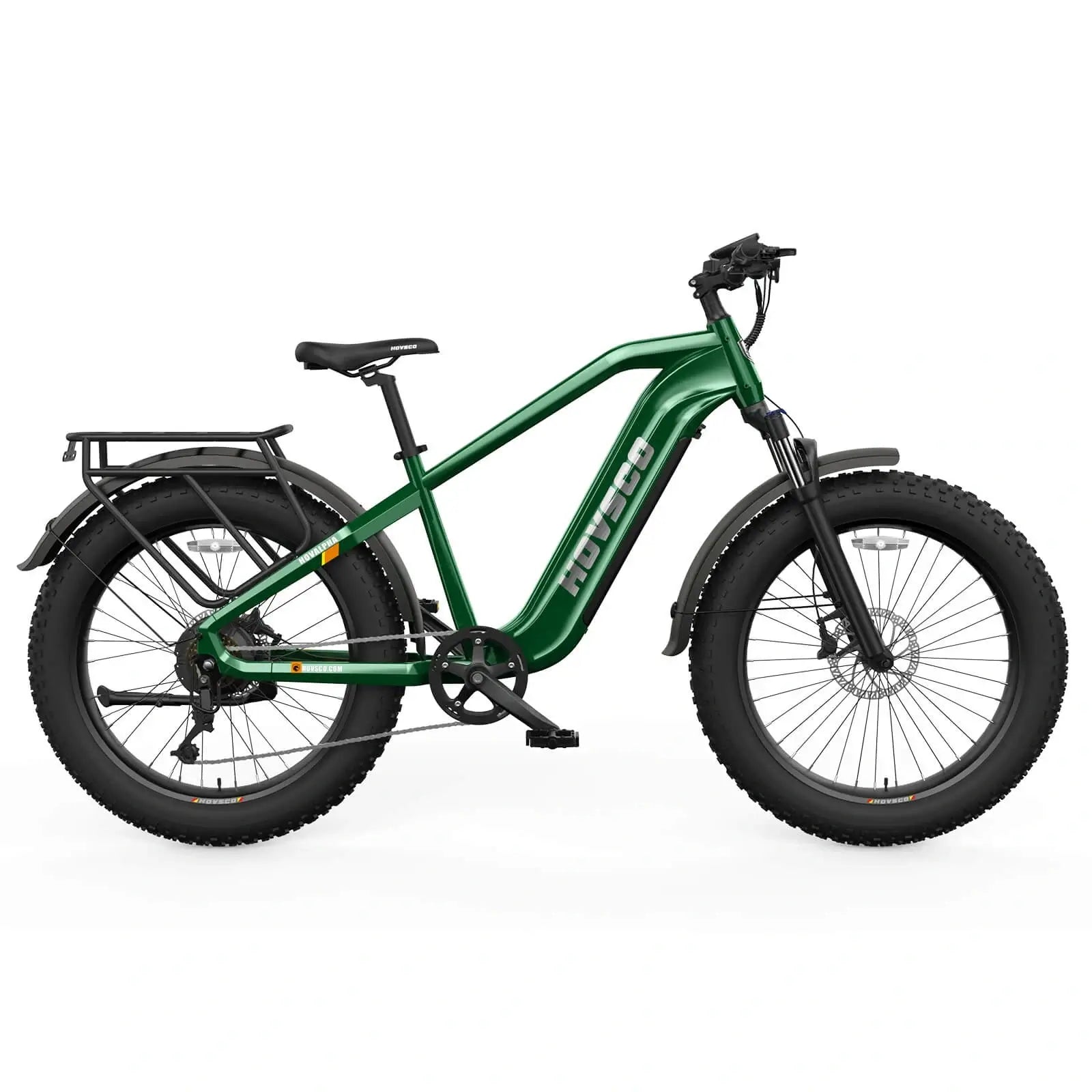
The HovScout 26" Obsidian Black Hardcore Off-Road Edition is built around an off-road geometry that favors stability and traction over twitchy response. Longer wheelbase, slack front angles, and stiff rear triangle pivots help the dual suspension and fat tires work as one traction system rather than separate comfort features.
From an assembly-line viewpoint, we validate weld quality, pivot tolerances, and shock mounting alignment so the frame does not introduce side-loads that would compromise tire contact. The “Hardcore Off-Road Edition” mindset is about surviving repeated strikes, not just looking aggressive: it must keep the rear wheel planted after dozens of hits, not just the first few.
There are engineering trade-offs: added weight, more pivot maintenance, and slightly slower initial acceleration due to bigger rotating mass. Full suspension also demands more precise shock setup; poorly tuned sag can steal drivetrain energy or make the bike wallow.
From a product-development standpoint, we accept those trade-offs because the upside—improved traction, comfort, and control on real trails—is large. Riders who primarily stay on pavement might prefer a simpler hardtail; the HovScout‑style platform is explicitly aimed at mixed and rough terrain, where traction is currency and comfort protects the rider’s capacity.
On an ebike, every watt you waste in wheelspin, bounce, or chassis flex comes straight off range and performance. When the rear wheel stays glued to the ground and the tire behaves like a traction carpet, you convert more of the motor’s output into usable forward momentum at a given battery draw.
In abuse tests, we see this as better speeds at a given assist level, lower current spikes on rough climbs, and fewer thermal stress events in the motor and controller. In simple rider language: the bike feels stronger without increasing nominal motor rating, because you are no longer throwing half your power into empty air and slippage.
“When we tuned the HovScout’s dual suspension and 26" x 4.0" tire package at HOVSCO, the goal wasn’t just ‘comfort’—it was contact. Every design choice, from linkage kinematics to casing spec, targets a rear wheel that refuses to let go of the trail. That’s where absolute traction comes from: not a single part, but a system that keeps motor torque married to the ground, hit after hit, mile after mile.”
“The Off-Road Overlord: Why Full Suspension and Fat Tires Command Absolute Traction” is more than a slogan—it describes how the HovScout 26"x4.0" architecture turns chaotic terrain into something predictable. Full suspension keeps the axle path low and continuous; fat tires lay down a deformable contact carpet; together they push rear-wheel contact duty cycle toward 100%, so nearly all available power becomes forward drive instead of noise, bounce, and spin.
For riders, the actionable move is to stop thinking of suspension and width as luxury and start treating them as traction tools. If your terrain includes rock gardens, loose climbs, or broken fire roads, a HOVSCO full-suspension fat platform like the HovScout 26" Obsidian Black Hardcore Off-Road Edition will not just feel smoother—it will let you carry speed, climb lines, and stay in control that hardtail setups simply cannot hold.
Is a full-suspension fat-tire ebike overkill for casual off-road use?
Not if your trails include rocks, roots, or loose climbs; the added traction and comfort make riding safer and more controlled even at moderate speeds.
Does a 26"x4.0" tire really grip better than a standard MTB tire?
Yes, at appropriate pressure the larger footprint and deformable casing deliver more contact points, improving traction on sand, snow, and rubble.
Can a HovScout-style full-suspension setup climb better than a hardtail?
On rough, ledgy, or loose climbs, full suspension helps keep the rear wheel planted, reducing spin‑out and stall compared to a rigid rear triangle.
Are there maintenance downsides to full suspension and fat tires?
There is more to service—pivots, shock, and larger casings—but for off-road riders the traction and control gains often outweigh these added tasks.
Does HOVSCO design their full-suspension fat bikes for real abuse?
Yes, HOVSCO tests frames, suspension, and tires under torture‑style off-road conditions to ensure the system maintains traction and structural integrity over time.
Share:
How Do Ebike Suspension Kinematics Turn Power Into Control?
Is a factory full‑suspension ebike like HovScout really the smarter luxury investment?