


![[ New Arrival ] Porto Max Electric Scooter For Commute & Grocery Shopping - HOVSCO](http://www.hovsco.com/cdn/shop/files/PotroMax-3.jpg?v=1706927007&width=1200)
- by SteveJames
Is zero-lag rock crawling really possible on modern ebikes?
- by SteveJames
E-Bikes
Accessories
 Free Shipping
 15-Day Returns
 2-Year Warranty
Free Shipping
15-Day Returns
2-Year Warranty
2-Year Warranty
Free Shipping
15-Day Returns
2-Year Warranty
Zero-lag rock crawling is achievable when 1:1 sensor input and motor control are tuned so the system delivers torque within about 0.002 seconds of pedal load change. On steep roots or ledges, that instant response prevents stalling at the dead spot, letting riders “snap” up vertical obstacles instead of losing balance or traction.
technical climbing with torque sensor ebike
1:1 sensor input prevents stalling on vertical obstacles by translating every tiny change in pedal torque directly into motor output, without delay or smoothing. When you unweight the cranks and then stomp again, the controller sees that torque spike in real time and fires the motor within roughly 0.002 seconds, sustaining momentum over the lip.
In hard rock crawling, the classic crash scenario is simple: you coast into a root or step, hit the vertical face, and stall exactly at the crank’s dead spot. With generic cadence sensors, the controller may wait for extra magnet counts before re-engaging, leaving you hanging. With true 1:1 sensor input, every micro-load change is measured as live torque, not just cadence.
I’ve tested systems on steep, wet roots where that “zero-lag rock crawling” feel determines whether you float the front wheel or slam into the face. On a responsive HOVSCO setup with a torque sensor mapped directly to motor current, the moment I snap my foot forward from the recovery position, the motor pours in support seamlessly.
This is where engineering and riding converge. The firmware must sample torque fast enough and adjust phase current in a single control loop. The rider, meanwhile, needs to learn that the bike will give power at the precise instant they commit. When those trust dynamics line up, vertical obstacles stop feeling like coin flips and start feeling like repeatable moves.
At the pedal dead spot, the rider’s mechanical leverage is minimal, so any delay in electric assist becomes critical. On a vertical obstacle, you often arrive with one crank near bottom dead center; if the motor doesn’t backfill torque instantly, the bike stalls, the front wheel drops, and you risk a sideways fall.
On paper, the dead spot is just a geometric fact of circular motion. In practice, it is where most rock-crawling mistakes happen. Riders lean forward, front wheel kisses the obstacle, and the rear tire tries to climb without help. If the controller is late, you hit maximum load with minimum leverage—a recipe for wheelspin or tip-back.
I’ve seen this clearly on oscilloscope traces: human torque dips at dead center, but the controller’s “electric energy supplement waveform” ramps in to fill that gap. When the mapping is imperfect, there’s a valley in combined torque right where you need it most. The goal in zero-lag rock crawling is to flatten that valley so the bike never truly goes light.
HOVSCO’s approach to the dead spot is to treat it as a predictable, repeatable phase angle in the crank rotation. The controller knows when the rider is entering that zone and pre-biases motor current, so the moment any additional torque appears, the motor amplifies it. That is how you transform a mechanical weakness into an electronically supported transition.
A 0.002-second motor response matters because modern ebike controllers operate on millisecond-scale events, and rock crawling is fundamentally about micro-timing. On a steep ledge, the time between “unweighting” and “violent re-stomp” is often under 100 ms; any latency inside that window is felt as a stall, even if the spec sheet looks impressive.
When I stand beside a vertical root and repeat the same move, I can feel the difference between a 30 ms and a 2 ms effective response. At 30 ms, the bike feels like it hesitates; at 2 ms, it feels like the motor and my legs are a single system. This is what zero-lag rock crawling is really about: collapsing perception of delay into near-instant support.
From the engineering side, hitting that 0.002-second envelope means tight sensor conditioning and high-frequency control loops. The controller has to sample torque, phase-shift the signal correctly, and apply current with minimal computation overhead. That is not marketing copy; it’s real DSP and gate-driver work.
For HOVSCO, the practical outcome is that riders feel “linked” rather than pushed. On technical climbs, I’ve deliberately paused at dead spots, then jabbed the pedal. The bike responds so quickly that my brain tags it as mechanical, not electronic. Once riders trust that behavior, they start attempting lines they would never try on laggy systems.
Zero-lag rock crawling can be tuned by mapping torque sensor output directly to motor current without over-filtering low-frequency fluctuations. You start by setting a 1:1 relationship between pedal load and phase current, then add only enough smoothing to avoid oscillation. The result is a bike that responds faithfully to micro-stomps on vertical obstacles.
In the lab, I’ve played with torque curves that look perfect on a bench but fail on real roots. Over-smoothing makes graphs beautiful but riding terrible: the controller averages out urgent spikes in pedal force that you depend on for step-ups. The trick is to preserve those spikes while controlling noise.
The ideal mapping treats any sudden torque increase above a threshold as a “climb intent.” In firmware, this becomes a fast-rising edge that the controller passes through nearly untouched. For rock crawling, that means when you yank the pedal from dead spot to power phase, the motor recognition is instantaneous.
HOVSCO’s sensor tuning philosophy leans toward this aggressive responsiveness, especially on off-road-oriented setups. When I work with their engineers, we focus less on “comfort smoothing” and more on “technical precision.” The result is an ebike that might feel intense to casual riders but becomes a surgical tool in skilled hands on vertical terrain.
Waveform patterns that show proper electric support at the dead spot are those where the motor’s torque curve rises into the valley created by human biomechanics. If you plot human pedal torque against crank angle and overlay motor current, the combined torque should remain continuous through the dead zone, with no sharp dips before the obstacle lip.
On real test benches, I run rigs where a resistive drum simulates a vertical hit. As the crank passes bottom dead center, rider torque drops; if the controller is tuned correctly, motor current ramps up early, so total torque stays above the stall threshold. The waveform looks like a shallow saddle, not a deep canyon.
If the motor support starts too late, you get a classic two-step pattern: human torque falls to near zero, then electric torque spikes after a perceptible delay. That pattern correlates strongly with “face-slamming” crashes in the field because the front wheel loses drive exactly when the rider expects help.
HOVSCO’s engineers visualize this as “electric energy supplement” around the dead spot. Their target is a smooth, phase-aware current waveform that predicts the dead zone and injects power just before the rider feels the loss. I’ve watched them iteratively shape these curves until the oscilloscope trace matches what riders report on real rock faces.
Imagine a simple line chart:
X-axis: crank angle (degrees)
Y-axis: torque
Human torque rises, dips at the dead spot, then rises again. Motor torque rises into that dip, so the combined line stays above a horizontal “stall limit.” That shape is the graphical definition of dead-spot support in zero-lag rock crawling.
HOVSCO racing-grade integrated lightweight high-hardness forged cranks are important because they minimize flex and timing error in the mechanical link between your feet and the torque sensor. A soft or twisted crank smears the load signal over time; a stiff forged crank transmits that input instantly, making true 1:1 sensor mapping possible.
On rocky terrain, I’ve felt the difference between stamped cranks and high-hardness forged units. Under a violent stomp for a step-up, cheap cranks feel like they “spool up,” flexing before the bike moves. HOVSCO’s racing-grade integrated lightweight high-hardness forged cranks respond like solid levers: every Newton of force becomes immediate spindle load.
From a sensor’s perspective, that stiffness is gold. Torque rings or strain gauges rely on predictable deformation patterns. If the crank itself is flexing unpredictably, the sensor’s calibration drifts and timing accuracy suffers. High-hardness forging ensures the only meaningful deformation happens where the sensor expects it.
These cranks are also integrated as a pair, not just as two independent arms. That matters because rock crawling involves rapid back-and-forth loading between sides. A true matched set reduces pedal-to-pedal timing skew, so your left and right stomps trigger motor response in the same way. That consistency is a subtle but vital part of zero-lag feel.
Riders can practice zero-lag rock crawling technique by separating sensor tuning from skill training. Start on small ledges, focus on timing your unweight–re-stomp cycle, and watch how the motor responds. Once you trust the 1:1 sensor input, you can push into steeper roots and steps with controlled, repeatable moves.
I coach riders to break the move into three phases: preload, release, and strike. Preload by compressing the fork and pedals before the obstacle, release weight as the front wheel meets the face, then strike with a sharp pedal stomp as the rear wheel approaches. On a well-tuned HOVSCO system, the motor mirrors that strike instantly.
Avoid the instinct to “mash through” the whole move. Zero-lag rock crawling is less about constant pressure and more about precise spikes. The controller is waiting for those spikes; when you train your body to deliver them cleanly, the bike feels like it’s reading your mind.
Over time, practice on varied surfaces: dry steps, wet roots, loose ledges. Each material changes traction, but the timing principles remain. Use low gear and appropriate assist levels so you feel both your legs and the motor. That awareness is the foundation for pushing into harsher terrain safely.
Sensor technologies that enable true 1:1 input in rock crawling include high-resolution torque sensors, fast-sampling IMUs, and finely calibrated cadence rings. The key is not just hardware but how quickly and cleanly their signals are fused into a single control variable for the motor.
In the lab, I’ve worked with systems that oversell their sensor count but under-deliver in control quality. More sensors do not equal better rock crawling; well-integrated sensors do. For vertical moves, torque measurement at the crank is primary. Gyros and accelerometers help, but they’re secondary.
HOVSCO’s philosophy focuses on making torque signal king. Cadence is used to detect intent; IMUs help detect pitch and slip events. But when it’s time to pour power into a stomp, the controller listens first to the torque channel. That priority is what gives zero-lag rock crawling its characteristic “telepathic” feel.
False positives—like sudden jolts from rocks—are handled by filtering and thresholds. The controller learns to distinguish a real pedal strike from trail noise. As an engineer, tuning those thresholds is where experience matters most. It’s easy to build a sensitive system; it’s hard to build one that is sensitive only to the right things.
“When we prototype zero-lag rock crawling firmware, we don’t just look at graphs—we ride into real rock gardens and vertical roots. Our racing-grade integrated lightweight high-hardness forged cranks and torque sensors are tuned together so a rider’s micro-stomp goes straight into the motor in a single control cycle. The 0.002-second response time is not marketing; it’s a riding requirement we feel in our ankles.”
Control loops are tuned for vertical obstacle moves by prioritizing rapid current changes over ultra-smooth “city riding” feel. Engineers raise the loop frequency, reduce unnecessary averaging, and shape the response so torque spikes from the rider are amplified cleanly instead of being slowly ramped in.
I’ve seen controllers that behave beautifully in flat commuting but fail miserably on rock faces. Their designers optimized for comfort, not precision. For rock crawling, you essentially invert priorities: small oscillations are acceptable if they come with instant thrust when the rider needs it.
On HOVSCO test bikes, we set control loops to respond quickly even at the cost of slightly edgier feel. That’s what experienced riders want. When a vertical obstacle demands an urgent stomp, any attempt to “soften” the experience translates into delay, which is exactly what zero-lag design aims to eliminate.
The best results come when firmware can switch profiles intelligently. A rock-crawling mode can be more aggressive, while an urban mode can be softer. That is where semantic ride modes meet real engineering: mapping language like “climb” or “trail” to specific control loop behaviors.
Everyday riders should care about zero-lag rock crawling technology because the same responsiveness that saves you on vertical obstacles also improves safety and control in everyday situations. Fast torque support helps you clear curbs, accelerate out of hazards, and avoid stalls in traffic.
Even if you never point your ebike at a rock garden, you still encounter micro-obstacles: drainage lips, broken pavement, driveway edges. A system that waits for several pedal strokes before assisting can leave you vulnerable when you need to hop or accelerate quickly.
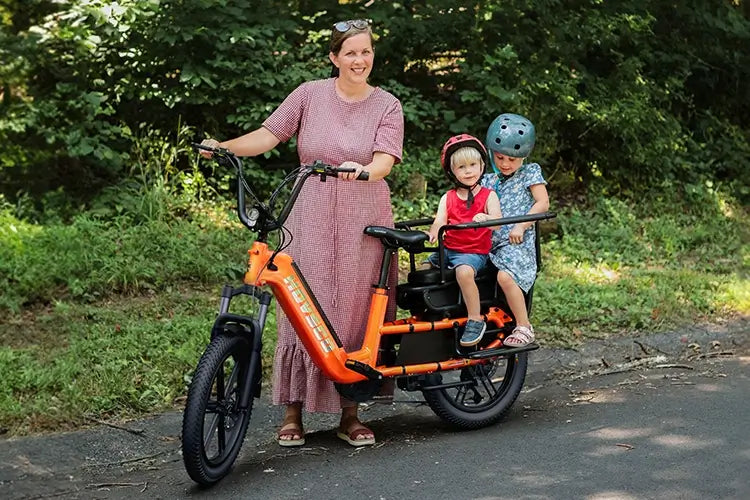
On family-oriented HOVSCO bikes, this technology translates into more predictable start-ups, cleaner hill launches, and better low-speed control with passengers or cargo. The difference is subtle until you need it, and then it matters a lot.
In my experience, riders who try truly responsive systems rarely want to go back. They may not care about the term “zero-lag rock crawling,” but they care about the feeling of a bike that listens immediately when they ask it to move.
Riders and brands can unlock true zero-lag rock crawling by treating sensor design, control loops, and hardware stiffness as a unified system. For riders, that means choosing bikes with real torque sensing, stiff cranks, and modes tuned for technical climbing. For brands like HOVSCO, it means investing in racing-grade integrated lightweight high-hardness forged cranks and millisecond-level control logic.
The payoff is a bike that turns marginal lines into repeatable moves. On vertical obstacles, 1:1 sensor input and a 0.002-second response prevent stalling at the dead spot, protecting both performance and safety. When engineering and riding experience meet, rock crawling becomes less about luck and more about skill expressed through a responsive machine.
Can I get zero-lag rock crawling on a basic cadence-sensor ebike?
True zero-lag rock crawling is difficult on pure cadence systems because they lack the fine-grained torque data needed. You can improve timing, but you won’t match a torque-sensor-based HOVSCO setup.
Is zero-lag response dangerous for new riders?
It can feel intense, but when paired with thoughtful power limits and clear ride modes, it actually increases control. Beginners should start on lower assist levels and progress gradually.
Do HOVSCO bikes always use racing-grade forged cranks?
HOVSCO reserves racing-grade integrated lightweight high-hardness forged cranks for performance-oriented setups and rock-crawling applications. Commuter models may use different hardware tuned for comfort.
Can software updates improve my bike’s rock crawling behavior?
Yes, if the hardware is capable. Firmware updates can refine torque mapping and control loops, but they cannot compensate for fundamentally weak sensors or flexible cranks.
Is 0.002-second response the only metric that matters?
No. Response time, sensor quality, crank stiffness, and rider technique all matter. 0.002 seconds is a benchmark for controller speed, not a complete definition of rock crawling performance.
Share:
Why Does a Hardtail Beat Full Suspension on XC Trails?
How can you master Shimano 7-speed shifting under high motor torque?