


![[ New Arrival ] Porto Max Electric Scooter For Commute & Grocery Shopping - HOVSCO](http://www.hovsco.com/cdn/shop/files/PotroMax-3.jpg?v=1706927007&width=1200)
- by SteveJames
What Should You Check Before Buying a Camping E-Bike?
- by SteveJames
E-Bikes
Accessories
 Free Shipping
 15-Day Returns
 2-Year Warranty
Free Shipping
15-Day Returns
2-Year Warranty
2-Year Warranty
Free Shipping
15-Day Returns
2-Year Warranty
A camping-ready electric bike needs to be judged on payload, range under real terrain, fold or transport size, tire volume for loose surfaces, and local land-use rules — not on marketing claims. This checklist walks through the specs, fit questions, and ownership realities that matter before you buy, using verified HOVSCO product data and general e-bike engineering knowledge to separate what's confirmed from what still needs a product-page check.
Camping and overlanding use an e-bike in conditions a city commuter never sees: gravel forest roads, sandy campsites, tent-to-trailhead hauls, and multi-day trips without a wall outlet nearby. A bike that's perfect for pavement commuting can struggle once the terrain turns loose or the cargo load goes up.
The core difference is load variability and surface unpredictability. A commuter mostly carries a backpack on known pavement; a camping rider might carry a cooler, firewood, or a passenger one day and ride unloaded singletrack the next. That means the checklist has to weigh payload capacity, tire volume, suspension travel, and range headroom more heavily than a typical city-bike buying guide would.
Payload swings widely — camp gear, coolers, and folding chairs add up fast, so a bike's rated capacity needs real margin, not just enough for the rider's body weight.
Surface changes mid-ride — gravel, packed dirt, sand, and paved fire roads can all show up on one outing, so tire width and suspension matter more than max speed.
Charging access is inconsistent — campsites and remote trailheads may not have reliable power, so range-per-charge and battery removability both matter.
Storage geometry is a real constraint — a bike has to fit in a truck bed, SUV cargo area, RV bay, or tow-behind rack, which is why folding designs get so much attention in this category.
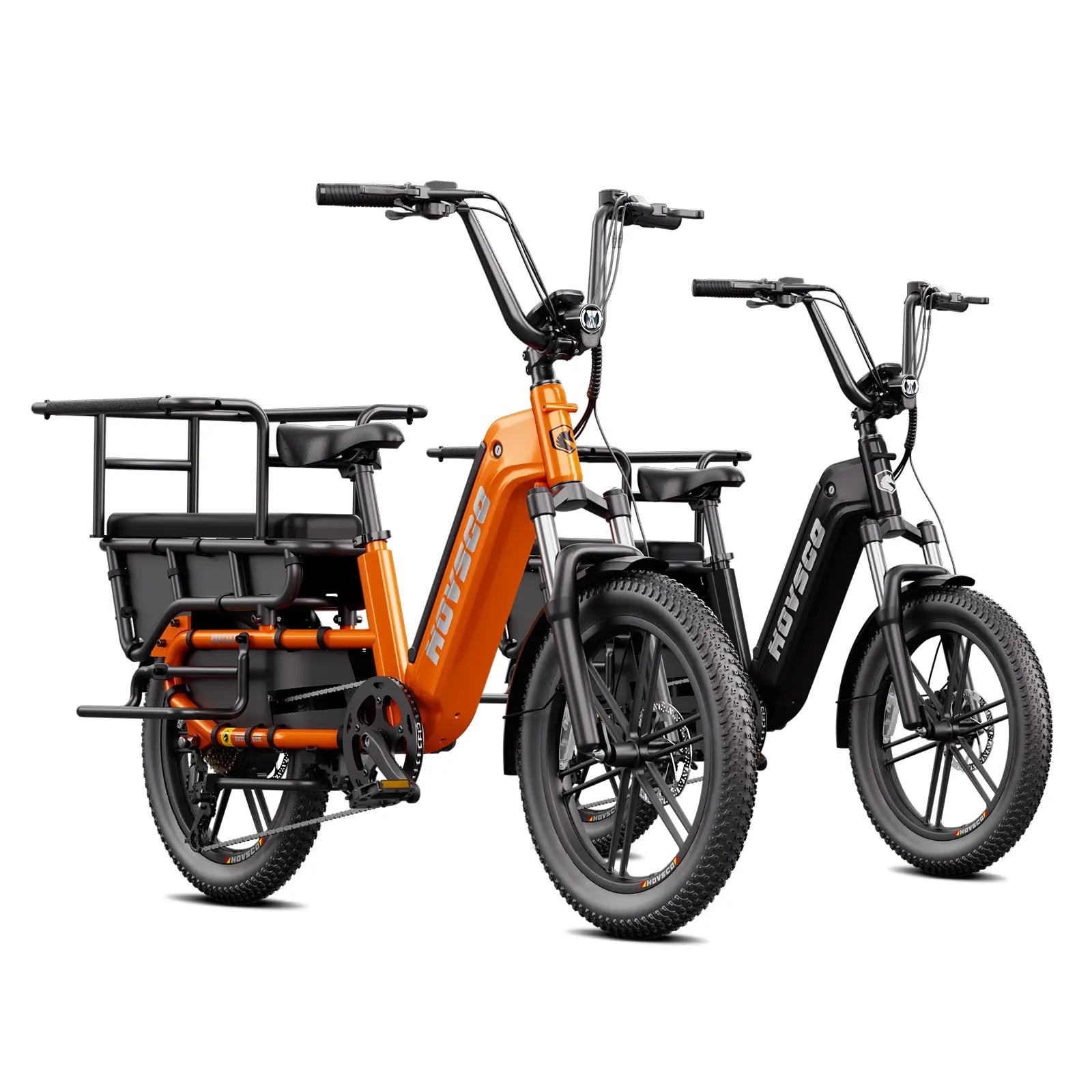
HOVSCO builds several fat-tire and cargo-style e-bikes that are commonly used for camping, overlanding, and RV trips, and the rest of this checklist uses their published specs as concrete reference points. A camping-ready e-bike is defined less by top speed and more by how it handles variable payload, mixed terrain, and unpredictable charging access over a multi-day trip.
Before comparing motors or batteries, confirm what your state and the land manager where you'll ride actually allow — an e-bike that's street-legal isn't automatically trail-legal. This is the one section where getting it wrong can mean a citation, a confiscated bike, or a ban from a trail system, so it belongs first.
In the US, e-bikes are generally sorted into three classes: Class 1 (pedal-assist only, no throttle, capped around 20 mph), Class 2 (adds a throttle, still capped around 20 mph), and Class 3 (pedal-assist to roughly 28 mph, often throttle-limited to 20 mph). These class definitions come from state-level model legislation, not a single federal standard, so the same bike can be treated differently depending on where you ride it. Land managers layer their own rules on top: many mountain-bike trails and wilderness areas only allow Class 1, some multi-use paths allow all three classes, and motorized-vehicle restrictions in wilderness areas can exclude e-bikes entirely regardless of class.
Check the specific trail system or campground's posted e-bike policy, not just your state's vehicle code — national forests, state parks, and BLM land each set their own rules.
Confirm whether the throttle mode is restricted on the trails you plan to use; some systems allow pedal-assist Class 1 but ban throttle-equipped bikes.
Review your state's helmet and age requirements for e-bike classes, since these vary and often apply specifically to Class 2 and 3 bikes.
Keep the bike's registration and any required class-labeling sticker visible, since some jurisdictions require it.
A HOVSCO e-bike's assist mode and throttle behavior can typically be adjusted through the HOVSCO app for ride tracking and warranty registration, which helps you stay inside the rules for a specific trail system on a given trip. Knowing your legal ceiling up front keeps the rest of this checklist grounded in what you're actually allowed to ride.
Payload capacity should cover your body weight plus the heaviest realistic combination of gear you'd carry — cooler, firewood, water, and a passenger seat, if applicable — with room to spare, not exactly matched to your weight alone. Treat the rated number as a ceiling, not a target.
The mechanism here is straightforward: payload rating reflects frame, wheel, and motor engineering limits, and riding consistently near that ceiling accelerates wear on tires, spokes, and brakes while also changing handling — a heavily loaded bike brakes and turns differently than an empty one. Manufacturers rate a maximum, but comfortable, controllable riding happens well under that number.
Solo camper, minimal gear — body weight plus a rear rack bag and maybe 20–30 lbs of supplies; almost any fat-tire e-bike's payload rating covers this with margin.
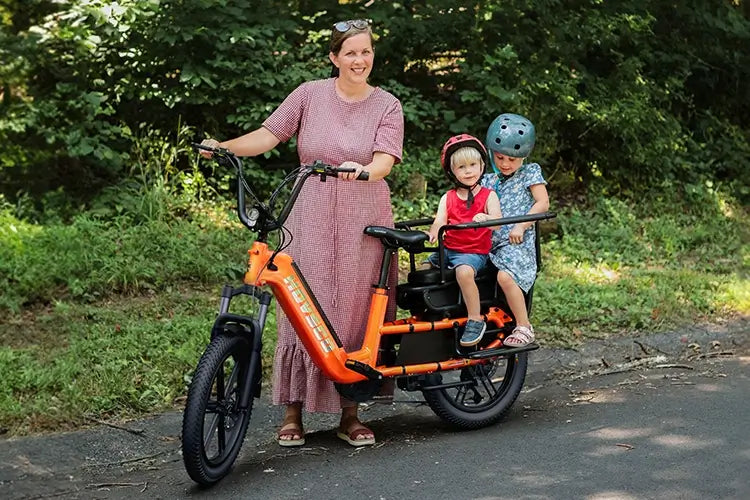
Family or cargo hauling — hauling a cooler, extra water, and possibly a child seat pushes total load up quickly; this is where a cargo-specific frame with a rated payload ceiling in the 400+ lb range earns its keep.
Passenger plus gear — an adult on a rear rack cushion plus a basket of supplies stacks weight fast, and this is exactly the scenario that separates commuter e-bikes from cargo-rated ones.
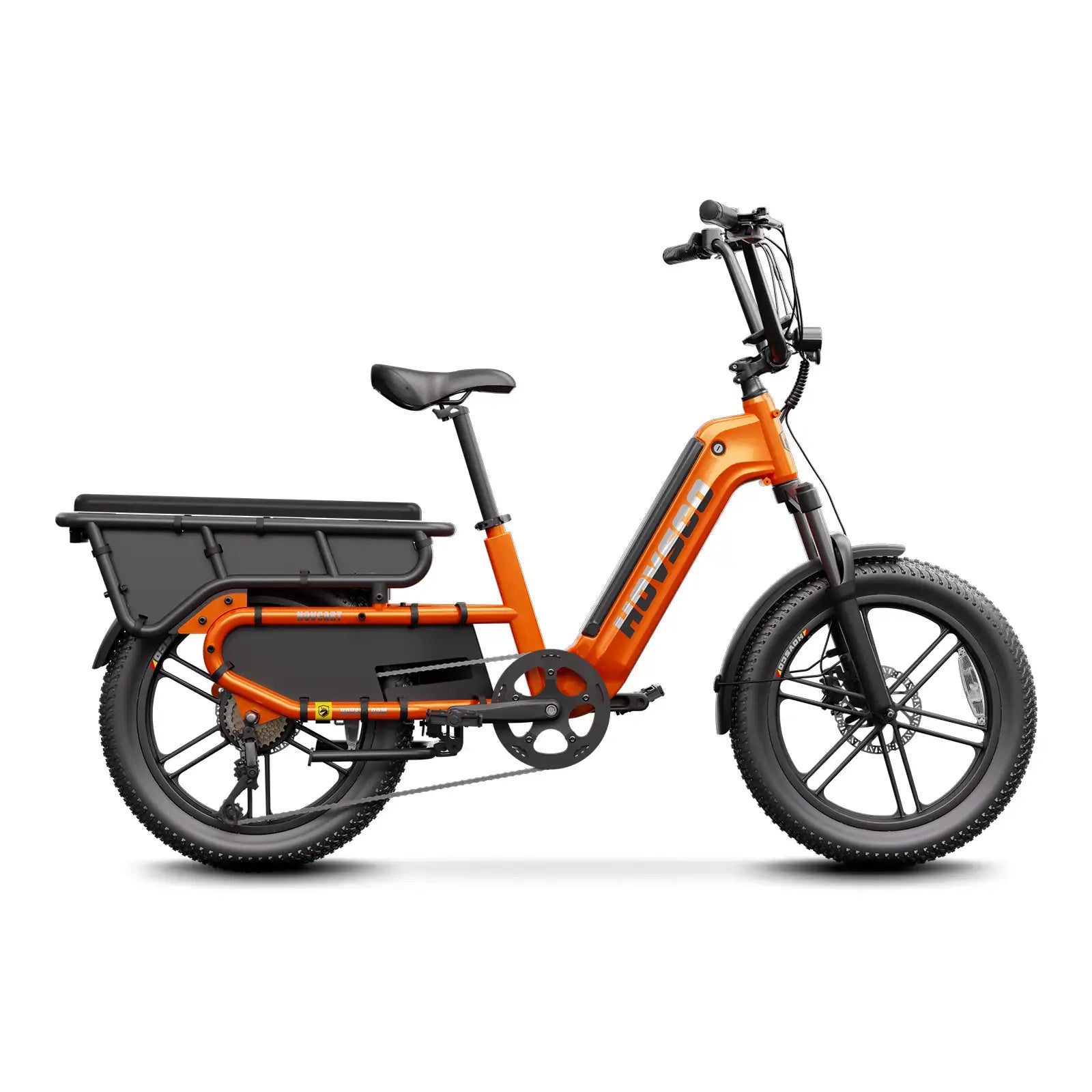
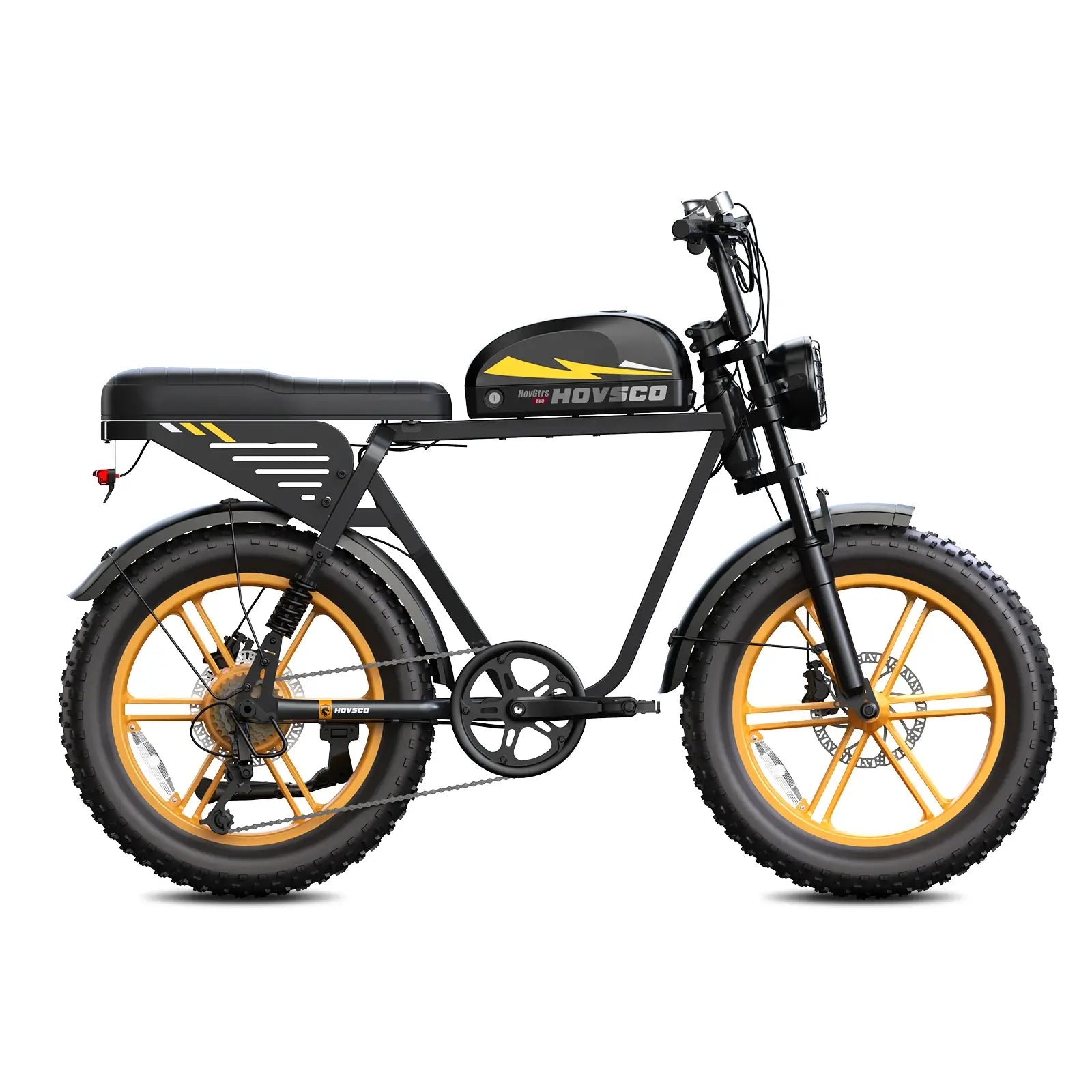
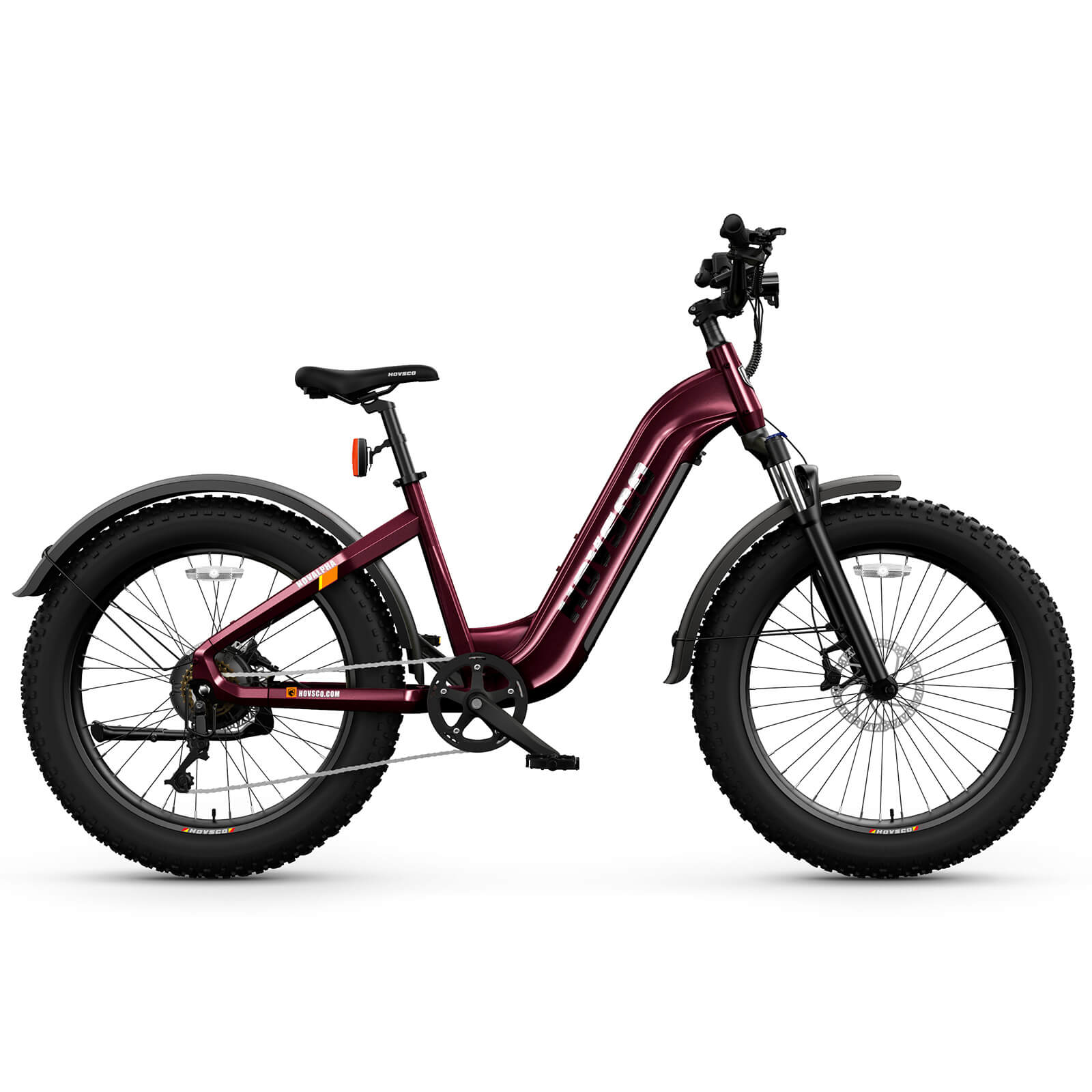
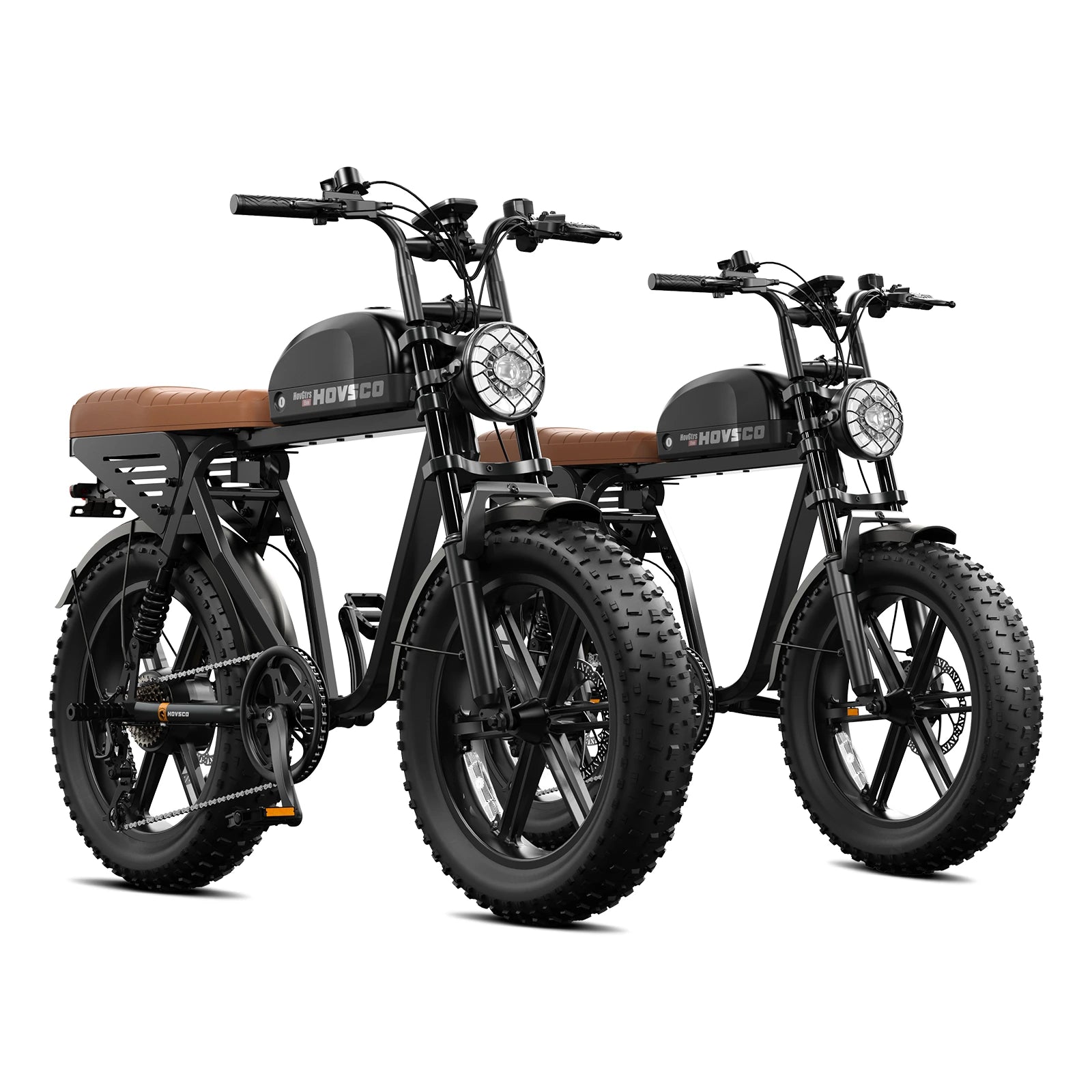
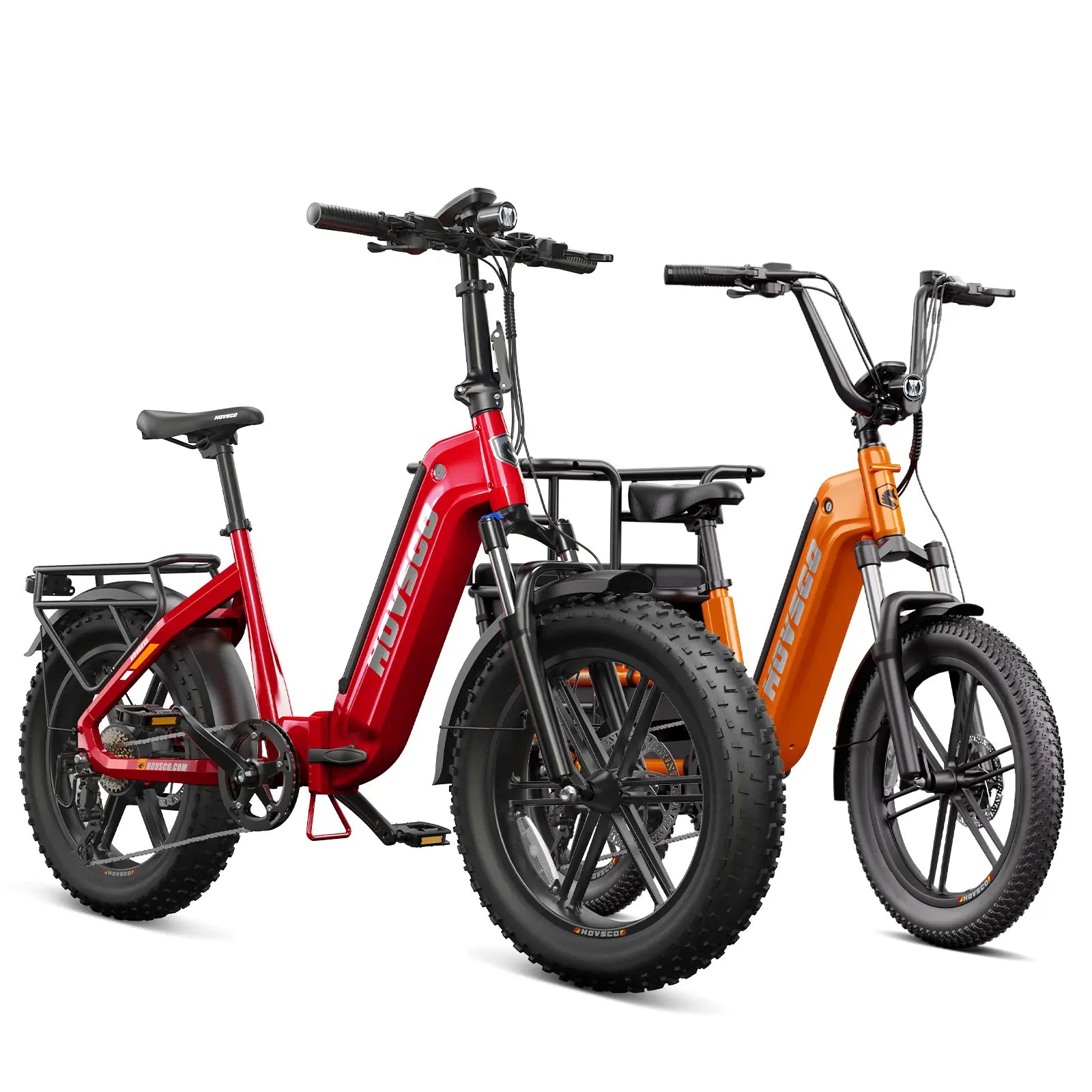
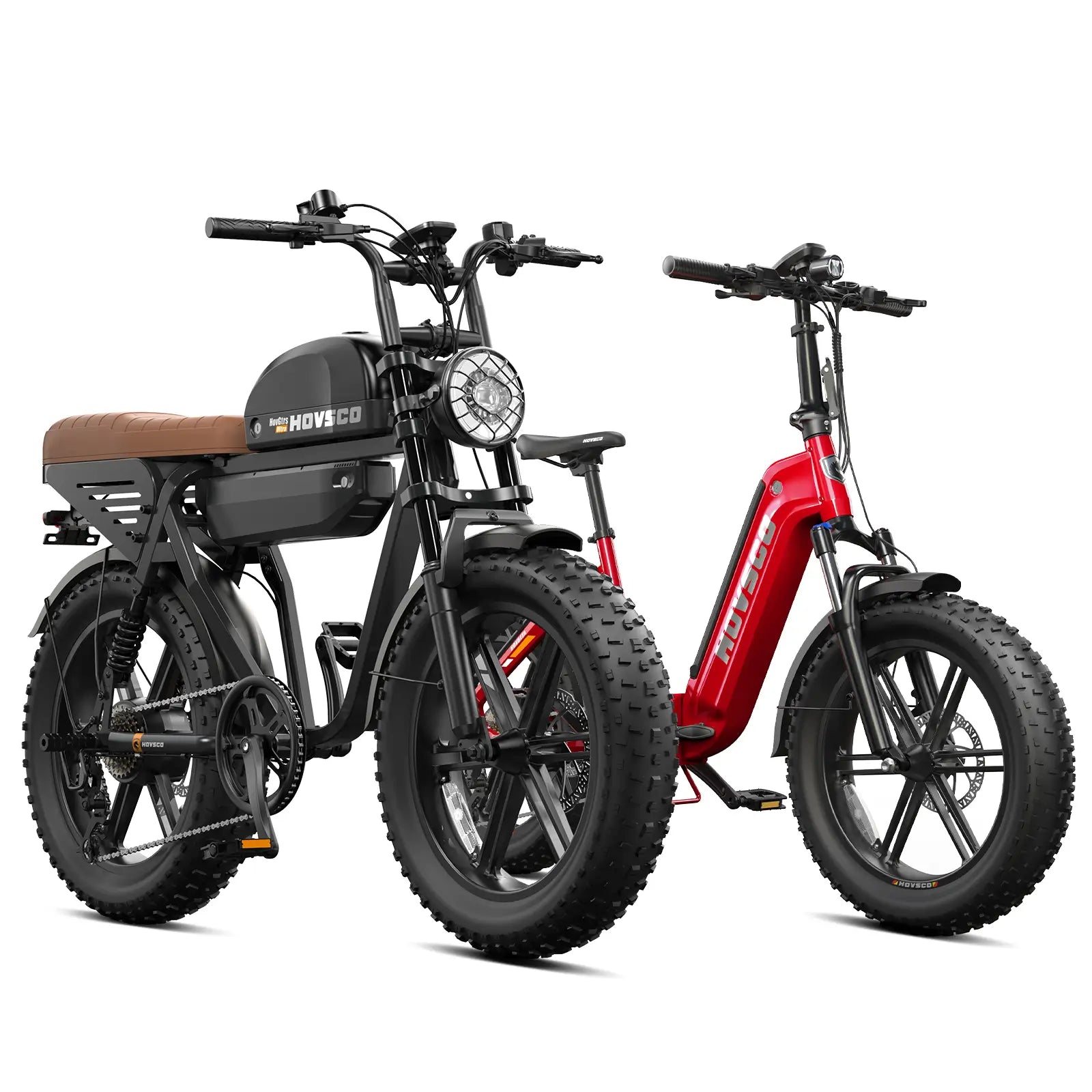
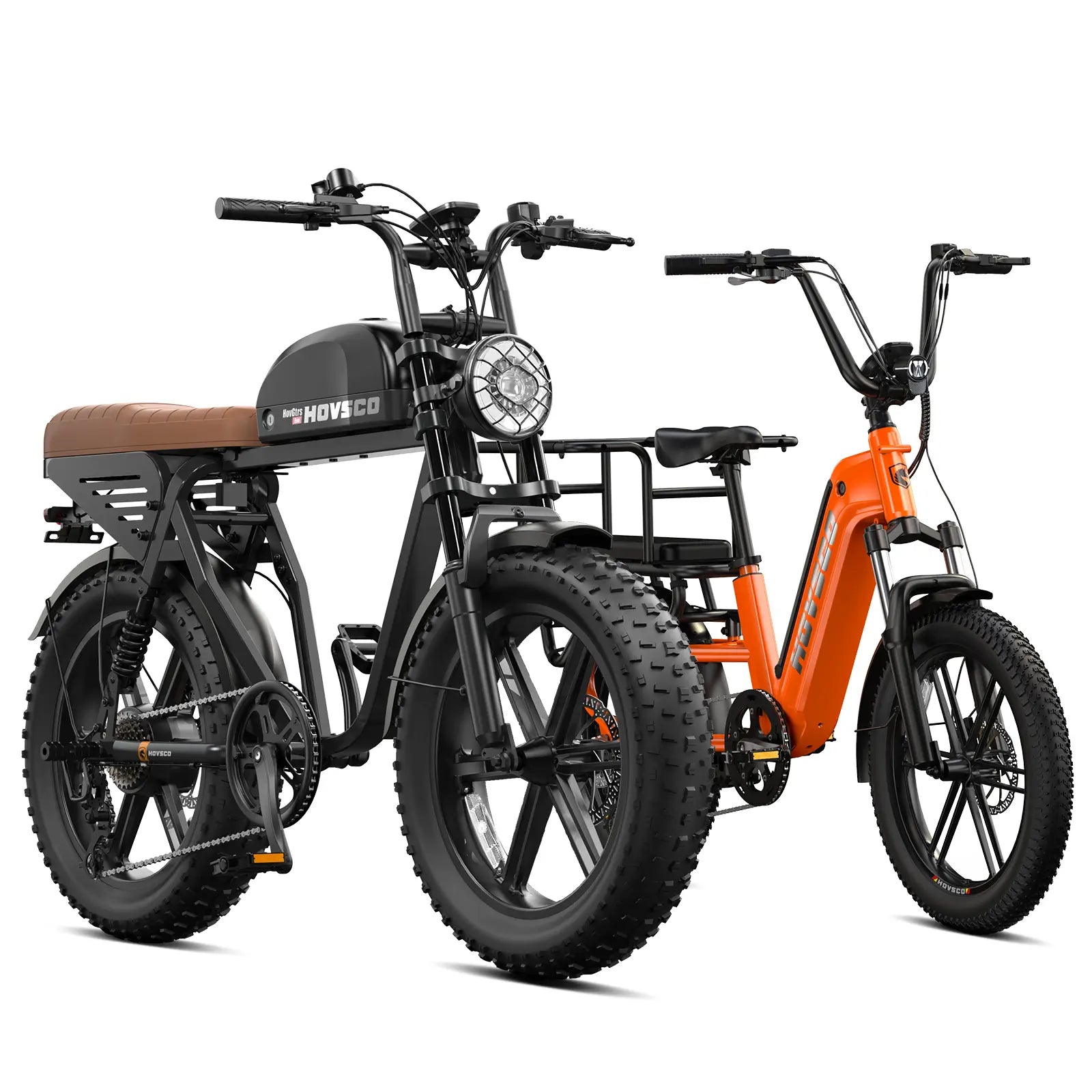
HOVSCO's HovCart, a 20-inch fat-tire cargo bike, is rated for a 450 lb maximum payload with a modular rear rack system, and its HovGtrs moped-style e-bike carries the same 450 lb payload rating. That 450 lb ceiling on both models means you can plan for a loaded cooler and a passenger without immediately maxing out the frame, but it's still a ceiling — not a number to ride at continuously. Once payload is settled, the next question is whether your fold or frame size actually fits your vehicle or campsite storage.
If you're storing the bike in an RV bay, a car trunk, or a tow-behind rack with limited space, a folding frame is worth prioritizing over a rigid one — but folding designs trade some frame stiffness and cargo capacity for that portability. Whether that trade-off is worth it depends entirely on your storage constraint.
Here's the mechanism: a folding hinge point on the main frame or stem reduces the bike's packed footprint significantly, which matters for RV storage bays, small SUV trunks, or tow-behind cargo boxes with fixed dimensions. But that hinge is also a mechanical joint that has to be engineered for repeated open-close cycles without developing play, and folding frames generally prioritize compactness over the cargo-rack real estate you'd get on a dedicated cargo frame.
Rigid cargo frame — maximizes rack space and stability for hauling gear, but takes up a full bike's footprint in storage; best when you have a truck bed, hitch rack, or dedicated garage space.
Folding fat-tire frame — collapses down for tight storage in an RV bay or car trunk, at the cost of some of the rack and payload versatility you'd get from a purpose-built cargo design.
Step-thru vs. step-over on either style — step-thru frames are easier to mount and dismount when gear is strapped to a rear rack, which matters more on a loaded camping trip than on an unloaded commute.
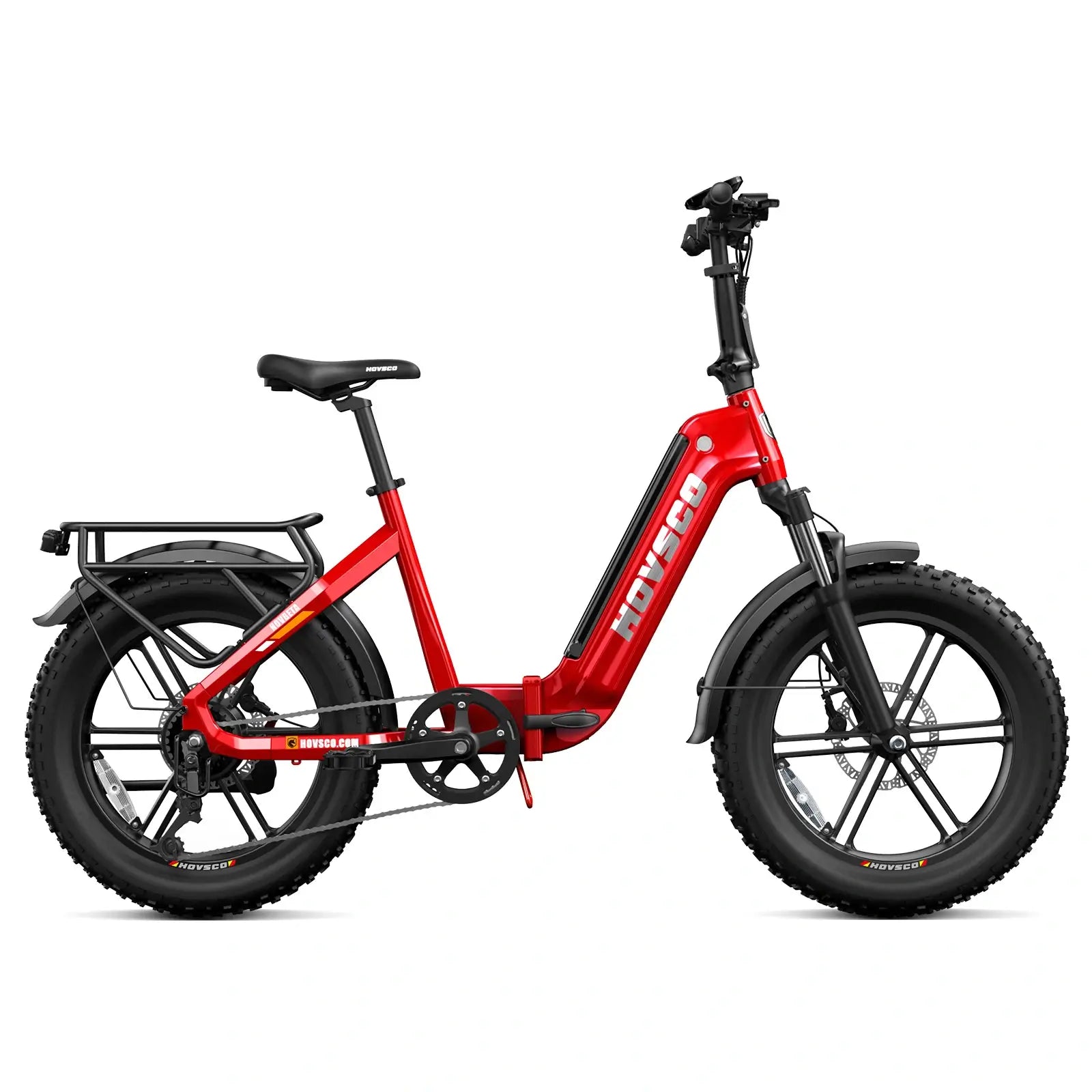
HOVSCO's HovBeta is a 20-inch foldable fat-tire e-bike built specifically for storage-constrained situations like RV and transit use, and it's rated for the same 450 lb payload and 40–60 mile range as HovCart despite its compact fold. That means a folding frame doesn't automatically mean a payload or range downgrade — but always confirm frame-specific numbers on the individual product page rather than assuming they carry over between models. Once storage is sorted, focus shifts to how far the bike will actually go once you're using that payload on real terrain.
Plan around the low end of a bike's advertised range window, not the high end, because range on a fully-loaded, hilly, cold-weather camping trip looks very different from a flat commute. Rated range figures assume favorable conditions, so building in a margin protects you from being stranded far from an outlet.
Range varies because battery output has to cover several variable loads at once: rider and cargo weight, elevation gain, wind, tire pressure, temperature, and how much you lean on throttle versus pedal-assist. A bike advertised at 40–60 miles is describing a range, not a guarantee, and the low end typically reflects throttle-heavy or hillier use while the high end reflects light pedal-assist on flatter ground. Cold weather compounds this: lithium batteries commonly lose a meaningful chunk of usable range in cold conditions as a matter of battery chemistry, which is standard across the e-bike industry and not specific to any one brand.
Battery capacity (Wh) is the base spec — higher watt-hour batteries generally support longer range, but only in proportion to how hard the motor works to move the load.
Assist level and throttle use — full throttle use drains a battery noticeably faster than higher pedal-assist levels, since the motor is doing more of the work with less rider contribution.
Terrain and elevation — climbing hills or riding loose gravel demands sustained higher power output than flat pavement, which shortens range per mile covered.
Temperature — riding in cold weather reduces usable battery capacity, a widely documented behavior of lithium-ion cells generally, independent of brand.
HOVSCO's HovCart and HovBeta are both rated for a 40–60 mile range on a single charge, while the HovGtrs moped-style e-bike offers a wider 65–150 mile range depending on which battery configuration (Evo, Pro, or Ultra) you choose. If your camping trip involves multiple days without charging access, a removable battery — which both HovCart and HovBeta offer — lets you carry a charged spare or charge indoors at a cabin or RV outlet rather than needing to plug in the whole bike. With range planning settled, the next question is whether the tires and suspension can actually handle the surfaces you'll ride on.
Wider tires and usable suspension travel matter on camping terrain because loose gravel, sand, and root-covered paths punish narrow, high-pressure tires and rigid frames in ways pavement never does. This is less about comfort and more about traction and control when the surface underneath you keeps changing.
The engineering trade-off is simple: wider tires run at lower pressure create a larger contact patch that flexes over bumps and loose material, improving traction and cushioning — but that same width and lower pressure adds rolling resistance on hard pavement, which is part of why fat-tire bikes feel slower to accelerate on a paved bike path. Front suspension absorbs impact from ruts and rocks before it reaches your hands and the frame, but suspension travel and lockout availability vary a lot between models, and locking it out on smooth pavement recovers some pedaling efficiency.
20x4-inch fat tires — the format used on HOVSCO's HovCart, HovBeta, and HovGtrs, provide a wide footprint suited to sand, gravel, and light snow, at some cost to on-road efficiency compared to narrower tires.
Front suspension with lockout — HovCart's suspension fork offers 45mm of travel with a lockout feature, letting you firm up the front end for pavement stretches and open it up for rougher trail sections.
Tire pressure adjustment — running lower pressure (commonly in the 8–12 psi range on snow, higher on gravel or pavement, as a general fat-tire guideline) changes traction and rolling resistance on the fly, which is a free adjustment most riders underuse.
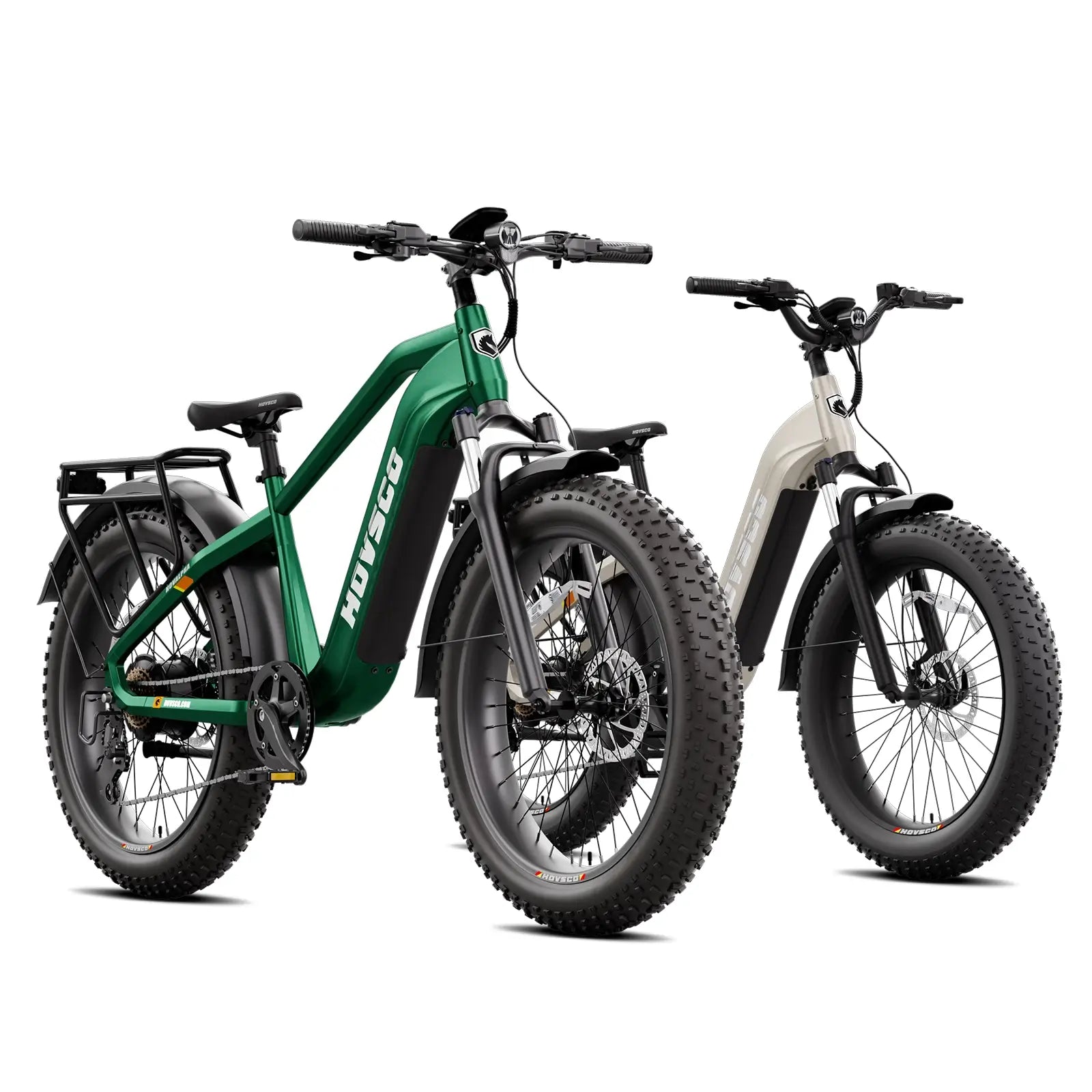
A HOVSCO fat-tire e-bike's 20x4-inch tire format is built for mixed surfaces from pavement to sand to light snow, and HovCart's front suspension includes 45mm of travel with a lockout for switching between rough trail sections and firm pavement. Here's a nuance most buying guides skip: suspension lockout isn't just a comfort feature, it's an efficiency tool — locking it out on a paved campground road can noticeably reduce the energy lost to fork bob during pedaling. Once terrain handling is confirmed, the next practical question is how the motor and sensor combination actually feels when you're hauling a loaded trailer or climbing a grade to a campsite.
A torque sensor generally feels more natural and responsive when you're hauling a loaded trailer or climbing with cargo, because it scales motor assist to how hard you're actually pedaling rather than simply detecting that the pedals are turning. Cadence sensors aren't inferior, but the feel is different, and that difference is most noticeable under load.
The mechanism: a torque sensor measures the actual force you apply to the pedals and adjusts assist output moment to moment, so pushing harder on a climb triggers more assist immediately — this is why torque-sensing e-bikes are generally considered a more intuitive, higher-end feature and are common on cargo and touring-oriented bikes. A cadence sensor instead detects that the pedals are spinning and applies a preset assist level regardless of how hard you're pushing, which can feel more like an on/off switch than a proportional response, particularly noticeable when you're hauling extra weight uphill.
Torque sensor — used on HOVSCO's HovCart (rated at up to 90 N·m of torque, as listed on the product page) and HovBeta (rated at up to 85 N·m of torque, as listed on the product page); trade-off is a slightly more complex, costlier system, but a payoff in responsiveness under load.
Cadence sensor — used on HOVSCO's HovGtrs moped-style e-bike; trade-off is a simpler system that some riders find less nuanced on technical climbs, though it's perfectly capable for moped-style throttle-forward riding.
Assist level range — all three models offer 5 levels of pedal assist plus thumb throttle, so you can dial in how much the motor versus your legs are doing the work regardless of sensor type.
This is where I'd push back on a common assumption: throttle-only riding is fine for flat, easy terrain, but on a loaded climb to a campsite, pedal-assist with a torque sensor typically delivers a smoother, more controllable ride than leaning on the throttle alone. With motor feel addressed, it's worth stepping back to compare how HOVSCO's camping-relevant models stack up side by side.
These three HOVSCO models cover the main camping use cases — cargo hauling, compact storage, and long-range touring — and comparing their verified specs side by side makes the trade-offs concrete rather than abstract. No single model wins every category; the right choice depends on which constraint (payload, storage size, or range) matters most for your trips.
Match your dominant constraint — cargo hauling, storage space, or range — to the model built around it, in this order:
Primary use — if you're hauling coolers, kids, or a passenger to a campsite, start with HovCart's cargo-rack system; if you need the bike to disappear into an RV bay or trunk, start with HovBeta; if long unsupported range matters most, start with HovGtrs.
Storage constraint — measure your RV bay, truck bed, or trunk space before deciding; HovBeta's folding frame is the only one of the three built specifically for compact storage.
Typical load — all three share a 450 lb payload ceiling, so this step usually doesn't eliminate an option, but confirm your heaviest realistic load (cooler plus passenger plus gear) stays comfortably under that number.
Range need — if your trip involves multiple days without reliable charging, HovGtrs's 65–150 mile window (depending on battery configuration) gives more headroom than HovCart or HovBeta's 40–60 mile range.
Assist feel — if you'll be climbing loaded grades to a campsite, HovCart or HovBeta's torque sensor generally feels more responsive under load than HovGtrs's cadence sensor.
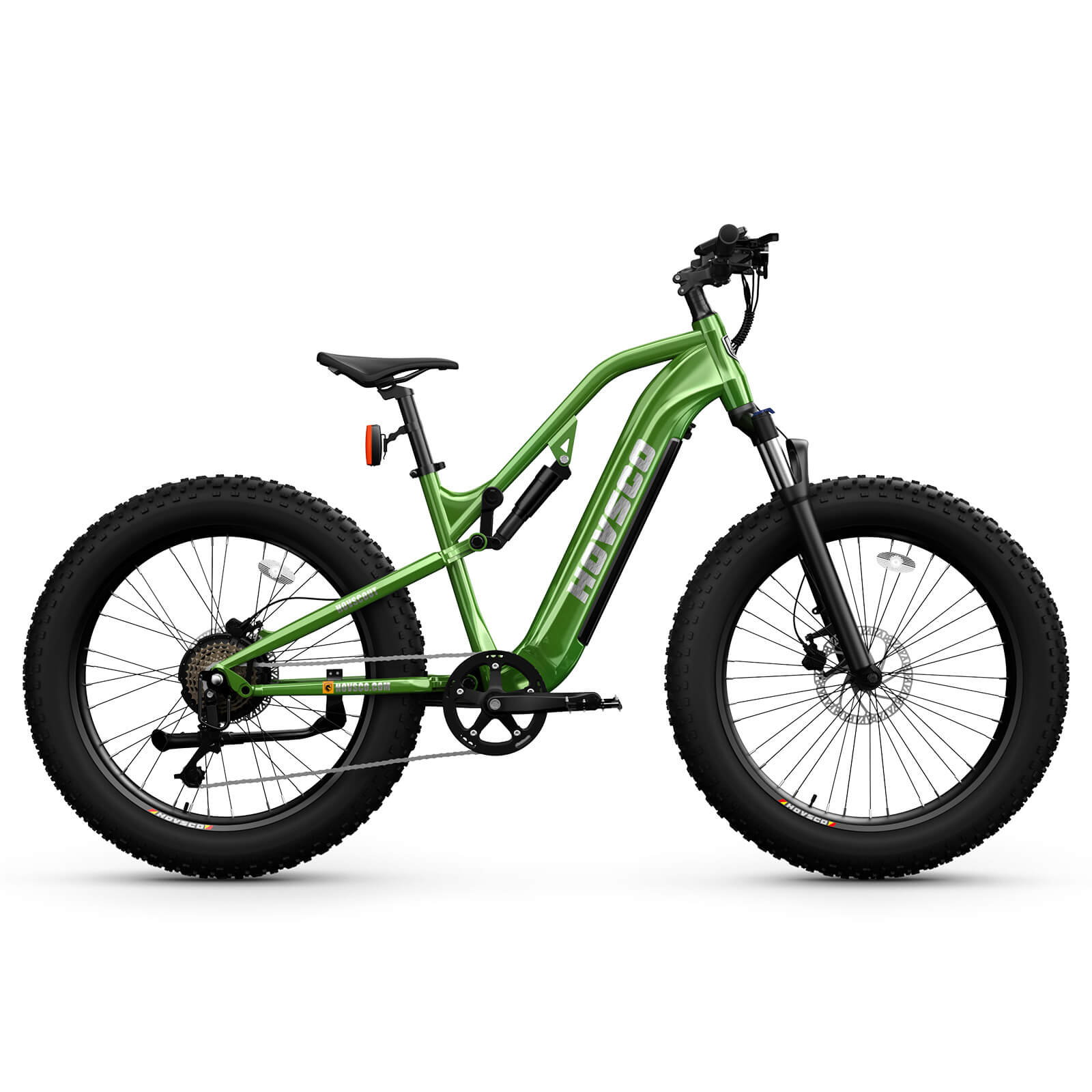
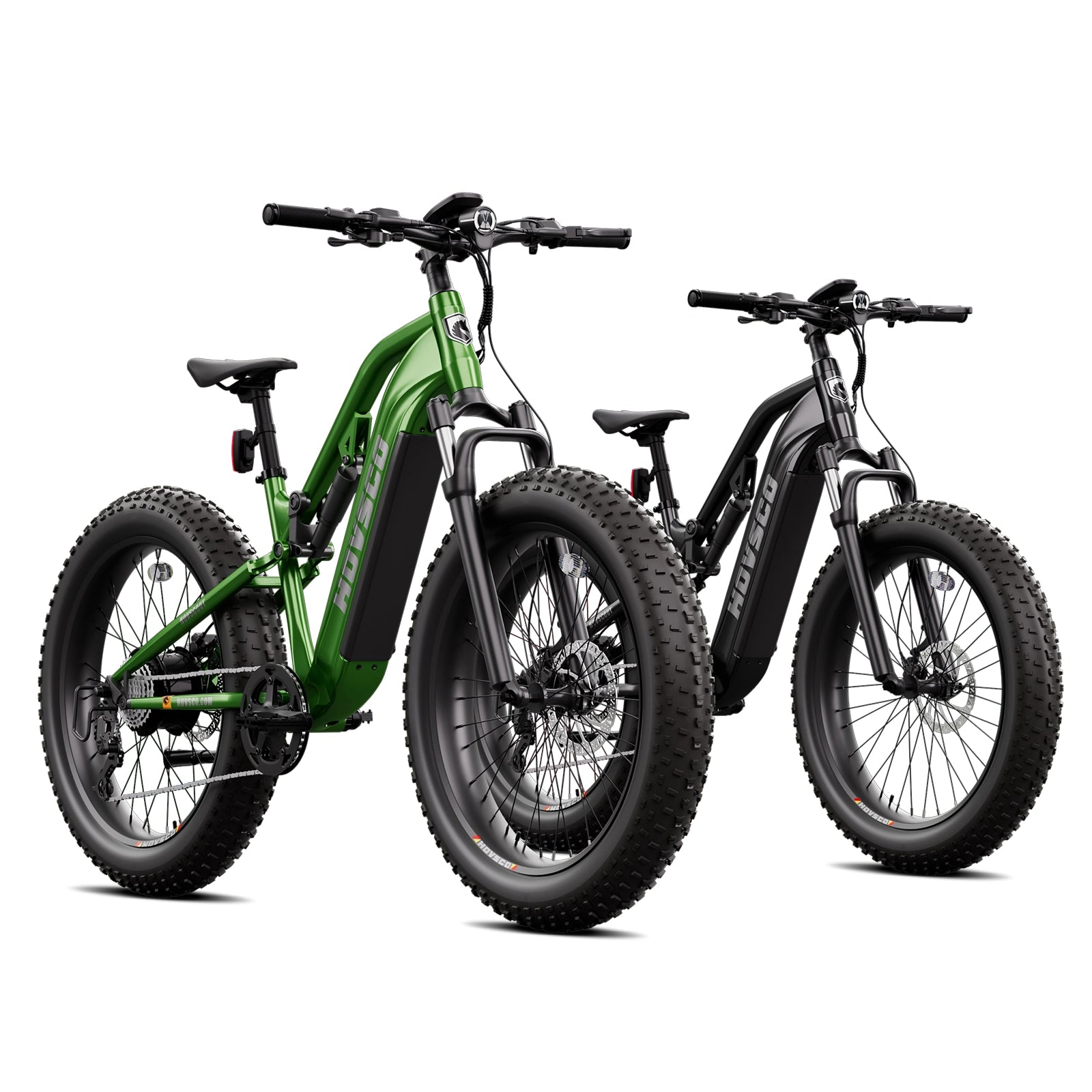
Terrain — all three run 20x4-inch fat tires suited to gravel, sand, and light snow, so terrain alone won't separate them, but HovGtrs's full suspension may suit rougher access roads better than HovCart's front-only setup.
Fat-tire cargo and folding e-bikes are not the right tool for technical singletrack mountain biking, deep mud, or situations demanding minimal weight for long backpacking-style hikes with the bike in tow. Being honest about these limits saves you from buying the wrong category of bike for your actual trip.
A cargo or fat-tire e-bike in the 66–77 lb range (with battery) is heavy compared to a dedicated lightweight trail e-bike, and that weight becomes a real liability if you need to lift, carry, or maneuver the bike over obstacles like downed trees or stream crossings on foot. Fat tires excel at flotation over sand and snow, but they're not designed for tight, technical singletrack where a narrower trail bike's agility and lighter weight matter more than payload capacity. And if your camping style is minimalist backpacking rather than car camping or RV touring, a heavier cargo-capable e-bike is likely overkill — a simpler, lighter setup (or no bike at all) may serve you better.
Deep mud or thick bog terrain can bog down even wide fat tires and add serious strain on the drivetrain and motor.
Extended hike-a-bike sections favor a lighter frame over cargo capacity, since you'll be carrying the bike's weight yourself.
If your trip is entirely on paved campground roads, the payload and suspension features of a cargo e-bike may be more capability than you actually need — a standard commuter e-bike could be lighter and sufficient.
Recognizing when a fat-tire cargo e-bike is the wrong tool is as valuable as knowing when it's the right one, and it keeps your purchase matched to how you actually camp rather than to the biggest spec sheet available.
HOVSCO's engineering approach for its fat-tire and cargo models centers on pairing a torque-sensing pedal-assist system with a wide-payload frame, since the two work together: a frame rated for heavier loads needs a motor and sensor combination that can respond proportionally when that load is on a climb, not just when it's on flat ground. That's part of why HovCart and HovBeta both pair a 720Wh removable battery with a torque sensor rather than a simpler cadence system — the removable battery format also matters for camping specifically, since it lets an owner charge a spare indoors or swap packs without needing an outlet at the bike itself.
The hydraulic disc brake choice across HOVSCO's fat-tire lineup — 180mm rotors on HovCart, HovBeta, and HovGtrs — reflects a general industry pattern: hydraulic systems provide more consistent stopping power under variable loads and wet conditions than mechanical disc brakes, which matters more on a loaded cargo bike descending a gravel grade than on an unloaded commuter bike. None of this should be read as brand-specific test data; it's the same set of engineering priorities that shape most serious cargo and fat-tire e-bikes on the market, applied consistently across HOVSCO's current lineup.
Choosing a camping e-bike comes down to matching payload, storage footprint, range, and terrain capability to how you actually camp — not to the single highest number on a spec sheet. A cargo-style HovCart, a foldable HovBeta, or a long-range HovGtrs each solve a different piece of that puzzle, and knowing your dominant constraint before you shop saves time and prevents an expensive mismatch.
Field checklist before you buy:
Confirm your state's e-bike class rules and the specific trail or campground's e-bike policy.
Add up your heaviest realistic load (gear plus passenger, if any) and compare it against the bike's rated payload with margin to spare.
Measure your RV bay, trunk, or rack space if a folding frame is a requirement.
Plan range around the low end of the advertised window, especially in cold weather or on hilly terrain.
Check tire width, suspension travel, and sensor type against the terrain and load you'll actually encounter.
Confirm brake type, battery removability, and whether specs are verified on the current product page rather than assumed from a similar model.
Assembly on HOVSCO e-bikes generally takes about 45–60 minutes, and the HOVSCO app supports ride tracking, odometer readings, and warranty registration once you're set up. If HovCart, HovBeta, or HovGtrs matches the constraints on your checklist, HOVSCO's e-bike collection is worth a closer look at the individual product pages for the most current specifications before you commit.
What payload capacity do I need for a camping e-bike?
Add your body weight to your heaviest realistic gear load — cooler, water, and a passenger seat, if used — then look for a bike rated comfortably above that total. HOVSCO's HovCart, HovBeta, and HovGtrs are each rated for a 450 lb maximum payload, but riding well under that ceiling protects handling and component wear.
Is a folding e-bike good for RV or truck-bed camping?
Yes, a folding frame like HOVSCO's HovBeta is built specifically for storage-constrained situations such as RV bays or car trunks, collapsing down while still carrying a 450 lb payload rating and 40–60 mile range. Measure your actual storage space first, since folded dimensions vary by model.
How far can a camping e-bike go on one charge?
It depends on terrain, load, temperature, and assist level, so plan around the low end of the advertised range. HOVSCO's HovCart and HovBeta are rated for 40–60 miles, while the HovGtrs offers 65–150 miles depending on which battery configuration (Evo, Pro, or Ultra) is selected.
Do I need a torque sensor or a cadence sensor for hauling gear?
A torque sensor, used on HOVSCO's HovCart and HovBeta, generally responds more proportionally to pedaling effort when hauling a loaded trailer or climbing, which many riders find more intuitive under load than a cadence sensor like the one on HovGtrs. Neither is unsafe — the difference is in responsiveness feel.
Are fat-tire e-bikes legal on all camping trails?
Not automatically. E-bike class rules vary by state, and land managers such as national forests, state parks, or BLM offices set their own additional restrictions, with some wilderness areas excluding e-bikes entirely. Always check the specific trail or campground's posted e-bike policy before you ride.
Share:
What is a bike repair shop and what services does it provide?
What Are the Best Electric Bikes for Short Riders?