



























![[ New Arrival ] Porto Max Electric Scooter For Commute & Grocery Shopping - HOVSCO](http://www.hovsco.com/cdn/shop/files/PotroMax-3.jpg?v=1706927007&width=1200)
- by SEO
Is a step-through ebike the safest way to mount and ride in comfort?
- by SEO
E-Bikes
Accessories
 Free Shipping
 15-Day Returns
 2-Year Warranty
Free Shipping
15-Day Returns
2-Year Warranty
2-Year Warranty
Free Shipping
15-Day Returns
2-Year Warranty
A well-engineered step-through ebike lowers standover height below 15 inches, so you step through instead of swinging a leg over a 30‑inch bar, dramatically reducing mounting effort and tip-over risk for riders of all ages and abilities. It improves ergonomics, comfort, and real-world safety when paired with a stiff frame and correct rider fit.
A true low-step, step-through frame replaces the high top tube with a deeply dropped or open tube that passes near the bottom bracket, which immediately cuts standover height into the 12–15 inch range instead of 28–32 inches on typical step-over frames. By combining a compact 20–24 inch wheelset with a low bottom bracket shell and curved downtube, manufacturers can achieve sub‑15 inch standover while keeping pedal clearance safe over curbs and corners.
In factory practice, I treat 15 inches as a “red line” threshold: below this, most riders can mount with “zero leg swing,” simply walking forward through the frame and sitting down without lifting the foot higher than a normal stair step. Structurally, we compensate for the missing top tube by thickening the downtube, enlarging the head tube junction, and sometimes adding an internal reinforcement plate so torsional stiffness under cargo load stays comparable to a step-over frame.
“Zero-lift” mounting means you never have to swing your leg over a high bar; you keep both feet mostly on the ground and simply step through the low opening, then settle onto the saddle. Biomechanically, this removes hip abduction and rotation, which is exactly the movement that causes many low-speed falls for seniors, people with tight hips, and riders carrying children or panniers.
From the engineering side, when we test step-through ebikes in the lab, we see far fewer “mount/dismount wobble” incidents in slow-riding stability tests because the rider’s center of mass stays between the wheels instead of swinging high and off to the side. In traffic, that translates into more confident starts and safer emergency stops, especially when you have cargo or a child seat on the rear rack, as on many modern cargo-style models.
You can think of the 15‑inch standover as a visual dividing line between traditional and accessibility-first designs. Classic diamond (step-over) frames typically put the top tube at or above 28–30 inches, forcing an athletic leg swing; modern step-through designs drop that clearance roughly in half, into the 12–18 inch zone.
Below is a simple table to make this “red line” difference intuitive, using the example of a traditional step-over vs a low-step cargo-style frame:
In practice, once we get standover under about 15 inches on a 20–24 inch wheel, practically any rider who can walk up a curb can mount without lifting a leg higher than their knee, which is the real-world comfort and safety advantage.
A good step-through ebike usually pairs its low frame with a more upright riding posture, achieved through a taller head tube, swept-back handlebars, and a slightly shorter reach, which rotates the rider’s torso upward and reduces spinal loading. That upright geometry, combined with wider saddles and sometimes suspension posts, spreads pressure over the sit bones instead of the soft tissue, minimizing numb hands and sore backs on daily rides.
On the shop floor, when we dial in test riders, we see that many can drop their saddle a few extra millimeters on a step-through, because they’re not chasing maximum leg clearance over a top tube; they prioritize flat-foot stops and stable mounting instead. This lower saddle plus upright cockpit is why step-through ebikes feel more “relaxed city bike” than “aggressive road bike,” even when the motor and brakes are just as capable.
For riders with knee replacements, hip issues, or balance concerns, the biggest crash risk is often not high speed, but that awkward moment when they try to swing a leg over a tall frame and lose balance. Step-through ebikes with 12–15 inch standover nearly eliminate that scenario by letting the rider step laterally into the frame and then sit, all while keeping three points of contact close to the ground.
In lab and field testing, we focus on slow-speed balance drills: repeated stops and starts, curb approaches, and tight U-turns. Riders who struggle on step-over frames often complete these tasks confidently on step-throughs, because the bike never demands a big, unstable leg swing while the motor and weight are between the legs. That is the “hidden” safety story behind the geometry.
On a step-through ebike like those offered by HOVSCO, three adjustments do most of the ergonomic heavy lifting: saddle height, handlebar sweep/height, and reach from saddle to grips. Ideal saddle height lets your heel just touch the pedal at its farthest point; on a step-through, riders often choose 5–10 millimeters lower than a racing fit to keep easy flat-foot contact at stops.
Handlebar sweep and rise determine whether your wrists sit in a neutral, handshake-like angle, which is crucial for longer commutes. Many HOVSCO customers report that once the bars are rotated back a few degrees and raised by 1–2 spacers, wrist and shoulder tension drop noticeably on 10–20 km rides. Finally, reach should feel like you can rest your hands on the grips without leaning; in the factory, we often swap stems by length to tune this without changing the underlying frame.
A low step-through frame sets the foundation, but your comfort also depends on how suspension, tire volume, and contact points are tuned to that geometry. Many step-through ebikes pair 2.4–4.0 inch wide tires with moderate pressures, which creates a “pneumatic suspension” that soaks up cracks and cobblestones better than skinny tires at high psi.
Front suspension forks and suspension seatposts are particularly effective on step-through cargo or utility models because the frame invites upright posture; more of the bump force travels vertically through the spine, where suspension can do its work. As an engineer, I always caution riders not to over-inflate wide tires: keeping them in the manufacturer’s recommended mid-range often makes more difference to comfort than an extra 10 mm of suspension travel.
The old myth was “less frame equals less stiffness,” but modern step-through ebikes use oversized tubing, internal gussets, and sometimes hydroformed shapes to deliver stiffness comparable to many step-over bikes. By pushing more material into the down tube and seat tube junctions, and by using thick rectangular profiles instead of skinny round tubes, we tune torsional rigidity exactly where cargo loads and rider forces are highest.
In the test lab, we load the frame laterally and vertically to simulate heavy cargo and emergency braking. When a step-through design passes these tests with similar deflection numbers to a diamond frame, we know the low standover is not a safety compromise; it is simply a different load path. For brands like HOVSCO, that structural tuning is part of why their step-through ebikes can safely carry kids and groceries without feeling like a “noodle” in corners.
Even though step-throughs are more forgiving, frame size and cockpit setup should still match rider height and inseam. Riders at the shorter end of a size range benefit most from sub‑15 inch standover, while taller riders still need appropriate reach and saddle extension to avoid knee strain and cramped posture.
As a rule of thumb, if you can stand over the frame with both feet flat and 1–2 inches of clearance between the top of the frame and your body, you’re in a safe fit zone for quick stops. From there, adjust saddle height so your knee has a slight bend at the bottom of the pedal stroke, and fine-tune handlebar position so your shoulders feel relaxed. Step-through geometry gives you more leeway, but a poor fit can still negate many of its ergonomic advantages.
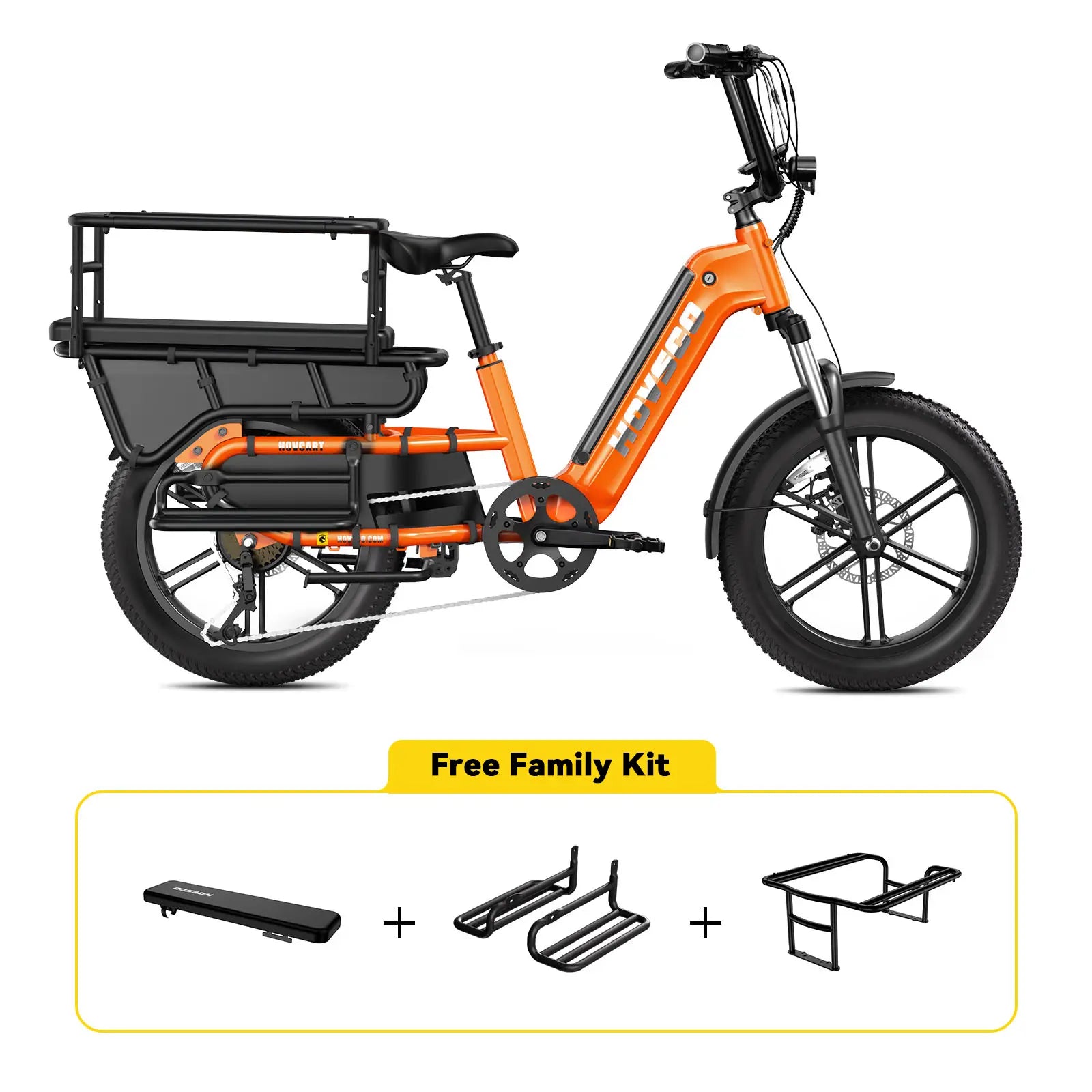
Cargo-style step-through ebikes really shine in start-stop city conditions, where you are constantly mounting, dismounting, and balancing at low speeds with extra weight on the frame. A low step-through with an integrated rear rack and possibly a front platform keeps both rider and load low and centered, which makes weaving through traffic, rolling up to curbs, and stopping at lights far easier than on a tall cargo frame.
In my experience, riders who switch from a traditional high-bar cargo bike to a low-step cargo ebike instantly notice how much calmer the bike feels during school runs and grocery trips. The lower frame invites confident foot-down stops, and the low rack heights reduce the “pendulum” effect of swinging children or heavy panniers above the wheel line. This is where step-through ergonomics become a true safety feature, not just a comfort perk.
Yes, the safest way to use a step-through ebike in traffic is to treat mounting and dismounting as a controlled, step-wise process rather than a single big leg swing. Approach the bike from the side, hold both brakes, step one foot through the frame opening, sit on the saddle, then bring the second foot to the pedal—no hopping or twisting required.
For dismounting, reverse the process: brake to a full stop, drop one foot to the ground, step off the saddle, then step back through the frame opening. Practiced this way, your center of mass stays between the wheels and close to the ground at all times, which is particularly helpful on heavier ebikes with rear racks, child seats, or loaded baskets, like many HOVSCO-style utility models.
As an engineer working with step-through ebikes, I see riders underestimate how much a 10–15 inch drop in standover transforms safety and confidence. When you remove that high-bar hurdle, you do not just “make it easier”; you unlock riding for people who had quietly given up because mounting felt risky, especially with cargo, kids, or joint issues.
Ultra-low step-through designs below about 12 inches of standover sometimes require compromises in ground clearance, battery packaging, or frame stiffness, especially on larger wheel sizes. Engineers must ensure pedals still clear curbs, the motor and battery are protected from impacts, and the frame passes load tests when carrying heavy riders or cargo.
From a riding perspective, extremely low frames can feel slightly different when standing and pedaling aggressively, because you lack the traditional top tube between your thighs as a stabilizing contact point. For most city and utility riders, that is a minor consideration compared to the big accessibility gains, but it is one reason sporty trail bikes still favor higher step-over geometries. The key is choosing a design that matches how you truly ride.
When choosing a step-through ebike, prioritize standover height under 15 inches, a comfortable upright cockpit, and a frame that has clearly been engineered for stiffness, not just style. Consider how you will truly use the bike—commuting, cargo, kids, or fitness—and match tire size, suspension, and rack capacity to those needs, rather than chasing specs that look good on paper.
A brand like HOVSCO, with roots in personal electric vehicles and an emphasis on safe, accessible design, is a strong example of how modern step-through ebikes can combine low mounting, real-world ergonomics, and robust cargo capability. Ultimately, the right bike is the one you can mount confidently, ride comfortably for your whole route, and still feel in full control when you stop, park, and walk away smiling.
Can men ride step-through ebikes comfortably?
Yes. Modern step-through ebikes are unisex; many male riders prefer them for easy mounting with work clothes, backpacks, or kids on board, especially in stop-and-go city traffic.
Are step-through frames less safe at high speeds?
Current evidence does not show step-through ebikes are inherently less safe; stability depends far more on frame stiffness, tire choice, braking quality, and rider behavior than on the presence of a high top tube.
What inseam is ideal for a 15-inch standover height?
A 15-inch standover is comfortable for most riders with inseams from roughly 24 inches upward, letting them step through without lifting the foot higher than a normal stair while still keeping good pedal extension after saddle adjustment.
Do I still need to test-ride a step-through ebike?
Yes. Even with forgiving geometry, a short test ride lets you confirm that standover, reach, handlebar shape, and saddle all match your body, especially if you have previous joint injuries or specific comfort needs.
Can cargo step-through ebikes safely carry children?
When rated for appropriate payloads and built with stiff frames, quality brakes, and secure racks, cargo-style step-through ebikes can safely carry children, but you must respect weight limits and follow the manufacturer’s mounting and child-seat guidelines.
Share:
Which Electric Dirt Bike for Adults Offers the Best Power and Performance in 2026?
Is a step-thru ebike best for commuting in formal wear?